SUBSCRIBE TO OUR FREE NEWSLETTER
Daily news & progressive opinion—funded by the people, not the corporations—delivered straight to your inbox.
5
#000000
#FFFFFF
To donate by check, phone, or other method, see our More Ways to Give page.
Daily news & progressive opinion—funded by the people, not the corporations—delivered straight to your inbox.
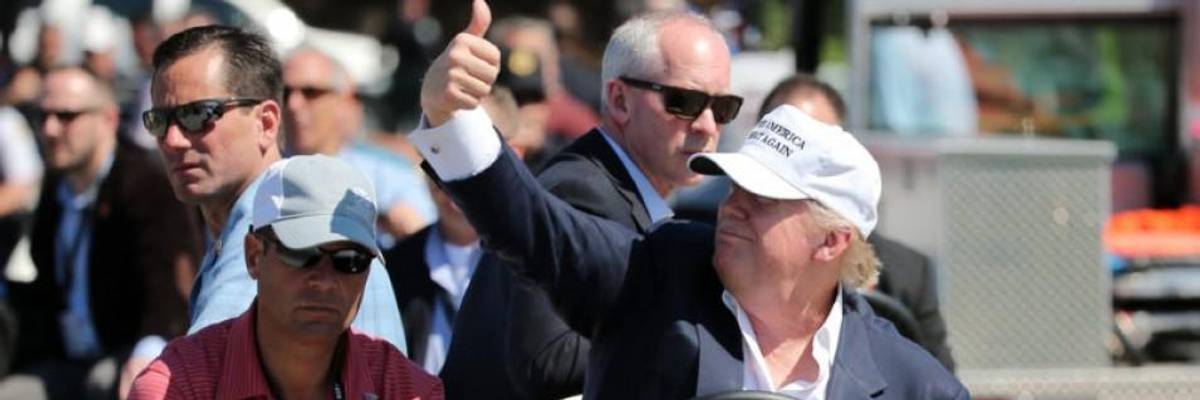
Then Republican presidential candidate Donald Trump makes an appearance prior to the start of play during the final round of the World Golf Championships-Cadillac Championship at Trump National Doral Blue Monster Course on March 6, 2016 in Doral, Florida. (Photo: Mike Ehrmann/Getty Images)
New reporting out Monday provides refreshed ammunition for anti-corruption advocates who've raised concerns about President Donald Trump's ethical violations while in office.
A forthcoming report from watchdog group Public Citizen, which has kept a close eye on who's spending at Trump businesses, claims that "nearly 200 campaigns and political groups--virtually all conservative--have spent more than $8 million at President Donald Trump's resorts and other businesses since his election in 2016," according to Politico.
The group previously noted that when he entered the White House, "Trump turned over control of businesses to his sons Don Jr. and Eric, but still controls the trust that owns the properties and can withdraw money whenever he likes."
The post-election number is a marked difference in such spending from before Trump was president--between 2012 and 2014, the report said, campaigns and political groups combined dropped a mere $69,000.
The most money--roughly $2.5 million--was spent by the groups at Trump's Washington hotel, an entity that's already drawn the scrutiny of the House oversight committee and triggered multiple lawsuits over possible emoluments violations. The hotel is in Washington's Old Post Office building, and The Trump Organization has leasing rights from the federal government, which it may want to sell.
The biggest spender on Trump businesses and hotels was the Trump campaign, which accounted for about 45 percent of the money, nearly $3.8 million. Another big spender at the businesses was the Republican National Committee, which spent $1.6 million.
Public Citizen's report puts the total political spending at the president's properties since June 2015 when Trump announced his bid for office at roughly $19 million--a figure in line with the Center for Responsive Politics' tally of Trump's "influence-buying and presidential profiteering."
"Some of the initial surge was related to the Trump campaign's using a Trump company plane during the 2016 election," Politico reported, "but much of the uptick comes from conservative candidates and groups." The spending wasn't limited to the Republican groups. From Politico:
"At least another 179 foreign governments, businesses, trade associations, and religious entities--some with interests before the federal government--have frequented Trump properties, according to Public Citizen, which gathered data from Federal Election Commission records, social media, and news reports."
A glaring case in point was T-Mobile executives stay at Trump's Washington hotel "while seeking a green light from the federal government for a merger with Sprint."
" Donald Trump should've completely divested from his businesses before he became president," said Rep. Dina Titus (D-Nev.), chair of the House Subcommittee on Economic Development, Public Buildings, and Emergency Management, which has jurisdiction over the Trump's Washington hotel, last month. "Instead, President Trump has made money from people looking to curry favor by booking hotel rooms and hosting private events. The Founding Fathers put the Emoluments Clauses in the Constitution to prevent presidents from accepting bribes."
Public Citizen is far from the only group tracking possible conflicts of interests. Another group, Citizens for Responsibility and Ethics in Washington (CREW), is adding up what it calls Trump's "unprecedented conflicts of interests."
"The relentless promotion of Trump businesses from the president and members of his administration has sent a message to those seeking political influence that patronizing his businesses is a way to appeal to the president," the group says.
"The corrupt relationship between the Trump Organization and the White House calls into question President Trump's decision-making as president," it continues. "When his personal financial interests diverge from America's national ones, which does he prioritize? That's not a question we should have to ask."
Dear Common Dreams reader, It’s been nearly 30 years since I co-founded Common Dreams with my late wife, Lina Newhouser. We had the radical notion that journalism should serve the public good, not corporate profits. It was clear to us from the outset what it would take to build such a project. No paid advertisements. No corporate sponsors. No millionaire publisher telling us what to think or do. Many people said we wouldn't last a year, but we proved those doubters wrong. Together with a tremendous team of journalists and dedicated staff, we built an independent media outlet free from the constraints of profits and corporate control. Our mission has always been simple: To inform. To inspire. To ignite change for the common good. Building Common Dreams was not easy. Our survival was never guaranteed. When you take on the most powerful forces—Wall Street greed, fossil fuel industry destruction, Big Tech lobbyists, and uber-rich oligarchs who have spent billions upon billions rigging the economy and democracy in their favor—the only bulwark you have is supporters who believe in your work. But here’s the urgent message from me today. It's never been this bad out there. And it's never been this hard to keep us going. At the very moment Common Dreams is most needed, the threats we face are intensifying. We need your support now more than ever. We don't accept corporate advertising and never will. We don't have a paywall because we don't think people should be blocked from critical news based on their ability to pay. Everything we do is funded by the donations of readers like you. When everyone does the little they can afford, we are strong. But if that support retreats or dries up, so do we. Will you donate now to make sure Common Dreams not only survives but thrives? —Craig Brown, Co-founder |
New reporting out Monday provides refreshed ammunition for anti-corruption advocates who've raised concerns about President Donald Trump's ethical violations while in office.
A forthcoming report from watchdog group Public Citizen, which has kept a close eye on who's spending at Trump businesses, claims that "nearly 200 campaigns and political groups--virtually all conservative--have spent more than $8 million at President Donald Trump's resorts and other businesses since his election in 2016," according to Politico.
The group previously noted that when he entered the White House, "Trump turned over control of businesses to his sons Don Jr. and Eric, but still controls the trust that owns the properties and can withdraw money whenever he likes."
The post-election number is a marked difference in such spending from before Trump was president--between 2012 and 2014, the report said, campaigns and political groups combined dropped a mere $69,000.
The most money--roughly $2.5 million--was spent by the groups at Trump's Washington hotel, an entity that's already drawn the scrutiny of the House oversight committee and triggered multiple lawsuits over possible emoluments violations. The hotel is in Washington's Old Post Office building, and The Trump Organization has leasing rights from the federal government, which it may want to sell.
The biggest spender on Trump businesses and hotels was the Trump campaign, which accounted for about 45 percent of the money, nearly $3.8 million. Another big spender at the businesses was the Republican National Committee, which spent $1.6 million.
Public Citizen's report puts the total political spending at the president's properties since June 2015 when Trump announced his bid for office at roughly $19 million--a figure in line with the Center for Responsive Politics' tally of Trump's "influence-buying and presidential profiteering."
"Some of the initial surge was related to the Trump campaign's using a Trump company plane during the 2016 election," Politico reported, "but much of the uptick comes from conservative candidates and groups." The spending wasn't limited to the Republican groups. From Politico:
"At least another 179 foreign governments, businesses, trade associations, and religious entities--some with interests before the federal government--have frequented Trump properties, according to Public Citizen, which gathered data from Federal Election Commission records, social media, and news reports."
A glaring case in point was T-Mobile executives stay at Trump's Washington hotel "while seeking a green light from the federal government for a merger with Sprint."
" Donald Trump should've completely divested from his businesses before he became president," said Rep. Dina Titus (D-Nev.), chair of the House Subcommittee on Economic Development, Public Buildings, and Emergency Management, which has jurisdiction over the Trump's Washington hotel, last month. "Instead, President Trump has made money from people looking to curry favor by booking hotel rooms and hosting private events. The Founding Fathers put the Emoluments Clauses in the Constitution to prevent presidents from accepting bribes."
Public Citizen is far from the only group tracking possible conflicts of interests. Another group, Citizens for Responsibility and Ethics in Washington (CREW), is adding up what it calls Trump's "unprecedented conflicts of interests."
"The relentless promotion of Trump businesses from the president and members of his administration has sent a message to those seeking political influence that patronizing his businesses is a way to appeal to the president," the group says.
"The corrupt relationship between the Trump Organization and the White House calls into question President Trump's decision-making as president," it continues. "When his personal financial interests diverge from America's national ones, which does he prioritize? That's not a question we should have to ask."
New reporting out Monday provides refreshed ammunition for anti-corruption advocates who've raised concerns about President Donald Trump's ethical violations while in office.
A forthcoming report from watchdog group Public Citizen, which has kept a close eye on who's spending at Trump businesses, claims that "nearly 200 campaigns and political groups--virtually all conservative--have spent more than $8 million at President Donald Trump's resorts and other businesses since his election in 2016," according to Politico.
The group previously noted that when he entered the White House, "Trump turned over control of businesses to his sons Don Jr. and Eric, but still controls the trust that owns the properties and can withdraw money whenever he likes."
The post-election number is a marked difference in such spending from before Trump was president--between 2012 and 2014, the report said, campaigns and political groups combined dropped a mere $69,000.
The most money--roughly $2.5 million--was spent by the groups at Trump's Washington hotel, an entity that's already drawn the scrutiny of the House oversight committee and triggered multiple lawsuits over possible emoluments violations. The hotel is in Washington's Old Post Office building, and The Trump Organization has leasing rights from the federal government, which it may want to sell.
The biggest spender on Trump businesses and hotels was the Trump campaign, which accounted for about 45 percent of the money, nearly $3.8 million. Another big spender at the businesses was the Republican National Committee, which spent $1.6 million.
Public Citizen's report puts the total political spending at the president's properties since June 2015 when Trump announced his bid for office at roughly $19 million--a figure in line with the Center for Responsive Politics' tally of Trump's "influence-buying and presidential profiteering."
"Some of the initial surge was related to the Trump campaign's using a Trump company plane during the 2016 election," Politico reported, "but much of the uptick comes from conservative candidates and groups." The spending wasn't limited to the Republican groups. From Politico:
"At least another 179 foreign governments, businesses, trade associations, and religious entities--some with interests before the federal government--have frequented Trump properties, according to Public Citizen, which gathered data from Federal Election Commission records, social media, and news reports."
A glaring case in point was T-Mobile executives stay at Trump's Washington hotel "while seeking a green light from the federal government for a merger with Sprint."
" Donald Trump should've completely divested from his businesses before he became president," said Rep. Dina Titus (D-Nev.), chair of the House Subcommittee on Economic Development, Public Buildings, and Emergency Management, which has jurisdiction over the Trump's Washington hotel, last month. "Instead, President Trump has made money from people looking to curry favor by booking hotel rooms and hosting private events. The Founding Fathers put the Emoluments Clauses in the Constitution to prevent presidents from accepting bribes."
Public Citizen is far from the only group tracking possible conflicts of interests. Another group, Citizens for Responsibility and Ethics in Washington (CREW), is adding up what it calls Trump's "unprecedented conflicts of interests."
"The relentless promotion of Trump businesses from the president and members of his administration has sent a message to those seeking political influence that patronizing his businesses is a way to appeal to the president," the group says.
"The corrupt relationship between the Trump Organization and the White House calls into question President Trump's decision-making as president," it continues. "When his personal financial interests diverge from America's national ones, which does he prioritize? That's not a question we should have to ask."