SUBSCRIBE TO OUR FREE NEWSLETTER
Daily news & progressive opinion—funded by the people, not the corporations—delivered straight to your inbox.
5
#000000
#FFFFFF
To donate by check, phone, or other method, see our More Ways to Give page.
Daily news & progressive opinion—funded by the people, not the corporations—delivered straight to your inbox.
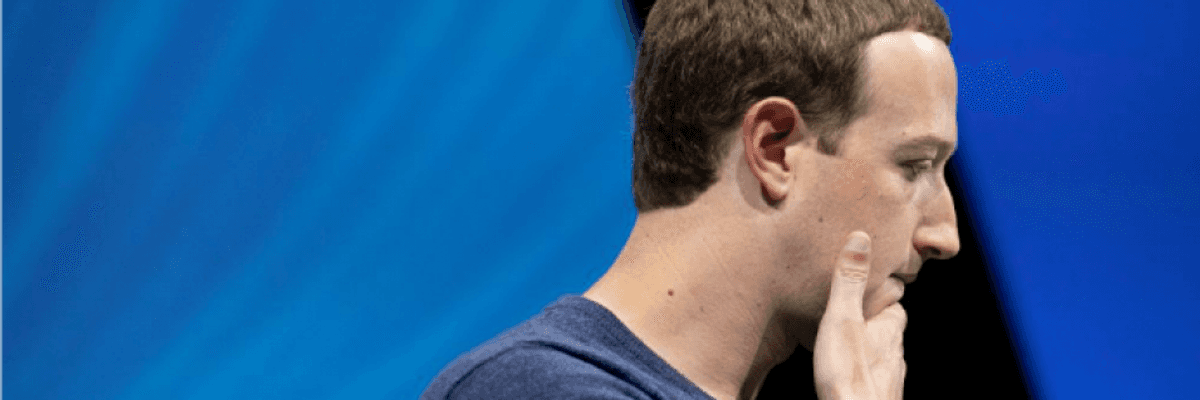
Mark Zuckerberg, chief executive officer and founder of Facebook, attends the Viva Tech start-up and technology gathering at Parc des Expositions Porte de Versailles on May 24, 2018 in Paris. (Photo: Christophe Morin/IP3/Getty Images)
After NBC News on Wednesday published a trove of leaked documents that show how Facebook "treated user data as a bargaining chip with external app developers," White House hopeful Sen. Bernie Sanders declared that it is time "to break Facebook up."
When British investigative journalist Duncan Campbell first shared the trove of documents with a handful of media outlets including NBC News in April, journalists Olivia Solon and Cyrus Farivar reported that "Facebook CEO Mark Zuckerberg oversaw plans to consolidate the social network's power and control competitors by treating its users' data as a bargaining chip, while publicly proclaiming to be protecting that data."
With the publication Wednesday of nearly 7,000 pages of records--which include internal Facebook emails, web chats, notes, presentations, and spreadsheets--journalists and the public can now have a closer look at exactly how the company was using the vast amount of data it collects when it came to bargaining with third parties.
Technically still under protective order in a California state civil lawsuit that the startup app developer Six4Three filed against Facebook in 2015, the leaked documents from the case include 3,799 pages of sealed exhibits, 2,737 pages of exhibits, 415 pages of related notes and summaries, and a 20-page memorandum (pdfs). More than 1,000 pages are labeled "highly confidential."
According to Solon and Farivar of NBC:
Taken together, they show how Zuckerberg, along with his board and management team, found ways to tap Facebook users' data--including information about friends, relationships, and photos--as leverage over the companies it partnered with. In some cases, Facebook would reward partners by giving them preferential access to certain types of user data while denying the same access to rival companies.
For example, Facebook gave Amazon special access to user data because it was spending money on Facebook advertising. In another case the messaging app MessageMe was cut off from access to data because it had grown too popular and could compete with Facebook.
All the while, Facebook planned to publicly frame these moves as a way to protect user privacy, the documents show.
Open Markets Institute fellow Matt Stoller tweeted in response to NBC's report Wednesday: "As I have been saying the privacy frame is bullshit. Facebook is all about criminal behavior to monopolize ad money."
The document dump comes as Facebook and Zuckerberg are facing widespread criticism over the company's political advertising policy, which allows candidates for elected office to lie in the ads they pay to circulate on the platform. It also comes as 47 state attorneys general, led by Letitia James of New York, are investigating the social media giant for antitrust violations.
The Week's national correspondent Ryan Cooper, who also responded to NBC's report on Twitter, wrote that "there are some practical (but not insurmountable) problems with putting antitrust regulations on say, Amazon. [But] Facebook you could just shut it down and the world would be a far better place."
The call from Sanders (I-Vt.) Wednesday to break up Facebook follows similar but less definitive statements from the senator.
One of Sanders' rivals in the 2020 Democratic presidential primary race, Sen. Elizabeth Warren (D-Mass.), released her plan to "Break Up Big Tech" in March. Zuckerberg is among the opponents of Warren's proposal, which also targets other major technology companies like Amazon and Google.
Dear Common Dreams reader, It’s been nearly 30 years since I co-founded Common Dreams with my late wife, Lina Newhouser. We had the radical notion that journalism should serve the public good, not corporate profits. It was clear to us from the outset what it would take to build such a project. No paid advertisements. No corporate sponsors. No millionaire publisher telling us what to think or do. Many people said we wouldn't last a year, but we proved those doubters wrong. Together with a tremendous team of journalists and dedicated staff, we built an independent media outlet free from the constraints of profits and corporate control. Our mission has always been simple: To inform. To inspire. To ignite change for the common good. Building Common Dreams was not easy. Our survival was never guaranteed. When you take on the most powerful forces—Wall Street greed, fossil fuel industry destruction, Big Tech lobbyists, and uber-rich oligarchs who have spent billions upon billions rigging the economy and democracy in their favor—the only bulwark you have is supporters who believe in your work. But here’s the urgent message from me today. It's never been this bad out there. And it's never been this hard to keep us going. At the very moment Common Dreams is most needed, the threats we face are intensifying. We need your support now more than ever. We don't accept corporate advertising and never will. We don't have a paywall because we don't think people should be blocked from critical news based on their ability to pay. Everything we do is funded by the donations of readers like you. When everyone does the little they can afford, we are strong. But if that support retreats or dries up, so do we. Will you donate now to make sure Common Dreams not only survives but thrives? —Craig Brown, Co-founder |
After NBC News on Wednesday published a trove of leaked documents that show how Facebook "treated user data as a bargaining chip with external app developers," White House hopeful Sen. Bernie Sanders declared that it is time "to break Facebook up."
When British investigative journalist Duncan Campbell first shared the trove of documents with a handful of media outlets including NBC News in April, journalists Olivia Solon and Cyrus Farivar reported that "Facebook CEO Mark Zuckerberg oversaw plans to consolidate the social network's power and control competitors by treating its users' data as a bargaining chip, while publicly proclaiming to be protecting that data."
With the publication Wednesday of nearly 7,000 pages of records--which include internal Facebook emails, web chats, notes, presentations, and spreadsheets--journalists and the public can now have a closer look at exactly how the company was using the vast amount of data it collects when it came to bargaining with third parties.
Technically still under protective order in a California state civil lawsuit that the startup app developer Six4Three filed against Facebook in 2015, the leaked documents from the case include 3,799 pages of sealed exhibits, 2,737 pages of exhibits, 415 pages of related notes and summaries, and a 20-page memorandum (pdfs). More than 1,000 pages are labeled "highly confidential."
According to Solon and Farivar of NBC:
Taken together, they show how Zuckerberg, along with his board and management team, found ways to tap Facebook users' data--including information about friends, relationships, and photos--as leverage over the companies it partnered with. In some cases, Facebook would reward partners by giving them preferential access to certain types of user data while denying the same access to rival companies.
For example, Facebook gave Amazon special access to user data because it was spending money on Facebook advertising. In another case the messaging app MessageMe was cut off from access to data because it had grown too popular and could compete with Facebook.
All the while, Facebook planned to publicly frame these moves as a way to protect user privacy, the documents show.
Open Markets Institute fellow Matt Stoller tweeted in response to NBC's report Wednesday: "As I have been saying the privacy frame is bullshit. Facebook is all about criminal behavior to monopolize ad money."
The document dump comes as Facebook and Zuckerberg are facing widespread criticism over the company's political advertising policy, which allows candidates for elected office to lie in the ads they pay to circulate on the platform. It also comes as 47 state attorneys general, led by Letitia James of New York, are investigating the social media giant for antitrust violations.
The Week's national correspondent Ryan Cooper, who also responded to NBC's report on Twitter, wrote that "there are some practical (but not insurmountable) problems with putting antitrust regulations on say, Amazon. [But] Facebook you could just shut it down and the world would be a far better place."
The call from Sanders (I-Vt.) Wednesday to break up Facebook follows similar but less definitive statements from the senator.
One of Sanders' rivals in the 2020 Democratic presidential primary race, Sen. Elizabeth Warren (D-Mass.), released her plan to "Break Up Big Tech" in March. Zuckerberg is among the opponents of Warren's proposal, which also targets other major technology companies like Amazon and Google.
After NBC News on Wednesday published a trove of leaked documents that show how Facebook "treated user data as a bargaining chip with external app developers," White House hopeful Sen. Bernie Sanders declared that it is time "to break Facebook up."
When British investigative journalist Duncan Campbell first shared the trove of documents with a handful of media outlets including NBC News in April, journalists Olivia Solon and Cyrus Farivar reported that "Facebook CEO Mark Zuckerberg oversaw plans to consolidate the social network's power and control competitors by treating its users' data as a bargaining chip, while publicly proclaiming to be protecting that data."
With the publication Wednesday of nearly 7,000 pages of records--which include internal Facebook emails, web chats, notes, presentations, and spreadsheets--journalists and the public can now have a closer look at exactly how the company was using the vast amount of data it collects when it came to bargaining with third parties.
Technically still under protective order in a California state civil lawsuit that the startup app developer Six4Three filed against Facebook in 2015, the leaked documents from the case include 3,799 pages of sealed exhibits, 2,737 pages of exhibits, 415 pages of related notes and summaries, and a 20-page memorandum (pdfs). More than 1,000 pages are labeled "highly confidential."
According to Solon and Farivar of NBC:
Taken together, they show how Zuckerberg, along with his board and management team, found ways to tap Facebook users' data--including information about friends, relationships, and photos--as leverage over the companies it partnered with. In some cases, Facebook would reward partners by giving them preferential access to certain types of user data while denying the same access to rival companies.
For example, Facebook gave Amazon special access to user data because it was spending money on Facebook advertising. In another case the messaging app MessageMe was cut off from access to data because it had grown too popular and could compete with Facebook.
All the while, Facebook planned to publicly frame these moves as a way to protect user privacy, the documents show.
Open Markets Institute fellow Matt Stoller tweeted in response to NBC's report Wednesday: "As I have been saying the privacy frame is bullshit. Facebook is all about criminal behavior to monopolize ad money."
The document dump comes as Facebook and Zuckerberg are facing widespread criticism over the company's political advertising policy, which allows candidates for elected office to lie in the ads they pay to circulate on the platform. It also comes as 47 state attorneys general, led by Letitia James of New York, are investigating the social media giant for antitrust violations.
The Week's national correspondent Ryan Cooper, who also responded to NBC's report on Twitter, wrote that "there are some practical (but not insurmountable) problems with putting antitrust regulations on say, Amazon. [But] Facebook you could just shut it down and the world would be a far better place."
The call from Sanders (I-Vt.) Wednesday to break up Facebook follows similar but less definitive statements from the senator.
One of Sanders' rivals in the 2020 Democratic presidential primary race, Sen. Elizabeth Warren (D-Mass.), released her plan to "Break Up Big Tech" in March. Zuckerberg is among the opponents of Warren's proposal, which also targets other major technology companies like Amazon and Google.