

SUBSCRIBE TO OUR FREE NEWSLETTER
Daily news & progressive opinion—funded by the people, not the corporations—delivered straight to your inbox.
5
#000000
#FFFFFF
To donate by check, phone, or other method, see our More Ways to Give page.
Daily news & progressive opinion—funded by the people, not the corporations—delivered straight to your inbox.
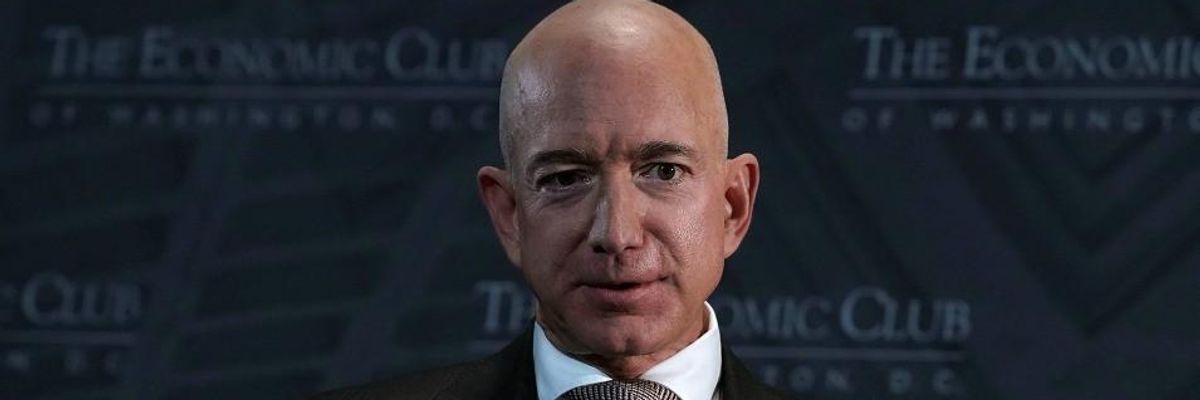
CEO and founder of Amazon Jeff Bezos participates in a discussion during a Milestone Celebration dinner September 13, 2018 in Washington, D.C. (Photo: Alex Wong/Getty Images)
The Washington Post, owned by world's richest man Jeff Bezos, is reportedly moving most of its staff onto what one Post journalist described as "high-deductible health insurance plans that shift significant costs and risks onto employees," a decision Medicare for All proponents highlighted as a prime example of the instability and injustice of the employer-sponsored healthcare system that is frequently praised by centrist Democratic presidential candidates.
The Washington Post Guild, the union that represents Post employees, sent an email Tuesday informing members that "the company announced changes to our healthcare plans for next year."
"The news is that the health plan that two-thirds of Post employees have now--the Aetna Health Fund--is going away (and your reserve Health Fund monies will not roll over)," the Guild said.
Opponents of Medicare for All--such as former Vice President Joe Biden and South Bend, Indiana Mayor Pete Buttigieg--often argue that a single-payer system would deprive people of the choice to keep their private insurance if they are satisfied with their coverage.
As Matt Bruenig of the People's Policy Project has pointed out, this argument ignores the fact that, under the current employer-sponsored insurance system, people don't have the choice to keep their plan if their boss decides to change it.
"The only way to stop that from happening to people is to create a seamless system where people do not constantly churn on and off of insurance," Bruenig wrote earlier this year. "Medicare for All offers that. Our current system offers the exact opposite. If you like losing your insurance all the time, then our current healthcare system is the right one for you."
Medicare for All supporters on Tuesday echoed Bruenig in response to the Post's decision to dramatically alter staffers' health insurance plans.
Kenneth Zinn, political director at National Nurses United, said the Post's move is "one more example of why employer-based healthcare is not stable and not just."
"Jeff Bezos, the richest man in America, gets to decide on a whim whether Washington Post employees get to see a doctor or not," Zinn tweeted.
Sen. Bernie Sanders (I-Vt.), a 2020 Democratic presidential candidate and the author of the 100-page Medicare for All Act of 2019, said "we shouldn't allow Jeff Bezos, or any other boss, to choose their profits over workers' healthcare."
"We need Medicare for All," said Sanders.
According to an Emerson poll released Tuesday, 70 percent of U.S. voters "strongly oppose" allowing employers "to change or eliminate an employee's health insurance against the employee's wishes."
In response to the survey, Bruenig tweeted, "Voters strongly oppose employer-based health insurance once they understand what it means."
Dear Common Dreams reader, It’s been nearly 30 years since I co-founded Common Dreams with my late wife, Lina Newhouser. We had the radical notion that journalism should serve the public good, not corporate profits. It was clear to us from the outset what it would take to build such a project. No paid advertisements. No corporate sponsors. No millionaire publisher telling us what to think or do. Many people said we wouldn't last a year, but we proved those doubters wrong. Together with a tremendous team of journalists and dedicated staff, we built an independent media outlet free from the constraints of profits and corporate control. Our mission has always been simple: To inform. To inspire. To ignite change for the common good. Building Common Dreams was not easy. Our survival was never guaranteed. When you take on the most powerful forces—Wall Street greed, fossil fuel industry destruction, Big Tech lobbyists, and uber-rich oligarchs who have spent billions upon billions rigging the economy and democracy in their favor—the only bulwark you have is supporters who believe in your work. But here’s the urgent message from me today. It's never been this bad out there. And it's never been this hard to keep us going. At the very moment Common Dreams is most needed, the threats we face are intensifying. We need your support now more than ever. We don't accept corporate advertising and never will. We don't have a paywall because we don't think people should be blocked from critical news based on their ability to pay. Everything we do is funded by the donations of readers like you. When everyone does the little they can afford, we are strong. But if that support retreats or dries up, so do we. Will you donate now to make sure Common Dreams not only survives but thrives? —Craig Brown, Co-founder |
The Washington Post, owned by world's richest man Jeff Bezos, is reportedly moving most of its staff onto what one Post journalist described as "high-deductible health insurance plans that shift significant costs and risks onto employees," a decision Medicare for All proponents highlighted as a prime example of the instability and injustice of the employer-sponsored healthcare system that is frequently praised by centrist Democratic presidential candidates.
The Washington Post Guild, the union that represents Post employees, sent an email Tuesday informing members that "the company announced changes to our healthcare plans for next year."
"The news is that the health plan that two-thirds of Post employees have now--the Aetna Health Fund--is going away (and your reserve Health Fund monies will not roll over)," the Guild said.
Opponents of Medicare for All--such as former Vice President Joe Biden and South Bend, Indiana Mayor Pete Buttigieg--often argue that a single-payer system would deprive people of the choice to keep their private insurance if they are satisfied with their coverage.
As Matt Bruenig of the People's Policy Project has pointed out, this argument ignores the fact that, under the current employer-sponsored insurance system, people don't have the choice to keep their plan if their boss decides to change it.
"The only way to stop that from happening to people is to create a seamless system where people do not constantly churn on and off of insurance," Bruenig wrote earlier this year. "Medicare for All offers that. Our current system offers the exact opposite. If you like losing your insurance all the time, then our current healthcare system is the right one for you."
Medicare for All supporters on Tuesday echoed Bruenig in response to the Post's decision to dramatically alter staffers' health insurance plans.
Kenneth Zinn, political director at National Nurses United, said the Post's move is "one more example of why employer-based healthcare is not stable and not just."
"Jeff Bezos, the richest man in America, gets to decide on a whim whether Washington Post employees get to see a doctor or not," Zinn tweeted.
Sen. Bernie Sanders (I-Vt.), a 2020 Democratic presidential candidate and the author of the 100-page Medicare for All Act of 2019, said "we shouldn't allow Jeff Bezos, or any other boss, to choose their profits over workers' healthcare."
"We need Medicare for All," said Sanders.
According to an Emerson poll released Tuesday, 70 percent of U.S. voters "strongly oppose" allowing employers "to change or eliminate an employee's health insurance against the employee's wishes."
In response to the survey, Bruenig tweeted, "Voters strongly oppose employer-based health insurance once they understand what it means."
The Washington Post, owned by world's richest man Jeff Bezos, is reportedly moving most of its staff onto what one Post journalist described as "high-deductible health insurance plans that shift significant costs and risks onto employees," a decision Medicare for All proponents highlighted as a prime example of the instability and injustice of the employer-sponsored healthcare system that is frequently praised by centrist Democratic presidential candidates.
The Washington Post Guild, the union that represents Post employees, sent an email Tuesday informing members that "the company announced changes to our healthcare plans for next year."
"The news is that the health plan that two-thirds of Post employees have now--the Aetna Health Fund--is going away (and your reserve Health Fund monies will not roll over)," the Guild said.
Opponents of Medicare for All--such as former Vice President Joe Biden and South Bend, Indiana Mayor Pete Buttigieg--often argue that a single-payer system would deprive people of the choice to keep their private insurance if they are satisfied with their coverage.
As Matt Bruenig of the People's Policy Project has pointed out, this argument ignores the fact that, under the current employer-sponsored insurance system, people don't have the choice to keep their plan if their boss decides to change it.
"The only way to stop that from happening to people is to create a seamless system where people do not constantly churn on and off of insurance," Bruenig wrote earlier this year. "Medicare for All offers that. Our current system offers the exact opposite. If you like losing your insurance all the time, then our current healthcare system is the right one for you."
Medicare for All supporters on Tuesday echoed Bruenig in response to the Post's decision to dramatically alter staffers' health insurance plans.
Kenneth Zinn, political director at National Nurses United, said the Post's move is "one more example of why employer-based healthcare is not stable and not just."
"Jeff Bezos, the richest man in America, gets to decide on a whim whether Washington Post employees get to see a doctor or not," Zinn tweeted.
Sen. Bernie Sanders (I-Vt.), a 2020 Democratic presidential candidate and the author of the 100-page Medicare for All Act of 2019, said "we shouldn't allow Jeff Bezos, or any other boss, to choose their profits over workers' healthcare."
"We need Medicare for All," said Sanders.
According to an Emerson poll released Tuesday, 70 percent of U.S. voters "strongly oppose" allowing employers "to change or eliminate an employee's health insurance against the employee's wishes."
In response to the survey, Bruenig tweeted, "Voters strongly oppose employer-based health insurance once they understand what it means."

