

SUBSCRIBE TO OUR FREE NEWSLETTER
Daily news & progressive opinion—funded by the people, not the corporations—delivered straight to your inbox.
5
#000000
#FFFFFF
To donate by check, phone, or other method, see our More Ways to Give page.
Daily news & progressive opinion—funded by the people, not the corporations—delivered straight to your inbox.
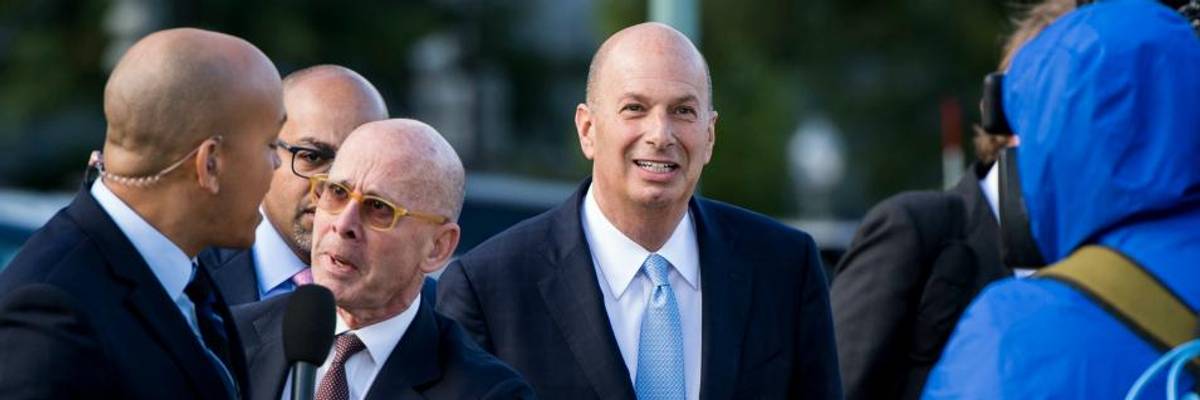
U.S. Ambassador to the European Union Gordon Sondland arrives at a closed session before the House Intelligence, Foreign Affairs and Oversight committees October 17, 2019 at the U.S. Capitol in Washington, D.C. (Photo by Alex Wong/Getty Images)
Gordon Sondland, U.S. Ambassador to the European Union, told House impeachment investigators on Thursday that President Donald Trump ordered him and other American diplomats to follow Rudy Giuliani's lead on Ukraine policy.
Sondland said in his opening statement (pdf) to the House committees leading the inquiry that he opposed the involvement of Giuliani, Trump's personal lawyer, in U.S.-Ukraine affairs--but ultimately obeyed the president's demands.
"Our view was that the men and women of the State Department, not the president's personal lawyer, should take responsibility for all aspects of U.S. foreign policy towards Ukraine," said Sondland, who was subpoenaed to testify after the Trump administration blocked him from appearing before the House last week.
"Based on the president's direction, we were faced with a choice," said Sondland. "We could abandon the goal of a White House meeting for [Ukranian] President [Volodymyr] Zelensky, which we all believed was crucial to strengthening U.S.-Ukrainian ties and furthering long-held U.S. foreign policy goals in the region; or we could do as President Trump directed and talk to Mr. Giuliani to address the president's concerns."
Rep. David Cicilline (D-R.I.), a member of the House Foreign Affairs Committee, told reporters Thursday that Sondland's opening remarks were "very damning" for the president and "further confirmation" that Giuliani was running a "shadow State Department effort" to investigate former Vice President Joe Biden.
Sondland said he didn't realize "until much later" that Giuliani was pressuring Ukraine to launch a probe into Biden.
Critics responded to Sondland's claim, which absolves him of complicity in potential wrongdoing, with skepticism. Washington Post reporter Aaron Blake noted on Twitter that "multiple stories" had been written about Giuliani's desire for an investigation into Biden.
"Mr. Giuliani has spearheaded the effort among conservatives to publicize and encourage the new investigation in Ukraine," the New York Times reported on May 1. Sondland said in his deposition that Trump instructed diplomats to work with Giuliani on Ukraine during a meeting on May 23.
As Sondland arrived at the Capitol to deliver his testimony, NBC reporter Geoff Bennett asked Sondland whether he is appearing before House investigators to "salvage" his reputation.
"I don't have a reputation to salvage," said Sondland.
Sondland refused to comment on whether there was a quid pro quo between Trump and Ukraine.
In his deposition, Sondland said he called Trump directly and asked him, "What do you want from Ukraine?"
"The president responded, 'Nothing. There is no quid pro quo.' The president repeated: 'no quid pro quo' multiple times," Sondland said. "This was a very short call. And I recall the president was in a bad mood."
As Common Dreams reported earlier this month, text exchanges released by House Democrats showed that Sondland attempted to assauge concerns about the president's actions raised by Bill Taylor, a top U.S. diplomat in Ukraine.
"Are we now saying that security assistance and WH meeting are conditioned on investigations?" Taylor asked in one September exchange.
Sondland replied simply, "Call me."
Dear Common Dreams reader, It’s been nearly 30 years since I co-founded Common Dreams with my late wife, Lina Newhouser. We had the radical notion that journalism should serve the public good, not corporate profits. It was clear to us from the outset what it would take to build such a project. No paid advertisements. No corporate sponsors. No millionaire publisher telling us what to think or do. Many people said we wouldn't last a year, but we proved those doubters wrong. Together with a tremendous team of journalists and dedicated staff, we built an independent media outlet free from the constraints of profits and corporate control. Our mission has always been simple: To inform. To inspire. To ignite change for the common good. Building Common Dreams was not easy. Our survival was never guaranteed. When you take on the most powerful forces—Wall Street greed, fossil fuel industry destruction, Big Tech lobbyists, and uber-rich oligarchs who have spent billions upon billions rigging the economy and democracy in their favor—the only bulwark you have is supporters who believe in your work. But here’s the urgent message from me today. It's never been this bad out there. And it's never been this hard to keep us going. At the very moment Common Dreams is most needed, the threats we face are intensifying. We need your support now more than ever. We don't accept corporate advertising and never will. We don't have a paywall because we don't think people should be blocked from critical news based on their ability to pay. Everything we do is funded by the donations of readers like you. When everyone does the little they can afford, we are strong. But if that support retreats or dries up, so do we. Will you donate now to make sure Common Dreams not only survives but thrives? —Craig Brown, Co-founder |
Gordon Sondland, U.S. Ambassador to the European Union, told House impeachment investigators on Thursday that President Donald Trump ordered him and other American diplomats to follow Rudy Giuliani's lead on Ukraine policy.
Sondland said in his opening statement (pdf) to the House committees leading the inquiry that he opposed the involvement of Giuliani, Trump's personal lawyer, in U.S.-Ukraine affairs--but ultimately obeyed the president's demands.
"Our view was that the men and women of the State Department, not the president's personal lawyer, should take responsibility for all aspects of U.S. foreign policy towards Ukraine," said Sondland, who was subpoenaed to testify after the Trump administration blocked him from appearing before the House last week.
"Based on the president's direction, we were faced with a choice," said Sondland. "We could abandon the goal of a White House meeting for [Ukranian] President [Volodymyr] Zelensky, which we all believed was crucial to strengthening U.S.-Ukrainian ties and furthering long-held U.S. foreign policy goals in the region; or we could do as President Trump directed and talk to Mr. Giuliani to address the president's concerns."
Rep. David Cicilline (D-R.I.), a member of the House Foreign Affairs Committee, told reporters Thursday that Sondland's opening remarks were "very damning" for the president and "further confirmation" that Giuliani was running a "shadow State Department effort" to investigate former Vice President Joe Biden.
Sondland said he didn't realize "until much later" that Giuliani was pressuring Ukraine to launch a probe into Biden.
Critics responded to Sondland's claim, which absolves him of complicity in potential wrongdoing, with skepticism. Washington Post reporter Aaron Blake noted on Twitter that "multiple stories" had been written about Giuliani's desire for an investigation into Biden.
"Mr. Giuliani has spearheaded the effort among conservatives to publicize and encourage the new investigation in Ukraine," the New York Times reported on May 1. Sondland said in his deposition that Trump instructed diplomats to work with Giuliani on Ukraine during a meeting on May 23.
As Sondland arrived at the Capitol to deliver his testimony, NBC reporter Geoff Bennett asked Sondland whether he is appearing before House investigators to "salvage" his reputation.
"I don't have a reputation to salvage," said Sondland.
Sondland refused to comment on whether there was a quid pro quo between Trump and Ukraine.
In his deposition, Sondland said he called Trump directly and asked him, "What do you want from Ukraine?"
"The president responded, 'Nothing. There is no quid pro quo.' The president repeated: 'no quid pro quo' multiple times," Sondland said. "This was a very short call. And I recall the president was in a bad mood."
As Common Dreams reported earlier this month, text exchanges released by House Democrats showed that Sondland attempted to assauge concerns about the president's actions raised by Bill Taylor, a top U.S. diplomat in Ukraine.
"Are we now saying that security assistance and WH meeting are conditioned on investigations?" Taylor asked in one September exchange.
Sondland replied simply, "Call me."
Gordon Sondland, U.S. Ambassador to the European Union, told House impeachment investigators on Thursday that President Donald Trump ordered him and other American diplomats to follow Rudy Giuliani's lead on Ukraine policy.
Sondland said in his opening statement (pdf) to the House committees leading the inquiry that he opposed the involvement of Giuliani, Trump's personal lawyer, in U.S.-Ukraine affairs--but ultimately obeyed the president's demands.
"Our view was that the men and women of the State Department, not the president's personal lawyer, should take responsibility for all aspects of U.S. foreign policy towards Ukraine," said Sondland, who was subpoenaed to testify after the Trump administration blocked him from appearing before the House last week.
"Based on the president's direction, we were faced with a choice," said Sondland. "We could abandon the goal of a White House meeting for [Ukranian] President [Volodymyr] Zelensky, which we all believed was crucial to strengthening U.S.-Ukrainian ties and furthering long-held U.S. foreign policy goals in the region; or we could do as President Trump directed and talk to Mr. Giuliani to address the president's concerns."
Rep. David Cicilline (D-R.I.), a member of the House Foreign Affairs Committee, told reporters Thursday that Sondland's opening remarks were "very damning" for the president and "further confirmation" that Giuliani was running a "shadow State Department effort" to investigate former Vice President Joe Biden.
Sondland said he didn't realize "until much later" that Giuliani was pressuring Ukraine to launch a probe into Biden.
Critics responded to Sondland's claim, which absolves him of complicity in potential wrongdoing, with skepticism. Washington Post reporter Aaron Blake noted on Twitter that "multiple stories" had been written about Giuliani's desire for an investigation into Biden.
"Mr. Giuliani has spearheaded the effort among conservatives to publicize and encourage the new investigation in Ukraine," the New York Times reported on May 1. Sondland said in his deposition that Trump instructed diplomats to work with Giuliani on Ukraine during a meeting on May 23.
As Sondland arrived at the Capitol to deliver his testimony, NBC reporter Geoff Bennett asked Sondland whether he is appearing before House investigators to "salvage" his reputation.
"I don't have a reputation to salvage," said Sondland.
Sondland refused to comment on whether there was a quid pro quo between Trump and Ukraine.
In his deposition, Sondland said he called Trump directly and asked him, "What do you want from Ukraine?"
"The president responded, 'Nothing. There is no quid pro quo.' The president repeated: 'no quid pro quo' multiple times," Sondland said. "This was a very short call. And I recall the president was in a bad mood."
As Common Dreams reported earlier this month, text exchanges released by House Democrats showed that Sondland attempted to assauge concerns about the president's actions raised by Bill Taylor, a top U.S. diplomat in Ukraine.
"Are we now saying that security assistance and WH meeting are conditioned on investigations?" Taylor asked in one September exchange.
Sondland replied simply, "Call me."

