SUBSCRIBE TO OUR FREE NEWSLETTER
Daily news & progressive opinion—funded by the people, not the corporations—delivered straight to your inbox.
5
#000000
#FFFFFF
To donate by check, phone, or other method, see our More Ways to Give page.
Daily news & progressive opinion—funded by the people, not the corporations—delivered straight to your inbox.
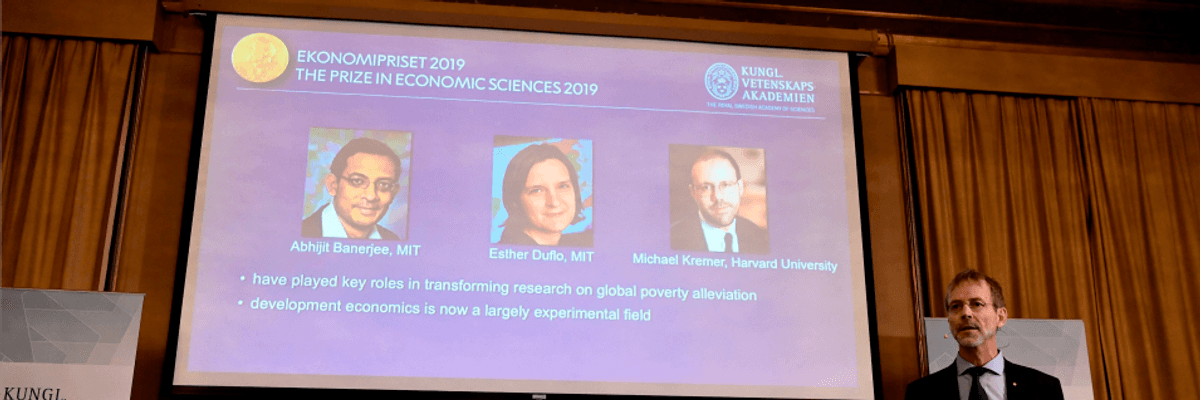
Abhijit Banerjee, Esther Duflo, and Michael Kremer won the Nobel Economics Prize for their "experimental approach to alleviating global poverty," the Royal Swedish Academy of Sciences said Monday. (Photo: Jonathan Nackstrand/AFP via Getty Images)
Three researchers on Monday were awarded the Nobel Memorial Prize in Economic Sciences for their groundbreaking work in studying poverty-stricken communities around the world and developing ways to make a difference in poor people's lives through education and healthcare.
Abhijit Banerjee and Esther Duflo of M.I.T. and Michael Kremer of Harvard were named the winners of this year's award, receiving recognition for their two decades of experiment-based research and the concrete impact they've had on the communities they study--a departure for a prize which has often been given to economists whose work is grounded in theory.
"The research conducted by this year's Laureates has considerably improved our ability to fight global poverty," the Royal Swedish Academy of Sciences said (pdf). "In just two decades, their new experiment-based approach has transformed development economics, which is now a flourishing field of research."
Banerjee, Duflo, and Kremer examine ways to alleviate poverty through interventions in some of the systems that leave the poorest people behind, including schools and healthcare.
In one experiment, the researchers found that access to extra textbooks did not have a meaningful impact on improving students' outcomes in Kenya--but that tutors for low-performing students in India did help them to learn more effectively in school.
"As a direct result of one of their studies, more than five million Indian children have benefited from effective programs of remedial tutoring in schools," the Academy of Sciences wrote.
The international charity Save the Children, which counts Banerjee among its trustees, praised the Academy of Sciences for recognizing the researchers' work.
The researchers also conducted an experiment in which residents in more than 200 villages in India spread information about vaccinations, finding that families were more likely to receive immunizations when the information was shared in the community.
"This is probably the first 21st-century prize in economics," Lawrence Katz, a Harvard economist, told the New York Times. "We've given lots of prizes for the advances of the 20th century."
"Their methods, and this is not stuff worked on 20, 30 years ago--this is stuff that, none of it started until the 2000s," he added. "This really is 21st-century economics, and it's wonderful that we're moving into the 21st century with the Nobel prize, in my view."
In a profile published by the New Yorker in 2010, Duflo said that as a graduate student, "I wrote in all the introductions of my papers, 'The ideal experiment to measure the effect of this would be...'"
"I just got fed up of writing about what the ideal experiment would be," she said. "Why don't we just do it?"
Duflo is only the second woman to be awarded the novel prize in economics. The late Elinor Ostrom won the prize in 2009 for her research into how people in small communities share natural resources with one another.
Economist Paul Krugman called the Academy's recognition of Dufko, Banerjee, and Kremer "heartening."
The economists' work "has great potential to further improve the lives of the worst-off people around the world," wrote the Academy.
Dear Common Dreams reader, It’s been nearly 30 years since I co-founded Common Dreams with my late wife, Lina Newhouser. We had the radical notion that journalism should serve the public good, not corporate profits. It was clear to us from the outset what it would take to build such a project. No paid advertisements. No corporate sponsors. No millionaire publisher telling us what to think or do. Many people said we wouldn't last a year, but we proved those doubters wrong. Together with a tremendous team of journalists and dedicated staff, we built an independent media outlet free from the constraints of profits and corporate control. Our mission has always been simple: To inform. To inspire. To ignite change for the common good. Building Common Dreams was not easy. Our survival was never guaranteed. When you take on the most powerful forces—Wall Street greed, fossil fuel industry destruction, Big Tech lobbyists, and uber-rich oligarchs who have spent billions upon billions rigging the economy and democracy in their favor—the only bulwark you have is supporters who believe in your work. But here’s the urgent message from me today. It's never been this bad out there. And it's never been this hard to keep us going. At the very moment Common Dreams is most needed, the threats we face are intensifying. We need your support now more than ever. We don't accept corporate advertising and never will. We don't have a paywall because we don't think people should be blocked from critical news based on their ability to pay. Everything we do is funded by the donations of readers like you. When everyone does the little they can afford, we are strong. But if that support retreats or dries up, so do we. Will you donate now to make sure Common Dreams not only survives but thrives? —Craig Brown, Co-founder |
Three researchers on Monday were awarded the Nobel Memorial Prize in Economic Sciences for their groundbreaking work in studying poverty-stricken communities around the world and developing ways to make a difference in poor people's lives through education and healthcare.
Abhijit Banerjee and Esther Duflo of M.I.T. and Michael Kremer of Harvard were named the winners of this year's award, receiving recognition for their two decades of experiment-based research and the concrete impact they've had on the communities they study--a departure for a prize which has often been given to economists whose work is grounded in theory.
"The research conducted by this year's Laureates has considerably improved our ability to fight global poverty," the Royal Swedish Academy of Sciences said (pdf). "In just two decades, their new experiment-based approach has transformed development economics, which is now a flourishing field of research."
Banerjee, Duflo, and Kremer examine ways to alleviate poverty through interventions in some of the systems that leave the poorest people behind, including schools and healthcare.
In one experiment, the researchers found that access to extra textbooks did not have a meaningful impact on improving students' outcomes in Kenya--but that tutors for low-performing students in India did help them to learn more effectively in school.
"As a direct result of one of their studies, more than five million Indian children have benefited from effective programs of remedial tutoring in schools," the Academy of Sciences wrote.
The international charity Save the Children, which counts Banerjee among its trustees, praised the Academy of Sciences for recognizing the researchers' work.
The researchers also conducted an experiment in which residents in more than 200 villages in India spread information about vaccinations, finding that families were more likely to receive immunizations when the information was shared in the community.
"This is probably the first 21st-century prize in economics," Lawrence Katz, a Harvard economist, told the New York Times. "We've given lots of prizes for the advances of the 20th century."
"Their methods, and this is not stuff worked on 20, 30 years ago--this is stuff that, none of it started until the 2000s," he added. "This really is 21st-century economics, and it's wonderful that we're moving into the 21st century with the Nobel prize, in my view."
In a profile published by the New Yorker in 2010, Duflo said that as a graduate student, "I wrote in all the introductions of my papers, 'The ideal experiment to measure the effect of this would be...'"
"I just got fed up of writing about what the ideal experiment would be," she said. "Why don't we just do it?"
Duflo is only the second woman to be awarded the novel prize in economics. The late Elinor Ostrom won the prize in 2009 for her research into how people in small communities share natural resources with one another.
Economist Paul Krugman called the Academy's recognition of Dufko, Banerjee, and Kremer "heartening."
The economists' work "has great potential to further improve the lives of the worst-off people around the world," wrote the Academy.
Three researchers on Monday were awarded the Nobel Memorial Prize in Economic Sciences for their groundbreaking work in studying poverty-stricken communities around the world and developing ways to make a difference in poor people's lives through education and healthcare.
Abhijit Banerjee and Esther Duflo of M.I.T. and Michael Kremer of Harvard were named the winners of this year's award, receiving recognition for their two decades of experiment-based research and the concrete impact they've had on the communities they study--a departure for a prize which has often been given to economists whose work is grounded in theory.
"The research conducted by this year's Laureates has considerably improved our ability to fight global poverty," the Royal Swedish Academy of Sciences said (pdf). "In just two decades, their new experiment-based approach has transformed development economics, which is now a flourishing field of research."
Banerjee, Duflo, and Kremer examine ways to alleviate poverty through interventions in some of the systems that leave the poorest people behind, including schools and healthcare.
In one experiment, the researchers found that access to extra textbooks did not have a meaningful impact on improving students' outcomes in Kenya--but that tutors for low-performing students in India did help them to learn more effectively in school.
"As a direct result of one of their studies, more than five million Indian children have benefited from effective programs of remedial tutoring in schools," the Academy of Sciences wrote.
The international charity Save the Children, which counts Banerjee among its trustees, praised the Academy of Sciences for recognizing the researchers' work.
The researchers also conducted an experiment in which residents in more than 200 villages in India spread information about vaccinations, finding that families were more likely to receive immunizations when the information was shared in the community.
"This is probably the first 21st-century prize in economics," Lawrence Katz, a Harvard economist, told the New York Times. "We've given lots of prizes for the advances of the 20th century."
"Their methods, and this is not stuff worked on 20, 30 years ago--this is stuff that, none of it started until the 2000s," he added. "This really is 21st-century economics, and it's wonderful that we're moving into the 21st century with the Nobel prize, in my view."
In a profile published by the New Yorker in 2010, Duflo said that as a graduate student, "I wrote in all the introductions of my papers, 'The ideal experiment to measure the effect of this would be...'"
"I just got fed up of writing about what the ideal experiment would be," she said. "Why don't we just do it?"
Duflo is only the second woman to be awarded the novel prize in economics. The late Elinor Ostrom won the prize in 2009 for her research into how people in small communities share natural resources with one another.
Economist Paul Krugman called the Academy's recognition of Dufko, Banerjee, and Kremer "heartening."
The economists' work "has great potential to further improve the lives of the worst-off people around the world," wrote the Academy.