

SUBSCRIBE TO OUR FREE NEWSLETTER
Daily news & progressive opinion—funded by the people, not the corporations—delivered straight to your inbox.
5
#000000
#FFFFFF
To donate by check, phone, or other method, see our More Ways to Give page.
Daily news & progressive opinion—funded by the people, not the corporations—delivered straight to your inbox.
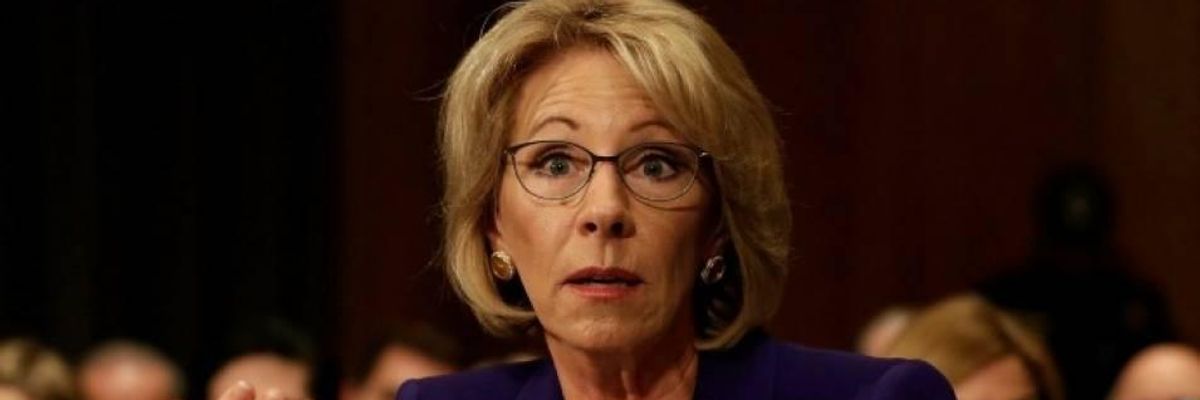
"Betsy DeVos is in trouble." (Photo: Reuters)
Education Secretary Betsy DeVos on Monday was told in no uncertain terms that her refusal to abide by a 2018 order stopping her department from collecting on student loans made to predatory for-profit Corinthian College had the potential to land her in jail, though Magistrate Judge Sallie Kim made clear that was, for now, an unlikely outcome.
"At best it is gross negligence, at worst it's an intentional flouting of my order," Kim told lawyers from the education department in court Monday. "I'm not sure if this is contempt or sanctions."
"I'm not sending anyone to jail yet," Kim added, "but it's good to know I have that ability."
As journalist Sarah Jaffe noted on Twitter, "Betsy DeVos is in trouble."
Kim ruled in 2018 that DeVos and the department had to stop collecting on student loans issued for attendees of Corinthian, which abruptly closed its doors in 2015. The school, an almagam of distressed colleges bought and bundled by venture capitalists, was one of the largest chains of for-profit colleges in the U.S. before shutting down under a cloud of what The Washington Post said were "charges of fraud and predatory lending."
Students at the schools applied for debt relief, and the Obama administration made some headway before clearing out for President Donald Trump's White House and DeVos. Rather than issue blanket relief, DeVos and the department used a means-tested approach which compared post-college earnings from Corinthian graduates with those of other vocational schools.
As the Post explained:
DeVos started processing claims in December 2017, announcing the approval of 12,900 applications and denial of 8,600 claims from former Corinthian students. She said applicants would receive full loan forgiveness if their earnings are less than 50 percent of those of their peers. If their pay is at or above that threshold, the department would provide relief on a sliding scale.
In 2018, Kim found that the practice violated the Privacy Act by using borrowers' Social Security numbers and other information to find earning information. Kim ruled that the department had to stop the practice and immediately cease all collection actions on the debt of the Corinthian students.
That is not, however, what happened, as the Post explained:
In a September court filing, the Education Department revealed that more than 16,000 former Corinthian students "were incorrectly informed at one time or another ... that they had payments due on their federal student loans" after a federal judge put a hold on collections in May 2018.
On Monday, Kim laid into department officials for ignoring her ruling.
"There have to be some consequences for the violation of my order 16,000 times," said Kim.
No matter what punishment the judge delivers to the department, Harvard University's Project on Predatory Student Lending legal director Eileen Connor told Bloomberg, the case for contempt seems straightforward.
"We think contempt is clear on the record presently before the court," said Connor, "and expect that the court will issue that finding, regardless of what sanctions are imposed."
Dear Common Dreams reader, It’s been nearly 30 years since I co-founded Common Dreams with my late wife, Lina Newhouser. We had the radical notion that journalism should serve the public good, not corporate profits. It was clear to us from the outset what it would take to build such a project. No paid advertisements. No corporate sponsors. No millionaire publisher telling us what to think or do. Many people said we wouldn't last a year, but we proved those doubters wrong. Together with a tremendous team of journalists and dedicated staff, we built an independent media outlet free from the constraints of profits and corporate control. Our mission has always been simple: To inform. To inspire. To ignite change for the common good. Building Common Dreams was not easy. Our survival was never guaranteed. When you take on the most powerful forces—Wall Street greed, fossil fuel industry destruction, Big Tech lobbyists, and uber-rich oligarchs who have spent billions upon billions rigging the economy and democracy in their favor—the only bulwark you have is supporters who believe in your work. But here’s the urgent message from me today. It's never been this bad out there. And it's never been this hard to keep us going. At the very moment Common Dreams is most needed, the threats we face are intensifying. We need your support now more than ever. We don't accept corporate advertising and never will. We don't have a paywall because we don't think people should be blocked from critical news based on their ability to pay. Everything we do is funded by the donations of readers like you. When everyone does the little they can afford, we are strong. But if that support retreats or dries up, so do we. Will you donate now to make sure Common Dreams not only survives but thrives? —Craig Brown, Co-founder |
Education Secretary Betsy DeVos on Monday was told in no uncertain terms that her refusal to abide by a 2018 order stopping her department from collecting on student loans made to predatory for-profit Corinthian College had the potential to land her in jail, though Magistrate Judge Sallie Kim made clear that was, for now, an unlikely outcome.
"At best it is gross negligence, at worst it's an intentional flouting of my order," Kim told lawyers from the education department in court Monday. "I'm not sure if this is contempt or sanctions."
"I'm not sending anyone to jail yet," Kim added, "but it's good to know I have that ability."
As journalist Sarah Jaffe noted on Twitter, "Betsy DeVos is in trouble."
Kim ruled in 2018 that DeVos and the department had to stop collecting on student loans issued for attendees of Corinthian, which abruptly closed its doors in 2015. The school, an almagam of distressed colleges bought and bundled by venture capitalists, was one of the largest chains of for-profit colleges in the U.S. before shutting down under a cloud of what The Washington Post said were "charges of fraud and predatory lending."
Students at the schools applied for debt relief, and the Obama administration made some headway before clearing out for President Donald Trump's White House and DeVos. Rather than issue blanket relief, DeVos and the department used a means-tested approach which compared post-college earnings from Corinthian graduates with those of other vocational schools.
As the Post explained:
DeVos started processing claims in December 2017, announcing the approval of 12,900 applications and denial of 8,600 claims from former Corinthian students. She said applicants would receive full loan forgiveness if their earnings are less than 50 percent of those of their peers. If their pay is at or above that threshold, the department would provide relief on a sliding scale.
In 2018, Kim found that the practice violated the Privacy Act by using borrowers' Social Security numbers and other information to find earning information. Kim ruled that the department had to stop the practice and immediately cease all collection actions on the debt of the Corinthian students.
That is not, however, what happened, as the Post explained:
In a September court filing, the Education Department revealed that more than 16,000 former Corinthian students "were incorrectly informed at one time or another ... that they had payments due on their federal student loans" after a federal judge put a hold on collections in May 2018.
On Monday, Kim laid into department officials for ignoring her ruling.
"There have to be some consequences for the violation of my order 16,000 times," said Kim.
No matter what punishment the judge delivers to the department, Harvard University's Project on Predatory Student Lending legal director Eileen Connor told Bloomberg, the case for contempt seems straightforward.
"We think contempt is clear on the record presently before the court," said Connor, "and expect that the court will issue that finding, regardless of what sanctions are imposed."
Education Secretary Betsy DeVos on Monday was told in no uncertain terms that her refusal to abide by a 2018 order stopping her department from collecting on student loans made to predatory for-profit Corinthian College had the potential to land her in jail, though Magistrate Judge Sallie Kim made clear that was, for now, an unlikely outcome.
"At best it is gross negligence, at worst it's an intentional flouting of my order," Kim told lawyers from the education department in court Monday. "I'm not sure if this is contempt or sanctions."
"I'm not sending anyone to jail yet," Kim added, "but it's good to know I have that ability."
As journalist Sarah Jaffe noted on Twitter, "Betsy DeVos is in trouble."
Kim ruled in 2018 that DeVos and the department had to stop collecting on student loans issued for attendees of Corinthian, which abruptly closed its doors in 2015. The school, an almagam of distressed colleges bought and bundled by venture capitalists, was one of the largest chains of for-profit colleges in the U.S. before shutting down under a cloud of what The Washington Post said were "charges of fraud and predatory lending."
Students at the schools applied for debt relief, and the Obama administration made some headway before clearing out for President Donald Trump's White House and DeVos. Rather than issue blanket relief, DeVos and the department used a means-tested approach which compared post-college earnings from Corinthian graduates with those of other vocational schools.
As the Post explained:
DeVos started processing claims in December 2017, announcing the approval of 12,900 applications and denial of 8,600 claims from former Corinthian students. She said applicants would receive full loan forgiveness if their earnings are less than 50 percent of those of their peers. If their pay is at or above that threshold, the department would provide relief on a sliding scale.
In 2018, Kim found that the practice violated the Privacy Act by using borrowers' Social Security numbers and other information to find earning information. Kim ruled that the department had to stop the practice and immediately cease all collection actions on the debt of the Corinthian students.
That is not, however, what happened, as the Post explained:
In a September court filing, the Education Department revealed that more than 16,000 former Corinthian students "were incorrectly informed at one time or another ... that they had payments due on their federal student loans" after a federal judge put a hold on collections in May 2018.
On Monday, Kim laid into department officials for ignoring her ruling.
"There have to be some consequences for the violation of my order 16,000 times," said Kim.
No matter what punishment the judge delivers to the department, Harvard University's Project on Predatory Student Lending legal director Eileen Connor told Bloomberg, the case for contempt seems straightforward.
"We think contempt is clear on the record presently before the court," said Connor, "and expect that the court will issue that finding, regardless of what sanctions are imposed."

