

SUBSCRIBE TO OUR FREE NEWSLETTER
Daily news & progressive opinion—funded by the people, not the corporations—delivered straight to your inbox.
5
#000000
#FFFFFF
To donate by check, phone, or other method, see our More Ways to Give page.
Daily news & progressive opinion—funded by the people, not the corporations—delivered straight to your inbox.
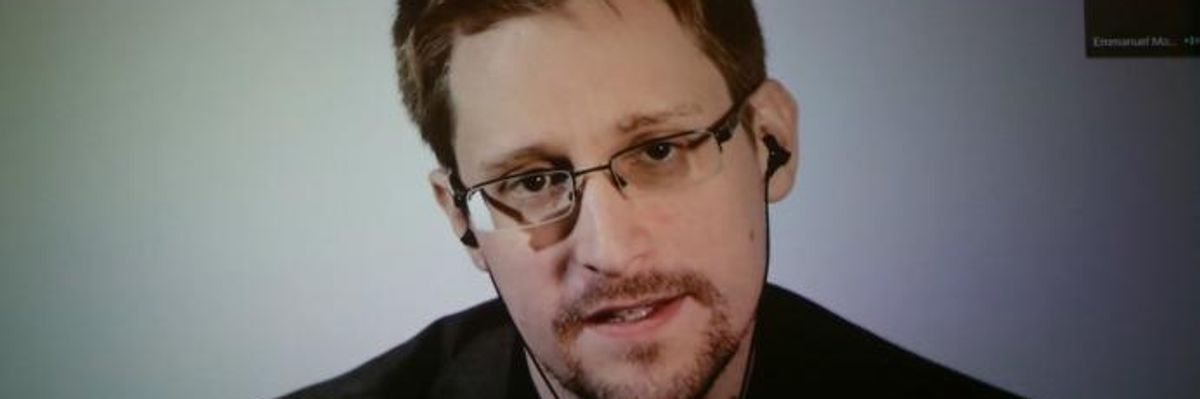
Edward Snowden speaks remotely at WIRED25 Festival: WIRED Celebrates 25th Anniversary Day 2 on October 14, 2018 in San Francisco, California.
Edward Snowden said Monday that he would return to the United States if afforded a fair trail where the American public could hear why he leaked global surveillance documents to the press.
The National Security Agency whistleblower, who was charged under the Espoinage Act and lives in exile in Russia, made the remarks in an interview with "CBS This Morning."
"Of course I would like to return to the United States," said Snowden. "That is the ultimate goal. But if I'm going to spend the rest of my life in prison, then one bottom line demand that we all have to agree to is at least I get a fair trial."
"That is the one thing the government has refused to guarantee because they won't provide me access to what's called a 'public interest defense,'" he said.
"I'm not asking for a pardon. I'm not asking for a pass," Snowden continued. "What I'm asking for is a fair trial. And this is the bottom line that any American should require. We don't want people thrown in prison without the jury being able to decide that what they did was right or wrong."
"The government wants to have a different kind of trial" in which they "use special procedures," he explained. "They want to be able to close the court room. They want the public not to be able to know what's going on."
"The most important fact to the government," Snowden said, "is that they do not want the jury to be able to consider the motivations--why I did what I did."
"Was it better for the United States? Did it benefit us? Or did it cause harm?" said Snowden. "They don't want the jury to be able to consider that at all."
The government has yet to produce any evidence his disclosure caused harm--"If they had some classified evidence that a hair on a single person's head was harmed, you know as well as I do, it would be on the front page of The New York Times by the end of the day," he said. The heart of the matter, said Snowden, is that the leak brought to light the government's mass surveillance system.
"When the government is embarrassed after being caught breaking the law," Snowden said, "they say the people who revealed that lawbreaking have caused serious harm to national security." He pointed to the case of Pentagon Papers whistleblower Daniel Ellsberg.
"What harms the country?" he asked. "Is it a war built on lies? Or is it the revelation of those lies? Is it the construction of a system of mass surveillance that violates our rights? Or is it the revelation of that by the newspapers that we trust?"
"If we can't trust newspapers, if we can't agree on the basic facts and then have a discussion, about whether this was right or wrong, not what's lawful or unlawful," Snowden said, "we're losing our position as a democracy and as a government that is controlled by the people--rather than people that are controlled by the government."
Trevor Timm, co-founder and the executive director of the Freedom of the Press Foundation, explained in 2013 how Snowden's chances at a fair trail are likely nil.
Timm posited:
If Edward Snowden comes back to the U.S. to face trial, he likely will not be able to tell a jury why he did what he did, and what happened because of his actions. Contrary to common sense, there is no public interest exception to the Espionage Act. Prosecutors in recent cases have convinced courts that the intent of the leaker, the value of leaks to the public, and the lack of harm caused by the leaks are irrelevant--and are therefore inadmissible in court.
In that scenario, Timm continued, Snowden would be unable "to tell the jury that his intent was to inform the American public about the government's secret interpretations of laws used to justify spying on millions of citizens without their knowledge, as opposed to selling secrets to hostile countries for their advantage."
Snowden would also be unable to talk about the consequences of his actions, including the fact "his leaks sparked more than two dozen bills in Congress, and half a dozen lawsuits, all designed to rein in unconstitutional surveillance."
"He wouldn't be allowed to explain how his leaks caught an official lying to Congress, that they've led to a White House review panel recommending forty-six reforms for U.S. intelligence agencies, or that they've led to an unprecedented review of government secrecy," wrote Timm.
Snowden's new interview came a day before the publication of his memoir, Permanent Record. It can be ordered from the publishers here.
Dear Common Dreams reader, It’s been nearly 30 years since I co-founded Common Dreams with my late wife, Lina Newhouser. We had the radical notion that journalism should serve the public good, not corporate profits. It was clear to us from the outset what it would take to build such a project. No paid advertisements. No corporate sponsors. No millionaire publisher telling us what to think or do. Many people said we wouldn't last a year, but we proved those doubters wrong. Together with a tremendous team of journalists and dedicated staff, we built an independent media outlet free from the constraints of profits and corporate control. Our mission has always been simple: To inform. To inspire. To ignite change for the common good. Building Common Dreams was not easy. Our survival was never guaranteed. When you take on the most powerful forces—Wall Street greed, fossil fuel industry destruction, Big Tech lobbyists, and uber-rich oligarchs who have spent billions upon billions rigging the economy and democracy in their favor—the only bulwark you have is supporters who believe in your work. But here’s the urgent message from me today. It's never been this bad out there. And it's never been this hard to keep us going. At the very moment Common Dreams is most needed, the threats we face are intensifying. We need your support now more than ever. We don't accept corporate advertising and never will. We don't have a paywall because we don't think people should be blocked from critical news based on their ability to pay. Everything we do is funded by the donations of readers like you. When everyone does the little they can afford, we are strong. But if that support retreats or dries up, so do we. Will you donate now to make sure Common Dreams not only survives but thrives? —Craig Brown, Co-founder |
Edward Snowden said Monday that he would return to the United States if afforded a fair trail where the American public could hear why he leaked global surveillance documents to the press.
The National Security Agency whistleblower, who was charged under the Espoinage Act and lives in exile in Russia, made the remarks in an interview with "CBS This Morning."
"Of course I would like to return to the United States," said Snowden. "That is the ultimate goal. But if I'm going to spend the rest of my life in prison, then one bottom line demand that we all have to agree to is at least I get a fair trial."
"That is the one thing the government has refused to guarantee because they won't provide me access to what's called a 'public interest defense,'" he said.
"I'm not asking for a pardon. I'm not asking for a pass," Snowden continued. "What I'm asking for is a fair trial. And this is the bottom line that any American should require. We don't want people thrown in prison without the jury being able to decide that what they did was right or wrong."
"The government wants to have a different kind of trial" in which they "use special procedures," he explained. "They want to be able to close the court room. They want the public not to be able to know what's going on."
"The most important fact to the government," Snowden said, "is that they do not want the jury to be able to consider the motivations--why I did what I did."
"Was it better for the United States? Did it benefit us? Or did it cause harm?" said Snowden. "They don't want the jury to be able to consider that at all."
The government has yet to produce any evidence his disclosure caused harm--"If they had some classified evidence that a hair on a single person's head was harmed, you know as well as I do, it would be on the front page of The New York Times by the end of the day," he said. The heart of the matter, said Snowden, is that the leak brought to light the government's mass surveillance system.
"When the government is embarrassed after being caught breaking the law," Snowden said, "they say the people who revealed that lawbreaking have caused serious harm to national security." He pointed to the case of Pentagon Papers whistleblower Daniel Ellsberg.
"What harms the country?" he asked. "Is it a war built on lies? Or is it the revelation of those lies? Is it the construction of a system of mass surveillance that violates our rights? Or is it the revelation of that by the newspapers that we trust?"
"If we can't trust newspapers, if we can't agree on the basic facts and then have a discussion, about whether this was right or wrong, not what's lawful or unlawful," Snowden said, "we're losing our position as a democracy and as a government that is controlled by the people--rather than people that are controlled by the government."
Trevor Timm, co-founder and the executive director of the Freedom of the Press Foundation, explained in 2013 how Snowden's chances at a fair trail are likely nil.
Timm posited:
If Edward Snowden comes back to the U.S. to face trial, he likely will not be able to tell a jury why he did what he did, and what happened because of his actions. Contrary to common sense, there is no public interest exception to the Espionage Act. Prosecutors in recent cases have convinced courts that the intent of the leaker, the value of leaks to the public, and the lack of harm caused by the leaks are irrelevant--and are therefore inadmissible in court.
In that scenario, Timm continued, Snowden would be unable "to tell the jury that his intent was to inform the American public about the government's secret interpretations of laws used to justify spying on millions of citizens without their knowledge, as opposed to selling secrets to hostile countries for their advantage."
Snowden would also be unable to talk about the consequences of his actions, including the fact "his leaks sparked more than two dozen bills in Congress, and half a dozen lawsuits, all designed to rein in unconstitutional surveillance."
"He wouldn't be allowed to explain how his leaks caught an official lying to Congress, that they've led to a White House review panel recommending forty-six reforms for U.S. intelligence agencies, or that they've led to an unprecedented review of government secrecy," wrote Timm.
Snowden's new interview came a day before the publication of his memoir, Permanent Record. It can be ordered from the publishers here.
Edward Snowden said Monday that he would return to the United States if afforded a fair trail where the American public could hear why he leaked global surveillance documents to the press.
The National Security Agency whistleblower, who was charged under the Espoinage Act and lives in exile in Russia, made the remarks in an interview with "CBS This Morning."
"Of course I would like to return to the United States," said Snowden. "That is the ultimate goal. But if I'm going to spend the rest of my life in prison, then one bottom line demand that we all have to agree to is at least I get a fair trial."
"That is the one thing the government has refused to guarantee because they won't provide me access to what's called a 'public interest defense,'" he said.
"I'm not asking for a pardon. I'm not asking for a pass," Snowden continued. "What I'm asking for is a fair trial. And this is the bottom line that any American should require. We don't want people thrown in prison without the jury being able to decide that what they did was right or wrong."
"The government wants to have a different kind of trial" in which they "use special procedures," he explained. "They want to be able to close the court room. They want the public not to be able to know what's going on."
"The most important fact to the government," Snowden said, "is that they do not want the jury to be able to consider the motivations--why I did what I did."
"Was it better for the United States? Did it benefit us? Or did it cause harm?" said Snowden. "They don't want the jury to be able to consider that at all."
The government has yet to produce any evidence his disclosure caused harm--"If they had some classified evidence that a hair on a single person's head was harmed, you know as well as I do, it would be on the front page of The New York Times by the end of the day," he said. The heart of the matter, said Snowden, is that the leak brought to light the government's mass surveillance system.
"When the government is embarrassed after being caught breaking the law," Snowden said, "they say the people who revealed that lawbreaking have caused serious harm to national security." He pointed to the case of Pentagon Papers whistleblower Daniel Ellsberg.
"What harms the country?" he asked. "Is it a war built on lies? Or is it the revelation of those lies? Is it the construction of a system of mass surveillance that violates our rights? Or is it the revelation of that by the newspapers that we trust?"
"If we can't trust newspapers, if we can't agree on the basic facts and then have a discussion, about whether this was right or wrong, not what's lawful or unlawful," Snowden said, "we're losing our position as a democracy and as a government that is controlled by the people--rather than people that are controlled by the government."
Trevor Timm, co-founder and the executive director of the Freedom of the Press Foundation, explained in 2013 how Snowden's chances at a fair trail are likely nil.
Timm posited:
If Edward Snowden comes back to the U.S. to face trial, he likely will not be able to tell a jury why he did what he did, and what happened because of his actions. Contrary to common sense, there is no public interest exception to the Espionage Act. Prosecutors in recent cases have convinced courts that the intent of the leaker, the value of leaks to the public, and the lack of harm caused by the leaks are irrelevant--and are therefore inadmissible in court.
In that scenario, Timm continued, Snowden would be unable "to tell the jury that his intent was to inform the American public about the government's secret interpretations of laws used to justify spying on millions of citizens without their knowledge, as opposed to selling secrets to hostile countries for their advantage."
Snowden would also be unable to talk about the consequences of his actions, including the fact "his leaks sparked more than two dozen bills in Congress, and half a dozen lawsuits, all designed to rein in unconstitutional surveillance."
"He wouldn't be allowed to explain how his leaks caught an official lying to Congress, that they've led to a White House review panel recommending forty-six reforms for U.S. intelligence agencies, or that they've led to an unprecedented review of government secrecy," wrote Timm.
Snowden's new interview came a day before the publication of his memoir, Permanent Record. It can be ordered from the publishers here.

