SUBSCRIBE TO OUR FREE NEWSLETTER
Daily news & progressive opinion—funded by the people, not the corporations—delivered straight to your inbox.
5
#000000
#FFFFFF
To donate by check, phone, or other method, see our More Ways to Give page.
Daily news & progressive opinion—funded by the people, not the corporations—delivered straight to your inbox.
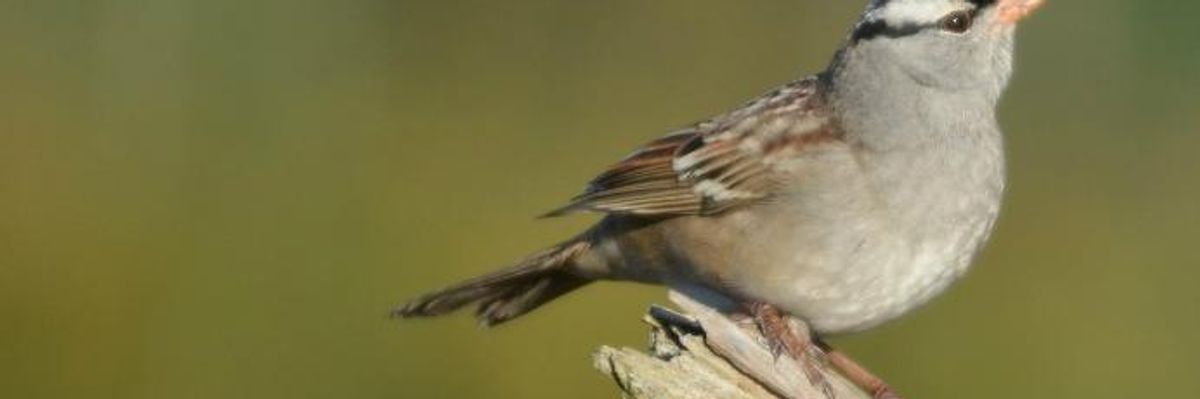
Scientists in Saskatchewan found that consuming small amounts of neonicotinoids led white-crowned sparrows to lose significant amounts of weight and delay migration, threatening their ability to reproduce. (Photo: Jen Goellnitz/Flickr/cc)
In addition to devastating effects on bee populations and the pollination needed to feed humans and other species, widely-used pesticides chemically related to nicotine may be deadly to birds and linked to some species' declines, according to a new study.
Researchers at the University of Saskatchewan studied the pesticide imidacloprid, in the nicotine-linked class of chemicals called neonicotinoids, or neonics, and found that the pesticide had effects on migrating birds' health and ability to reproduce.
The scientists gave small amounts of the pesticide to white-crowned sparrows and found that the limited consumption caused the birds to lose weight and delay their migration.
Within hours of being given the neonics, the birds stopped eating and lost an average of six percent of their body weight and about 17 percent of their fat stores, making it impossible for them to complete their long flights south. The birds took at least an extra 3.5 days to recover and migrate.
"It's just a few days, but we know that just a few days can have significant consequences for survival and reproduction," Margaret Eng, an ecotoxicologist who led the study told Science magazine, where the research was published Friday.
The disruption of the species' normal migration led to decreased ability to reproduce and survive, the researchers found.
The study "causatively links a pesticide to something that is really, tangibly negative to birds that is causing their population declines," study author Christy Morrissey told the Associated Press. "It's clear evidence these chemicals can affect populations."
More than 70 percent of North American farmland bird species are currently experiencing population declines.
The research shows for the first time "behavioral effects in free-living birds as result of neonicotinoid intoxication," Caspar Hallmann, an ecologist at Radboud University in the Netherlands, told National Geographic after reviewing Eng's study.
Scientists in Europe revealed in 2017 that neonicotinoids can decimate honey bee populations, threatening food sources for humans and other species.
The European Union banned the use of neonics in 2018 due to their effects on pollinators.
The EPA announced in May it would cancel the registrations of 12 neonicotinoid pesticides, but in July, the Trump administration removed restrictions on sulfoxaflor, a neonic that's been found to kill bees in low doses.
Dear Common Dreams reader, It’s been nearly 30 years since I co-founded Common Dreams with my late wife, Lina Newhouser. We had the radical notion that journalism should serve the public good, not corporate profits. It was clear to us from the outset what it would take to build such a project. No paid advertisements. No corporate sponsors. No millionaire publisher telling us what to think or do. Many people said we wouldn't last a year, but we proved those doubters wrong. Together with a tremendous team of journalists and dedicated staff, we built an independent media outlet free from the constraints of profits and corporate control. Our mission has always been simple: To inform. To inspire. To ignite change for the common good. Building Common Dreams was not easy. Our survival was never guaranteed. When you take on the most powerful forces—Wall Street greed, fossil fuel industry destruction, Big Tech lobbyists, and uber-rich oligarchs who have spent billions upon billions rigging the economy and democracy in their favor—the only bulwark you have is supporters who believe in your work. But here’s the urgent message from me today. It's never been this bad out there. And it's never been this hard to keep us going. At the very moment Common Dreams is most needed, the threats we face are intensifying. We need your support now more than ever. We don't accept corporate advertising and never will. We don't have a paywall because we don't think people should be blocked from critical news based on their ability to pay. Everything we do is funded by the donations of readers like you. When everyone does the little they can afford, we are strong. But if that support retreats or dries up, so do we. Will you donate now to make sure Common Dreams not only survives but thrives? —Craig Brown, Co-founder |
In addition to devastating effects on bee populations and the pollination needed to feed humans and other species, widely-used pesticides chemically related to nicotine may be deadly to birds and linked to some species' declines, according to a new study.
Researchers at the University of Saskatchewan studied the pesticide imidacloprid, in the nicotine-linked class of chemicals called neonicotinoids, or neonics, and found that the pesticide had effects on migrating birds' health and ability to reproduce.
The scientists gave small amounts of the pesticide to white-crowned sparrows and found that the limited consumption caused the birds to lose weight and delay their migration.
Within hours of being given the neonics, the birds stopped eating and lost an average of six percent of their body weight and about 17 percent of their fat stores, making it impossible for them to complete their long flights south. The birds took at least an extra 3.5 days to recover and migrate.
"It's just a few days, but we know that just a few days can have significant consequences for survival and reproduction," Margaret Eng, an ecotoxicologist who led the study told Science magazine, where the research was published Friday.
The disruption of the species' normal migration led to decreased ability to reproduce and survive, the researchers found.
The study "causatively links a pesticide to something that is really, tangibly negative to birds that is causing their population declines," study author Christy Morrissey told the Associated Press. "It's clear evidence these chemicals can affect populations."
More than 70 percent of North American farmland bird species are currently experiencing population declines.
The research shows for the first time "behavioral effects in free-living birds as result of neonicotinoid intoxication," Caspar Hallmann, an ecologist at Radboud University in the Netherlands, told National Geographic after reviewing Eng's study.
Scientists in Europe revealed in 2017 that neonicotinoids can decimate honey bee populations, threatening food sources for humans and other species.
The European Union banned the use of neonics in 2018 due to their effects on pollinators.
The EPA announced in May it would cancel the registrations of 12 neonicotinoid pesticides, but in July, the Trump administration removed restrictions on sulfoxaflor, a neonic that's been found to kill bees in low doses.
In addition to devastating effects on bee populations and the pollination needed to feed humans and other species, widely-used pesticides chemically related to nicotine may be deadly to birds and linked to some species' declines, according to a new study.
Researchers at the University of Saskatchewan studied the pesticide imidacloprid, in the nicotine-linked class of chemicals called neonicotinoids, or neonics, and found that the pesticide had effects on migrating birds' health and ability to reproduce.
The scientists gave small amounts of the pesticide to white-crowned sparrows and found that the limited consumption caused the birds to lose weight and delay their migration.
Within hours of being given the neonics, the birds stopped eating and lost an average of six percent of their body weight and about 17 percent of their fat stores, making it impossible for them to complete their long flights south. The birds took at least an extra 3.5 days to recover and migrate.
"It's just a few days, but we know that just a few days can have significant consequences for survival and reproduction," Margaret Eng, an ecotoxicologist who led the study told Science magazine, where the research was published Friday.
The disruption of the species' normal migration led to decreased ability to reproduce and survive, the researchers found.
The study "causatively links a pesticide to something that is really, tangibly negative to birds that is causing their population declines," study author Christy Morrissey told the Associated Press. "It's clear evidence these chemicals can affect populations."
More than 70 percent of North American farmland bird species are currently experiencing population declines.
The research shows for the first time "behavioral effects in free-living birds as result of neonicotinoid intoxication," Caspar Hallmann, an ecologist at Radboud University in the Netherlands, told National Geographic after reviewing Eng's study.
Scientists in Europe revealed in 2017 that neonicotinoids can decimate honey bee populations, threatening food sources for humans and other species.
The European Union banned the use of neonics in 2018 due to their effects on pollinators.
The EPA announced in May it would cancel the registrations of 12 neonicotinoid pesticides, but in July, the Trump administration removed restrictions on sulfoxaflor, a neonic that's been found to kill bees in low doses.