SUBSCRIBE TO OUR FREE NEWSLETTER
Daily news & progressive opinion—funded by the people, not the corporations—delivered straight to your inbox.
5
#000000
#FFFFFF
To donate by check, phone, or other method, see our More Ways to Give page.
Daily news & progressive opinion—funded by the people, not the corporations—delivered straight to your inbox.
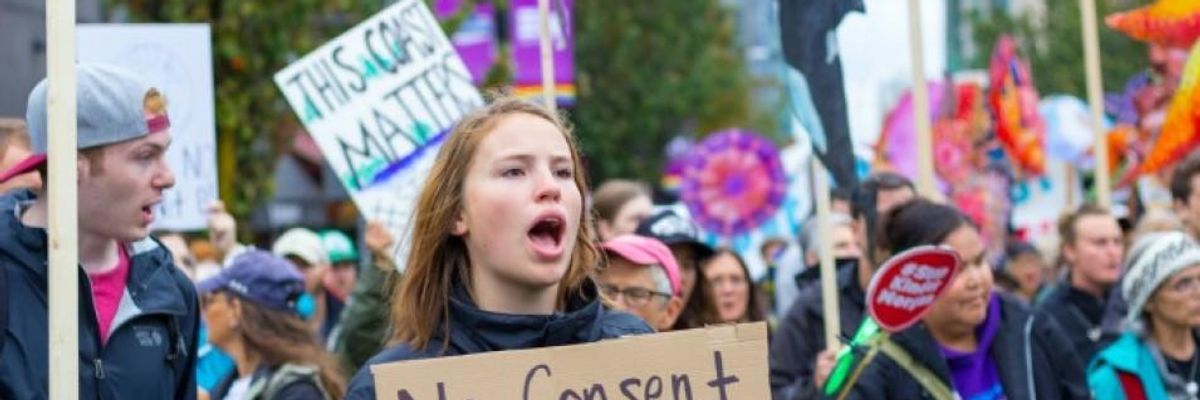
Protesters at a rally in Vancouver to show opposition to the Trans Mountain pipeline on September 9th, 2017. (Photo: William Chen/flickr/cc)
An investigative report released Wednesday by international environmental group Stand.earth details "fundamental problems" with Canada's Trans Mountain oil pipeline, outlines the long history of delays for its planned expansion, and highlights the anticipated social and ecological impacts at seven of the "most troubling hot spots."
"Canadians taxpayers... deserve to know the realities of these dangerous construction hot spots that could push the cost of this project even higher."
--Tzeporah Berman, Stand.earth
The report, Trans Mountain Pipeline: The Truth About Construction (pdf), is based on thousands of documents and interviews with experts and local residents tracking a proposed expansion. Along with warning of the project's expected consequences for local communities and ecosystems, the report calls into question the government's three-year construction timeline.
Under the leadership of Prime Minister Justin Trudeau--who is facing a tough general election next month--the Canadian federal government infuriated residents along the route, Indigenous groups, and environmentalists last year when it purchased the existing Trans Mountain pipeline and expansion project from Texas-based Kinder Morgan, after the company faced a series of delays.
"As detailed in Stand.earth's new investigative report, this project continues to face several permitting delays," Sven Biggs, climate and energy campaigner with the environmental group, said Wednesday. "This project is dangerously close to becoming financially unviable according to the Parliamentary Budget Office's own projections. It's time for the federal government to pull the plug."
In July, Canada's National Energy Board (NEB)--which was replaced with the Canadian Energy Regulator (CER) in late August--revoked all previous route approvals for the Trans Mountain pipeline and ordered a new hearing process for the entire route. No segment of the project currently has the full approval required.
"In addition to the outstanding NEB conditions, the project needs 1,187 permits from the Province of [British Columbia]," the report says. "As of June 2019, the province was still reviewing 658 of these permits and a further 243 have not even been applied for yet."
There are also ongoing appeals filed by six First Nations challenging the government's approval of the project as well as unresolved objections from the Coldwater First Nation and the City of Chilliwack in British Columbia, which have raised concerns about how the pipeline could endanger drinking water.
Last month, Trans Mountain CEO and president Ian Anderson announced that the project wouldn't be completed until mid-2022--which, the report notes, "is a six-month delay from the previous timeline released by the federal government."
Stand.earth livestreamed a press conference Wednesday featuring medical experts, Indigenous peoples, and local residents who shared their worries about the project. Watch:
Stand.earth's international program director Tzeporah Berman said Wednesday that "although this pipeline is now owned by the government, there remains an air of secrecy and lack of transparency about the dangerous risks at several construction hot spots along the route.
"Canadians taxpayers--who are the ones paying for this multi-billion dollar pipeline--have a right to know the impacts that construction will have on communities and the environment," Berman said. "They deserve to know the realities of these dangerous construction hot spots that could push the cost of this project even higher."
"We have a right to say no to these resource extraction projects which are a threat to Indigenous women. We do not consent to Trans Mountain building pipelines or man camps on our unceded territory."
--Beverly Manuel, Tiny House Warriors
"These construction risks include drilling under the Fraser River and through Burnaby Mountain, and the expansion of infrastructure at tank farms in Burnaby and Abbotsford," Berman noted, listing some of the hot spots. The report also spotlights concerns about the risks of the pipeline crossing the Coquihalla River at five different locations.
Another hot spot, the Westride Tanker Terminal at the Burrard Inlet, would see a seven-fold increase in oil tanker traffic under the proposed expansion. Residents are worried not only that the tankers would make the area unsafe for recreational use but also that a vessel carrying oil could collide with nearby bridges, leading to a spill. Citing a pair of local researchers, the report warns that if the expansion project goes through, there is a 79-87 percent chance of a spill in the next 50 years.
The final concern the report points to is the establishment of temporary work camps, or "man camps," in at least five communities in British Columbia during the pipeline construction. "Historically, these man camps have been strongly correlated with dramatic increases in rates of sexual violence towards women in the communities surrounding the camp," the report says, noting that this is especially true for Indigenous females.
As Common Dreams reported in June, the Canadian government concluded with a National Inquiry that violence against First Nations, Inuit, and Metis women, girls, and 2SLGBTQQIA (Two-Spirit, lesbian, gay, bisexual, transgender, queer, questioning, intersex, and asexual) people "amounts to a race-based genocide of Indigenous Peoples."
"We have a right to say no to these resource extraction projects which are a threat to Indigenous women. We do not consent to Trans Mountain building pipelines or man camps on our unceded territory where we hold title," Beverly Manuel of the Tiny House Warriors said Wednesday. "We have six tiny houses built and ready to launch. Five are already blockading Trans Mountain's man camp in Blue River."
Dear Common Dreams reader, It’s been nearly 30 years since I co-founded Common Dreams with my late wife, Lina Newhouser. We had the radical notion that journalism should serve the public good, not corporate profits. It was clear to us from the outset what it would take to build such a project. No paid advertisements. No corporate sponsors. No millionaire publisher telling us what to think or do. Many people said we wouldn't last a year, but we proved those doubters wrong. Together with a tremendous team of journalists and dedicated staff, we built an independent media outlet free from the constraints of profits and corporate control. Our mission has always been simple: To inform. To inspire. To ignite change for the common good. Building Common Dreams was not easy. Our survival was never guaranteed. When you take on the most powerful forces—Wall Street greed, fossil fuel industry destruction, Big Tech lobbyists, and uber-rich oligarchs who have spent billions upon billions rigging the economy and democracy in their favor—the only bulwark you have is supporters who believe in your work. But here’s the urgent message from me today. It's never been this bad out there. And it's never been this hard to keep us going. At the very moment Common Dreams is most needed, the threats we face are intensifying. We need your support now more than ever. We don't accept corporate advertising and never will. We don't have a paywall because we don't think people should be blocked from critical news based on their ability to pay. Everything we do is funded by the donations of readers like you. When everyone does the little they can afford, we are strong. But if that support retreats or dries up, so do we. Will you donate now to make sure Common Dreams not only survives but thrives? —Craig Brown, Co-founder |
An investigative report released Wednesday by international environmental group Stand.earth details "fundamental problems" with Canada's Trans Mountain oil pipeline, outlines the long history of delays for its planned expansion, and highlights the anticipated social and ecological impacts at seven of the "most troubling hot spots."
"Canadians taxpayers... deserve to know the realities of these dangerous construction hot spots that could push the cost of this project even higher."
--Tzeporah Berman, Stand.earth
The report, Trans Mountain Pipeline: The Truth About Construction (pdf), is based on thousands of documents and interviews with experts and local residents tracking a proposed expansion. Along with warning of the project's expected consequences for local communities and ecosystems, the report calls into question the government's three-year construction timeline.
Under the leadership of Prime Minister Justin Trudeau--who is facing a tough general election next month--the Canadian federal government infuriated residents along the route, Indigenous groups, and environmentalists last year when it purchased the existing Trans Mountain pipeline and expansion project from Texas-based Kinder Morgan, after the company faced a series of delays.
"As detailed in Stand.earth's new investigative report, this project continues to face several permitting delays," Sven Biggs, climate and energy campaigner with the environmental group, said Wednesday. "This project is dangerously close to becoming financially unviable according to the Parliamentary Budget Office's own projections. It's time for the federal government to pull the plug."
In July, Canada's National Energy Board (NEB)--which was replaced with the Canadian Energy Regulator (CER) in late August--revoked all previous route approvals for the Trans Mountain pipeline and ordered a new hearing process for the entire route. No segment of the project currently has the full approval required.
"In addition to the outstanding NEB conditions, the project needs 1,187 permits from the Province of [British Columbia]," the report says. "As of June 2019, the province was still reviewing 658 of these permits and a further 243 have not even been applied for yet."
There are also ongoing appeals filed by six First Nations challenging the government's approval of the project as well as unresolved objections from the Coldwater First Nation and the City of Chilliwack in British Columbia, which have raised concerns about how the pipeline could endanger drinking water.
Last month, Trans Mountain CEO and president Ian Anderson announced that the project wouldn't be completed until mid-2022--which, the report notes, "is a six-month delay from the previous timeline released by the federal government."
Stand.earth livestreamed a press conference Wednesday featuring medical experts, Indigenous peoples, and local residents who shared their worries about the project. Watch:
Stand.earth's international program director Tzeporah Berman said Wednesday that "although this pipeline is now owned by the government, there remains an air of secrecy and lack of transparency about the dangerous risks at several construction hot spots along the route.
"Canadians taxpayers--who are the ones paying for this multi-billion dollar pipeline--have a right to know the impacts that construction will have on communities and the environment," Berman said. "They deserve to know the realities of these dangerous construction hot spots that could push the cost of this project even higher."
"We have a right to say no to these resource extraction projects which are a threat to Indigenous women. We do not consent to Trans Mountain building pipelines or man camps on our unceded territory."
--Beverly Manuel, Tiny House Warriors
"These construction risks include drilling under the Fraser River and through Burnaby Mountain, and the expansion of infrastructure at tank farms in Burnaby and Abbotsford," Berman noted, listing some of the hot spots. The report also spotlights concerns about the risks of the pipeline crossing the Coquihalla River at five different locations.
Another hot spot, the Westride Tanker Terminal at the Burrard Inlet, would see a seven-fold increase in oil tanker traffic under the proposed expansion. Residents are worried not only that the tankers would make the area unsafe for recreational use but also that a vessel carrying oil could collide with nearby bridges, leading to a spill. Citing a pair of local researchers, the report warns that if the expansion project goes through, there is a 79-87 percent chance of a spill in the next 50 years.
The final concern the report points to is the establishment of temporary work camps, or "man camps," in at least five communities in British Columbia during the pipeline construction. "Historically, these man camps have been strongly correlated with dramatic increases in rates of sexual violence towards women in the communities surrounding the camp," the report says, noting that this is especially true for Indigenous females.
As Common Dreams reported in June, the Canadian government concluded with a National Inquiry that violence against First Nations, Inuit, and Metis women, girls, and 2SLGBTQQIA (Two-Spirit, lesbian, gay, bisexual, transgender, queer, questioning, intersex, and asexual) people "amounts to a race-based genocide of Indigenous Peoples."
"We have a right to say no to these resource extraction projects which are a threat to Indigenous women. We do not consent to Trans Mountain building pipelines or man camps on our unceded territory where we hold title," Beverly Manuel of the Tiny House Warriors said Wednesday. "We have six tiny houses built and ready to launch. Five are already blockading Trans Mountain's man camp in Blue River."
An investigative report released Wednesday by international environmental group Stand.earth details "fundamental problems" with Canada's Trans Mountain oil pipeline, outlines the long history of delays for its planned expansion, and highlights the anticipated social and ecological impacts at seven of the "most troubling hot spots."
"Canadians taxpayers... deserve to know the realities of these dangerous construction hot spots that could push the cost of this project even higher."
--Tzeporah Berman, Stand.earth
The report, Trans Mountain Pipeline: The Truth About Construction (pdf), is based on thousands of documents and interviews with experts and local residents tracking a proposed expansion. Along with warning of the project's expected consequences for local communities and ecosystems, the report calls into question the government's three-year construction timeline.
Under the leadership of Prime Minister Justin Trudeau--who is facing a tough general election next month--the Canadian federal government infuriated residents along the route, Indigenous groups, and environmentalists last year when it purchased the existing Trans Mountain pipeline and expansion project from Texas-based Kinder Morgan, after the company faced a series of delays.
"As detailed in Stand.earth's new investigative report, this project continues to face several permitting delays," Sven Biggs, climate and energy campaigner with the environmental group, said Wednesday. "This project is dangerously close to becoming financially unviable according to the Parliamentary Budget Office's own projections. It's time for the federal government to pull the plug."
In July, Canada's National Energy Board (NEB)--which was replaced with the Canadian Energy Regulator (CER) in late August--revoked all previous route approvals for the Trans Mountain pipeline and ordered a new hearing process for the entire route. No segment of the project currently has the full approval required.
"In addition to the outstanding NEB conditions, the project needs 1,187 permits from the Province of [British Columbia]," the report says. "As of June 2019, the province was still reviewing 658 of these permits and a further 243 have not even been applied for yet."
There are also ongoing appeals filed by six First Nations challenging the government's approval of the project as well as unresolved objections from the Coldwater First Nation and the City of Chilliwack in British Columbia, which have raised concerns about how the pipeline could endanger drinking water.
Last month, Trans Mountain CEO and president Ian Anderson announced that the project wouldn't be completed until mid-2022--which, the report notes, "is a six-month delay from the previous timeline released by the federal government."
Stand.earth livestreamed a press conference Wednesday featuring medical experts, Indigenous peoples, and local residents who shared their worries about the project. Watch:
Stand.earth's international program director Tzeporah Berman said Wednesday that "although this pipeline is now owned by the government, there remains an air of secrecy and lack of transparency about the dangerous risks at several construction hot spots along the route.
"Canadians taxpayers--who are the ones paying for this multi-billion dollar pipeline--have a right to know the impacts that construction will have on communities and the environment," Berman said. "They deserve to know the realities of these dangerous construction hot spots that could push the cost of this project even higher."
"We have a right to say no to these resource extraction projects which are a threat to Indigenous women. We do not consent to Trans Mountain building pipelines or man camps on our unceded territory."
--Beverly Manuel, Tiny House Warriors
"These construction risks include drilling under the Fraser River and through Burnaby Mountain, and the expansion of infrastructure at tank farms in Burnaby and Abbotsford," Berman noted, listing some of the hot spots. The report also spotlights concerns about the risks of the pipeline crossing the Coquihalla River at five different locations.
Another hot spot, the Westride Tanker Terminal at the Burrard Inlet, would see a seven-fold increase in oil tanker traffic under the proposed expansion. Residents are worried not only that the tankers would make the area unsafe for recreational use but also that a vessel carrying oil could collide with nearby bridges, leading to a spill. Citing a pair of local researchers, the report warns that if the expansion project goes through, there is a 79-87 percent chance of a spill in the next 50 years.
The final concern the report points to is the establishment of temporary work camps, or "man camps," in at least five communities in British Columbia during the pipeline construction. "Historically, these man camps have been strongly correlated with dramatic increases in rates of sexual violence towards women in the communities surrounding the camp," the report says, noting that this is especially true for Indigenous females.
As Common Dreams reported in June, the Canadian government concluded with a National Inquiry that violence against First Nations, Inuit, and Metis women, girls, and 2SLGBTQQIA (Two-Spirit, lesbian, gay, bisexual, transgender, queer, questioning, intersex, and asexual) people "amounts to a race-based genocide of Indigenous Peoples."
"We have a right to say no to these resource extraction projects which are a threat to Indigenous women. We do not consent to Trans Mountain building pipelines or man camps on our unceded territory where we hold title," Beverly Manuel of the Tiny House Warriors said Wednesday. "We have six tiny houses built and ready to launch. Five are already blockading Trans Mountain's man camp in Blue River."