SUBSCRIBE TO OUR FREE NEWSLETTER
Daily news & progressive opinion—funded by the people, not the corporations—delivered straight to your inbox.
5
#000000
#FFFFFF
To donate by check, phone, or other method, see our More Ways to Give page.
Daily news & progressive opinion—funded by the people, not the corporations—delivered straight to your inbox.
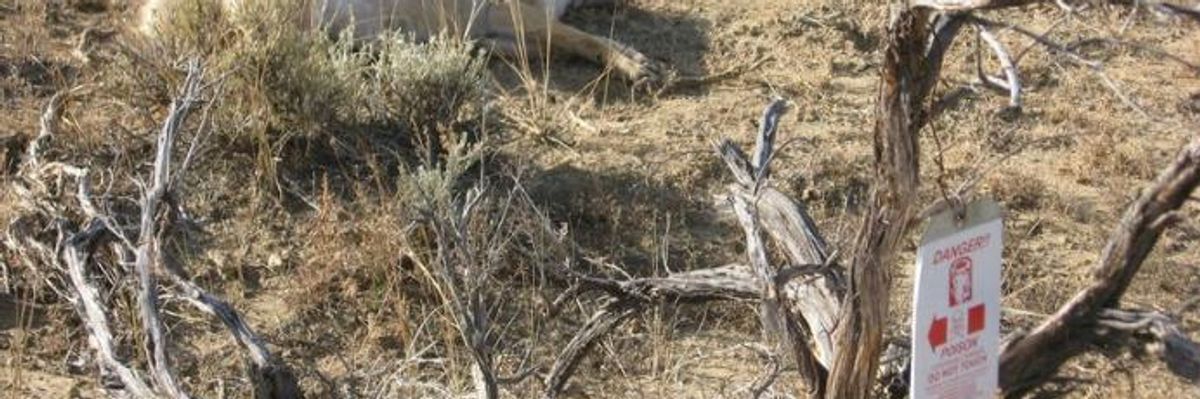
This image obtained through a FOIA request by the Center for Biological Diversity shows a dead wolf or coyote near a poison sign in New Mexico.
Brushing off overwhelming public opposition, the Trump administration this week re-approved the use of so-called "cyanide bombs" to kill wild animals on public lands.
Known officially as M-44s, the devices "can't be used safely by anyone, anywhere," said Collette Adkins, carnivore conservation director at the Center for Biological Diversity, noting that they claim the lives of target animals like coyotes as well as non-target animals including foxes, bears, and family pets.
The announcement was posted in the Federal Register, authorizing their use on "an interim basis--until a final decision can be made in 2021," as Newsweek reported. It authorizes their use by Wildlife Services, a program of the U.S. Department of Agriculture, and by state agencies in South Dakota, Montana, Wyoming, New Mexico, and Texas, said the Center for Biological Diversity.
Wildlife Services--which has been in the crosshairs of animal welfare and conservation groups--says its mission is "to resolve wildlife conflicts to allow people and wildlife to coexist." However, critics like the Humane Society say (pdf) it "has shown a preference for lethal methods in resolving conflicts" and has been "exterminating wildlife as a government subsidy for private ranchers and other special interests, using inhumane and ineffective methods, while the U.S. taxpayers foot a large share of the bill."
Agence France-Presse reported:
The devices, known as M-44s, which are implanted in the ground and resemble lawn sprinklers, use a spring-loaded ejector to release sodium cyanide when an animal tugs on its baited capsule holder.
The government halted the use of the devices last year after one of them was responsible for injuring a boy and killing his dog in Idaho.
BBC News added:
But the EPA has decided they are still safe for use, after support from rancher groups and "stakeholders" including farmers groups.
It said that the cyanide bombs stopped predators from killing livestock and that a ban would result in farmers losing money.
The Center for Biological Diversity, in a tweet, called M-44s "horrific death traps."
When the EPA earlier this year proposed their reinstatement, the Center for Biological Diversity and Western Environmental Law Center analyzed a batch of over 22,000 public comments.
Public sentiment was clear, said the groups, as 99.9 percent of people supported a ban on the cyanide bombs.
The conservation groups also pointed to Wildlife Services' own data showing that out of the nearly 6,600 animals it killed in 2018, over 200 were non-target animals--a death toll they say is likely an under-count.
"EPA is blatantly ignoring its fundamental duty to protect the public, our pets, and native wildlife from the cruel, lethal impacts of cyanide bombs lurking on our public lands," said Kelly Nokes, a wildlife attorney with the Western Environmental Law Center.
The EPA did add restrictions--including increasing the amount of space between a public roadway and the devices, and the distance between warning signs and the cyanide bombs--but those changes did little to assuage conservation groups' concerns.
"Tightening up use restrictions is turning a blind eye to the reality of M-44s," said Brooks Fahy, executive director of Predator Defense.
"In my 25 years working with M-44 victims I've learned that Wildlife Services' agents frequently do not follow the use restrictions. And warning signs will not prevent more dogs, wild animals, and potentially children from being killed," he continued. "They cannot read them."
"M-44s are a safety menace," said Fahy, "and must be banned."
Dear Common Dreams reader, It’s been nearly 30 years since I co-founded Common Dreams with my late wife, Lina Newhouser. We had the radical notion that journalism should serve the public good, not corporate profits. It was clear to us from the outset what it would take to build such a project. No paid advertisements. No corporate sponsors. No millionaire publisher telling us what to think or do. Many people said we wouldn't last a year, but we proved those doubters wrong. Together with a tremendous team of journalists and dedicated staff, we built an independent media outlet free from the constraints of profits and corporate control. Our mission has always been simple: To inform. To inspire. To ignite change for the common good. Building Common Dreams was not easy. Our survival was never guaranteed. When you take on the most powerful forces—Wall Street greed, fossil fuel industry destruction, Big Tech lobbyists, and uber-rich oligarchs who have spent billions upon billions rigging the economy and democracy in their favor—the only bulwark you have is supporters who believe in your work. But here’s the urgent message from me today. It's never been this bad out there. And it's never been this hard to keep us going. At the very moment Common Dreams is most needed, the threats we face are intensifying. We need your support now more than ever. We don't accept corporate advertising and never will. We don't have a paywall because we don't think people should be blocked from critical news based on their ability to pay. Everything we do is funded by the donations of readers like you. When everyone does the little they can afford, we are strong. But if that support retreats or dries up, so do we. Will you donate now to make sure Common Dreams not only survives but thrives? —Craig Brown, Co-founder |
Brushing off overwhelming public opposition, the Trump administration this week re-approved the use of so-called "cyanide bombs" to kill wild animals on public lands.
Known officially as M-44s, the devices "can't be used safely by anyone, anywhere," said Collette Adkins, carnivore conservation director at the Center for Biological Diversity, noting that they claim the lives of target animals like coyotes as well as non-target animals including foxes, bears, and family pets.
The announcement was posted in the Federal Register, authorizing their use on "an interim basis--until a final decision can be made in 2021," as Newsweek reported. It authorizes their use by Wildlife Services, a program of the U.S. Department of Agriculture, and by state agencies in South Dakota, Montana, Wyoming, New Mexico, and Texas, said the Center for Biological Diversity.
Wildlife Services--which has been in the crosshairs of animal welfare and conservation groups--says its mission is "to resolve wildlife conflicts to allow people and wildlife to coexist." However, critics like the Humane Society say (pdf) it "has shown a preference for lethal methods in resolving conflicts" and has been "exterminating wildlife as a government subsidy for private ranchers and other special interests, using inhumane and ineffective methods, while the U.S. taxpayers foot a large share of the bill."
Agence France-Presse reported:
The devices, known as M-44s, which are implanted in the ground and resemble lawn sprinklers, use a spring-loaded ejector to release sodium cyanide when an animal tugs on its baited capsule holder.
The government halted the use of the devices last year after one of them was responsible for injuring a boy and killing his dog in Idaho.
BBC News added:
But the EPA has decided they are still safe for use, after support from rancher groups and "stakeholders" including farmers groups.
It said that the cyanide bombs stopped predators from killing livestock and that a ban would result in farmers losing money.
The Center for Biological Diversity, in a tweet, called M-44s "horrific death traps."
When the EPA earlier this year proposed their reinstatement, the Center for Biological Diversity and Western Environmental Law Center analyzed a batch of over 22,000 public comments.
Public sentiment was clear, said the groups, as 99.9 percent of people supported a ban on the cyanide bombs.
The conservation groups also pointed to Wildlife Services' own data showing that out of the nearly 6,600 animals it killed in 2018, over 200 were non-target animals--a death toll they say is likely an under-count.
"EPA is blatantly ignoring its fundamental duty to protect the public, our pets, and native wildlife from the cruel, lethal impacts of cyanide bombs lurking on our public lands," said Kelly Nokes, a wildlife attorney with the Western Environmental Law Center.
The EPA did add restrictions--including increasing the amount of space between a public roadway and the devices, and the distance between warning signs and the cyanide bombs--but those changes did little to assuage conservation groups' concerns.
"Tightening up use restrictions is turning a blind eye to the reality of M-44s," said Brooks Fahy, executive director of Predator Defense.
"In my 25 years working with M-44 victims I've learned that Wildlife Services' agents frequently do not follow the use restrictions. And warning signs will not prevent more dogs, wild animals, and potentially children from being killed," he continued. "They cannot read them."
"M-44s are a safety menace," said Fahy, "and must be banned."
Brushing off overwhelming public opposition, the Trump administration this week re-approved the use of so-called "cyanide bombs" to kill wild animals on public lands.
Known officially as M-44s, the devices "can't be used safely by anyone, anywhere," said Collette Adkins, carnivore conservation director at the Center for Biological Diversity, noting that they claim the lives of target animals like coyotes as well as non-target animals including foxes, bears, and family pets.
The announcement was posted in the Federal Register, authorizing their use on "an interim basis--until a final decision can be made in 2021," as Newsweek reported. It authorizes their use by Wildlife Services, a program of the U.S. Department of Agriculture, and by state agencies in South Dakota, Montana, Wyoming, New Mexico, and Texas, said the Center for Biological Diversity.
Wildlife Services--which has been in the crosshairs of animal welfare and conservation groups--says its mission is "to resolve wildlife conflicts to allow people and wildlife to coexist." However, critics like the Humane Society say (pdf) it "has shown a preference for lethal methods in resolving conflicts" and has been "exterminating wildlife as a government subsidy for private ranchers and other special interests, using inhumane and ineffective methods, while the U.S. taxpayers foot a large share of the bill."
Agence France-Presse reported:
The devices, known as M-44s, which are implanted in the ground and resemble lawn sprinklers, use a spring-loaded ejector to release sodium cyanide when an animal tugs on its baited capsule holder.
The government halted the use of the devices last year after one of them was responsible for injuring a boy and killing his dog in Idaho.
BBC News added:
But the EPA has decided they are still safe for use, after support from rancher groups and "stakeholders" including farmers groups.
It said that the cyanide bombs stopped predators from killing livestock and that a ban would result in farmers losing money.
The Center for Biological Diversity, in a tweet, called M-44s "horrific death traps."
When the EPA earlier this year proposed their reinstatement, the Center for Biological Diversity and Western Environmental Law Center analyzed a batch of over 22,000 public comments.
Public sentiment was clear, said the groups, as 99.9 percent of people supported a ban on the cyanide bombs.
The conservation groups also pointed to Wildlife Services' own data showing that out of the nearly 6,600 animals it killed in 2018, over 200 were non-target animals--a death toll they say is likely an under-count.
"EPA is blatantly ignoring its fundamental duty to protect the public, our pets, and native wildlife from the cruel, lethal impacts of cyanide bombs lurking on our public lands," said Kelly Nokes, a wildlife attorney with the Western Environmental Law Center.
The EPA did add restrictions--including increasing the amount of space between a public roadway and the devices, and the distance between warning signs and the cyanide bombs--but those changes did little to assuage conservation groups' concerns.
"Tightening up use restrictions is turning a blind eye to the reality of M-44s," said Brooks Fahy, executive director of Predator Defense.
"In my 25 years working with M-44 victims I've learned that Wildlife Services' agents frequently do not follow the use restrictions. And warning signs will not prevent more dogs, wild animals, and potentially children from being killed," he continued. "They cannot read them."
"M-44s are a safety menace," said Fahy, "and must be banned."