

SUBSCRIBE TO OUR FREE NEWSLETTER
Daily news & progressive opinion—funded by the people, not the corporations—delivered straight to your inbox.
5
#000000
#FFFFFF
To donate by check, phone, or other method, see our More Ways to Give page.
Daily news & progressive opinion—funded by the people, not the corporations—delivered straight to your inbox.
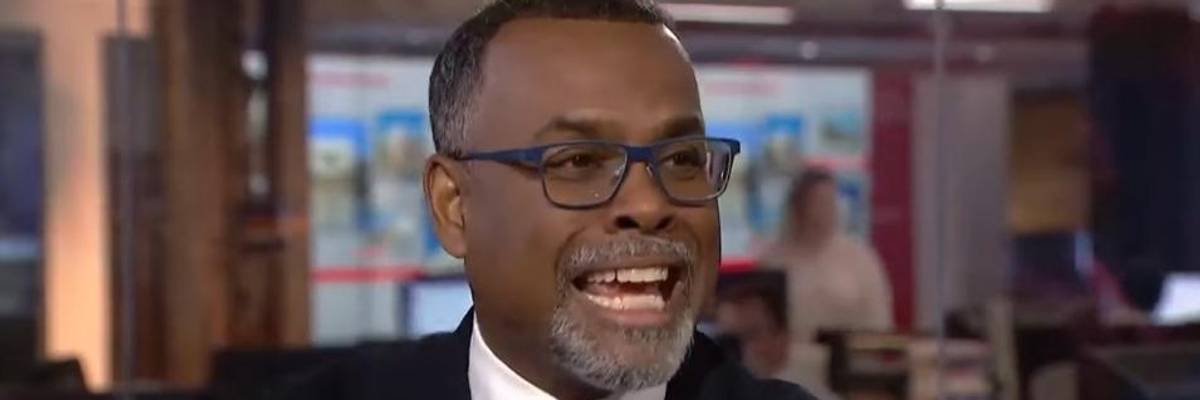
Eddie Glaude, a Princeton University professor and MSNBC contributor, said Monday night that while Trump's own racism cannot be ignored, the fact of the matter is that the president is "a manifestation of the ugliness" that pervades the nation. (Photo: Screenshot/MSNBC)
Princeton University professor Eddie Glaude received praise overnight for comments made on MSNBC Monday as he called on the American people to acknowledge that while blaming President Donald Trump might be easy to do--especially given the available evidence--for the racist-inspired massacre at a Wal-Mart in El Paso, Texas over the weekend it cannot be ignored that hatred and violence behind the attack is something deeply woven into the fabric of the country's politics and culture.
"America's not unique in its sins as a country," Glaude said. "We're not unique in our evils, to be honest with you. I think where we may be singular is our refusal to acknowledge them--and the legends and myths we tell about our inherent goodness to hide and cover and conceal so we can maintain a kind of willful ignorance that protects our innocence."
Rep. Alexandria Ocasio-Cortez (D-NY) was among those applauding the "must-watch" remarks, calling Glaude's statement "incredibly powerful."
Watch:
Reminding viewers of the rise of the racist right-wing Tea Party during the Obama administration--and highlighting how social scientists even at the time were warning that the phenomenon was fueled not just by "economic populism" but the "ugly underbelly of the country"--Glaude explained that the massacre in El Paso, in which parents "broke the bones" of their own baby "trying to shield him from being killed" by a racist gunman, is just the latest example of in which Americans are strangely forced to asked the question, "Oh my God, is this who we are?"
"What we know," Glaude continued, "is that this country has been playing politics for a long time on this hatred--we know this. So it's easy for us to place it all on Donald Trump's shoulders. It's easy to place Pittsburgh on his shoulders. It's easy for me to place Charlottesville on his shoulders. It's easy to place El Paso on his shoulders." But he then sharply added, clapping his hands: "This is us!"
"And if we're gonna get past this," he continued with emotion in his voice, "we can't blame it on [Trump]. He's a manifestation of the ugliness that's in us."
Author and activist Trita Parsi urged people to watch the segment until the very end. "Then watch it again," he said. "Then again. And again. Until it clicks."
Dear Common Dreams reader, It’s been nearly 30 years since I co-founded Common Dreams with my late wife, Lina Newhouser. We had the radical notion that journalism should serve the public good, not corporate profits. It was clear to us from the outset what it would take to build such a project. No paid advertisements. No corporate sponsors. No millionaire publisher telling us what to think or do. Many people said we wouldn't last a year, but we proved those doubters wrong. Together with a tremendous team of journalists and dedicated staff, we built an independent media outlet free from the constraints of profits and corporate control. Our mission has always been simple: To inform. To inspire. To ignite change for the common good. Building Common Dreams was not easy. Our survival was never guaranteed. When you take on the most powerful forces—Wall Street greed, fossil fuel industry destruction, Big Tech lobbyists, and uber-rich oligarchs who have spent billions upon billions rigging the economy and democracy in their favor—the only bulwark you have is supporters who believe in your work. But here’s the urgent message from me today. It's never been this bad out there. And it's never been this hard to keep us going. At the very moment Common Dreams is most needed, the threats we face are intensifying. We need your support now more than ever. We don't accept corporate advertising and never will. We don't have a paywall because we don't think people should be blocked from critical news based on their ability to pay. Everything we do is funded by the donations of readers like you. When everyone does the little they can afford, we are strong. But if that support retreats or dries up, so do we. Will you donate now to make sure Common Dreams not only survives but thrives? —Craig Brown, Co-founder |
Princeton University professor Eddie Glaude received praise overnight for comments made on MSNBC Monday as he called on the American people to acknowledge that while blaming President Donald Trump might be easy to do--especially given the available evidence--for the racist-inspired massacre at a Wal-Mart in El Paso, Texas over the weekend it cannot be ignored that hatred and violence behind the attack is something deeply woven into the fabric of the country's politics and culture.
"America's not unique in its sins as a country," Glaude said. "We're not unique in our evils, to be honest with you. I think where we may be singular is our refusal to acknowledge them--and the legends and myths we tell about our inherent goodness to hide and cover and conceal so we can maintain a kind of willful ignorance that protects our innocence."
Rep. Alexandria Ocasio-Cortez (D-NY) was among those applauding the "must-watch" remarks, calling Glaude's statement "incredibly powerful."
Watch:
Reminding viewers of the rise of the racist right-wing Tea Party during the Obama administration--and highlighting how social scientists even at the time were warning that the phenomenon was fueled not just by "economic populism" but the "ugly underbelly of the country"--Glaude explained that the massacre in El Paso, in which parents "broke the bones" of their own baby "trying to shield him from being killed" by a racist gunman, is just the latest example of in which Americans are strangely forced to asked the question, "Oh my God, is this who we are?"
"What we know," Glaude continued, "is that this country has been playing politics for a long time on this hatred--we know this. So it's easy for us to place it all on Donald Trump's shoulders. It's easy to place Pittsburgh on his shoulders. It's easy for me to place Charlottesville on his shoulders. It's easy to place El Paso on his shoulders." But he then sharply added, clapping his hands: "This is us!"
"And if we're gonna get past this," he continued with emotion in his voice, "we can't blame it on [Trump]. He's a manifestation of the ugliness that's in us."
Author and activist Trita Parsi urged people to watch the segment until the very end. "Then watch it again," he said. "Then again. And again. Until it clicks."
Princeton University professor Eddie Glaude received praise overnight for comments made on MSNBC Monday as he called on the American people to acknowledge that while blaming President Donald Trump might be easy to do--especially given the available evidence--for the racist-inspired massacre at a Wal-Mart in El Paso, Texas over the weekend it cannot be ignored that hatred and violence behind the attack is something deeply woven into the fabric of the country's politics and culture.
"America's not unique in its sins as a country," Glaude said. "We're not unique in our evils, to be honest with you. I think where we may be singular is our refusal to acknowledge them--and the legends and myths we tell about our inherent goodness to hide and cover and conceal so we can maintain a kind of willful ignorance that protects our innocence."
Rep. Alexandria Ocasio-Cortez (D-NY) was among those applauding the "must-watch" remarks, calling Glaude's statement "incredibly powerful."
Watch:
Reminding viewers of the rise of the racist right-wing Tea Party during the Obama administration--and highlighting how social scientists even at the time were warning that the phenomenon was fueled not just by "economic populism" but the "ugly underbelly of the country"--Glaude explained that the massacre in El Paso, in which parents "broke the bones" of their own baby "trying to shield him from being killed" by a racist gunman, is just the latest example of in which Americans are strangely forced to asked the question, "Oh my God, is this who we are?"
"What we know," Glaude continued, "is that this country has been playing politics for a long time on this hatred--we know this. So it's easy for us to place it all on Donald Trump's shoulders. It's easy to place Pittsburgh on his shoulders. It's easy for me to place Charlottesville on his shoulders. It's easy to place El Paso on his shoulders." But he then sharply added, clapping his hands: "This is us!"
"And if we're gonna get past this," he continued with emotion in his voice, "we can't blame it on [Trump]. He's a manifestation of the ugliness that's in us."
Author and activist Trita Parsi urged people to watch the segment until the very end. "Then watch it again," he said. "Then again. And again. Until it clicks."

