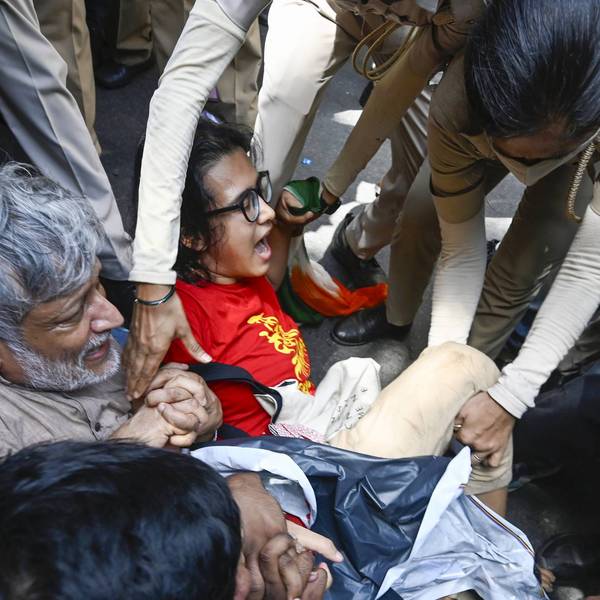
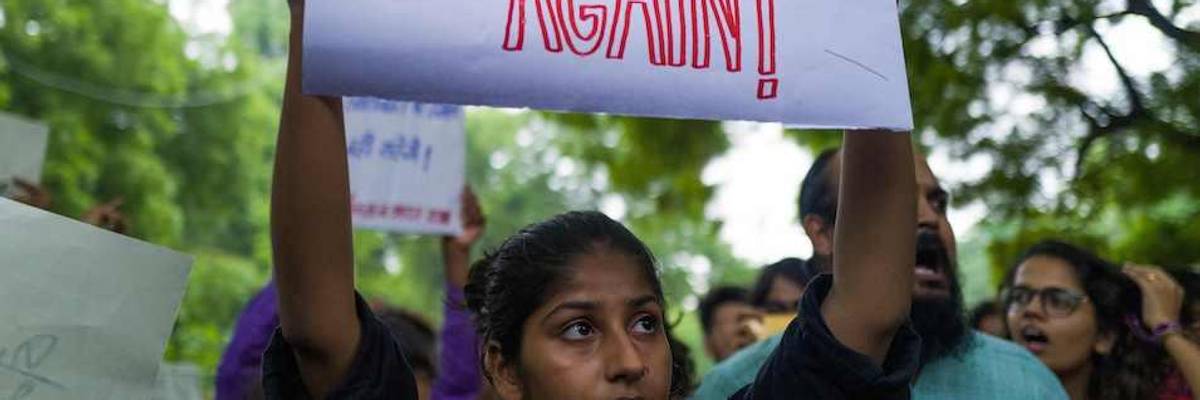
An activist and supporter of Indian left wing parties holds a placard during a demonstration to protest against the presidential decree abolishing Article 370 of the constitution giving special autonomy to Muslim-majority Kashmir, in New Delhi on August 5, 2019. (Photo: Jewel Samad/AFP/Getty Images)
India's Ruling Party Turning Kashmir 'Into a Black Hole,' Critics Claim, as Fears of Widespread Conflict Rise
"The government of India has cut its nose to spite its face."
After decades of an uneasy and sometimes violent power-sharing agreement with Pakistan over the region of Kashmir, India on Monday revoked Article 370 of its constitution that allowed that agreement, paving the way to annexing the region's Jammu and Kashmir territory.
The legislative move, which was driven by Home Minister Amit Shah, came after a weekend in which India cracked down on the territory by flooding the area with soldiers, imprisoning political leaders, and cutting off Kashmiris from internet and phone communications with the outside world.
"India has turned Kashmir into a black hole right now," tweeted Kashmiri activist Shehla Rashid. "With normal life thrown out of gear, no clarity on the situation, no advisory/communication for local people from the government, there's panic, speculation and rumor-mongering all around. Phones and internet are off."
In a tweet, human rights group Amnesty International condemned the Indian government's behavior.
"The unilateral decision by Government of India to revoke Jammu and Kashmir's special status without consulting Jammu and Kashmir stakeholders, amidst a clampdown on civil liberties and communications blackout," said the group, "is likely to increase the risk of further human rights violations and inflame tensions."
Activist Rashid told reporters she and her allies were ready to fight the move by India in the courts.
"We will challenge the presidential order in Supreme Court," said Rashid. "I am in touch with a team of lawyers and a few activists. We will find out the best legal way to fight it this. We hope we will get justice in the Supreme Court as we are in a strong position constitutionally and legally."
Lawmakers from India's extreme right-wing ruling Bharatiya Janata Party (BJP) were behind the parliamentary maneuver, which generated anger from the country's opposition parties.
"Today the BJP has murdered the Constitution of India," the Indian National Congress's Ghulam Nabi Azad said.
HuffPost India editor-in-chief Aman Sethi said in an opinion piece that he wasn't hopeful that the opposition could make much of a dent in the political situation:
It isn't hard to predict how the erasure of Kashmir will play out over the next few weeks. The government's gaggle of friendly news anchors have already begun dancing to their master's tunes. At some point, someone will hail this as a political masterstroke. Someone will find a way to blame the opposition.
Annexation of Jammu and Kashmir has long been a priority for the BJP and their Hindu nationalist allies; the revocation of Article 370 was a major part of the party's platform in its electoral victory earlier in 2019 which returned Prime Minister Narendra Modi to office for another term.
"Politically, it's advantage BJP," Jawaharlal Nehru University professor Happymon Jacob told Reuters.
But, Jacob added, that advantage will come with consequences for India and Kashmir.
"The scrapping of Article 370 of the constitution is likely to set off a slew of political, constitutional, and legal battles," Jacob said, "not to speak of the battles on the streets of Kashmir."
Pakistan rejected India's unilateral move on Monday. Members of political parties in the Muslim-majority country, which has fought two wars with India over the territory, made clear that it would not accept its neighbor's declaration of sovereignty over the territory and was prepared to push back.
"The people of Kashmir cannot be left alone at this moment," said Pakistan Muslim League-Nawaz president Shahbaz Sharif. "We will go to every extent to defend the human rights and legal rights of Kashmiris."
Both Pakistan and India are nuclear armed countries, making any conflict potentially catastrophic for the rest of the world.
In a tweet, Pakistani Prime Minister Imran Khan recalled that U.S. President Donald Trump offered to mediate the situation in Kashmir during their Washington meeting in July. Khan said he welcomed the opportunity to avoid bloodshed.
"President Trump offered to mediate on Kashmir," said Khan. "This is the time to do so as situation deteriorates there and along the [Line of Control] with new aggressive actions being taken by Indian occupation forces. This has the potential to blow up into a regional crisis."
In video commentary, Pakistani journalist Omar Quraishi said that the BJP's move was tied to Trump and Khan's meeting.
"The government of India has cut its nose to spite its face," said Quraishi.
We are at a crossroads
This country and this world are at a monumental crossroads. In a few short weeks, US voters will have an opportunity to beat back the forces of fascism and confront the billionaires who are rigging the economy, our media system, and our democracy, making it increasingly impossible for ordinary people to get by. We’re not just talking about the election. We’re talking about what must be done once these fascist elements are vanquished from power. We need a bolder set of solutions than what either major party has so far been willing to offer and a working-class movement ready to fight like hell for it. Trump didn't emerge from nowhere. The conditions that fueled MAGA authoritarianism were created by decades of radical neoliberal economic policies and a corrupt political system dominated by corporate interests. They slashed taxes on the super-rich, promising that the benefits would trickle down. They said giveaways to the corporate titans would make life more affordable for the rest of us. It was all bullshit. And when a bitter, betrayed populace searches for someone to blame, right-wing demagogues have little trouble finding scapegoats. People know when they're being lied to, but you won't hear any of this from the corporate media. Only independent journalism—powered and funded by people who believe in building a better world—can deliver truly trustworthy daily news. Our Fall Campaign is underway, and we need your help. To power our newsroom through the rest of the year, we need to raise $125,000 by midnight on October 31. So if you share our vision, please contribute whatever you can to sustain our work. |
After decades of an uneasy and sometimes violent power-sharing agreement with Pakistan over the region of Kashmir, India on Monday revoked Article 370 of its constitution that allowed that agreement, paving the way to annexing the region's Jammu and Kashmir territory.
The legislative move, which was driven by Home Minister Amit Shah, came after a weekend in which India cracked down on the territory by flooding the area with soldiers, imprisoning political leaders, and cutting off Kashmiris from internet and phone communications with the outside world.
"India has turned Kashmir into a black hole right now," tweeted Kashmiri activist Shehla Rashid. "With normal life thrown out of gear, no clarity on the situation, no advisory/communication for local people from the government, there's panic, speculation and rumor-mongering all around. Phones and internet are off."
In a tweet, human rights group Amnesty International condemned the Indian government's behavior.
"The unilateral decision by Government of India to revoke Jammu and Kashmir's special status without consulting Jammu and Kashmir stakeholders, amidst a clampdown on civil liberties and communications blackout," said the group, "is likely to increase the risk of further human rights violations and inflame tensions."
Activist Rashid told reporters she and her allies were ready to fight the move by India in the courts.
"We will challenge the presidential order in Supreme Court," said Rashid. "I am in touch with a team of lawyers and a few activists. We will find out the best legal way to fight it this. We hope we will get justice in the Supreme Court as we are in a strong position constitutionally and legally."
Lawmakers from India's extreme right-wing ruling Bharatiya Janata Party (BJP) were behind the parliamentary maneuver, which generated anger from the country's opposition parties.
"Today the BJP has murdered the Constitution of India," the Indian National Congress's Ghulam Nabi Azad said.
HuffPost India editor-in-chief Aman Sethi said in an opinion piece that he wasn't hopeful that the opposition could make much of a dent in the political situation:
It isn't hard to predict how the erasure of Kashmir will play out over the next few weeks. The government's gaggle of friendly news anchors have already begun dancing to their master's tunes. At some point, someone will hail this as a political masterstroke. Someone will find a way to blame the opposition.
Annexation of Jammu and Kashmir has long been a priority for the BJP and their Hindu nationalist allies; the revocation of Article 370 was a major part of the party's platform in its electoral victory earlier in 2019 which returned Prime Minister Narendra Modi to office for another term.
"Politically, it's advantage BJP," Jawaharlal Nehru University professor Happymon Jacob told Reuters.
But, Jacob added, that advantage will come with consequences for India and Kashmir.
"The scrapping of Article 370 of the constitution is likely to set off a slew of political, constitutional, and legal battles," Jacob said, "not to speak of the battles on the streets of Kashmir."
Pakistan rejected India's unilateral move on Monday. Members of political parties in the Muslim-majority country, which has fought two wars with India over the territory, made clear that it would not accept its neighbor's declaration of sovereignty over the territory and was prepared to push back.
"The people of Kashmir cannot be left alone at this moment," said Pakistan Muslim League-Nawaz president Shahbaz Sharif. "We will go to every extent to defend the human rights and legal rights of Kashmiris."
Both Pakistan and India are nuclear armed countries, making any conflict potentially catastrophic for the rest of the world.
In a tweet, Pakistani Prime Minister Imran Khan recalled that U.S. President Donald Trump offered to mediate the situation in Kashmir during their Washington meeting in July. Khan said he welcomed the opportunity to avoid bloodshed.
"President Trump offered to mediate on Kashmir," said Khan. "This is the time to do so as situation deteriorates there and along the [Line of Control] with new aggressive actions being taken by Indian occupation forces. This has the potential to blow up into a regional crisis."
In video commentary, Pakistani journalist Omar Quraishi said that the BJP's move was tied to Trump and Khan's meeting.
"The government of India has cut its nose to spite its face," said Quraishi.
After decades of an uneasy and sometimes violent power-sharing agreement with Pakistan over the region of Kashmir, India on Monday revoked Article 370 of its constitution that allowed that agreement, paving the way to annexing the region's Jammu and Kashmir territory.
The legislative move, which was driven by Home Minister Amit Shah, came after a weekend in which India cracked down on the territory by flooding the area with soldiers, imprisoning political leaders, and cutting off Kashmiris from internet and phone communications with the outside world.
"India has turned Kashmir into a black hole right now," tweeted Kashmiri activist Shehla Rashid. "With normal life thrown out of gear, no clarity on the situation, no advisory/communication for local people from the government, there's panic, speculation and rumor-mongering all around. Phones and internet are off."
In a tweet, human rights group Amnesty International condemned the Indian government's behavior.
"The unilateral decision by Government of India to revoke Jammu and Kashmir's special status without consulting Jammu and Kashmir stakeholders, amidst a clampdown on civil liberties and communications blackout," said the group, "is likely to increase the risk of further human rights violations and inflame tensions."
Activist Rashid told reporters she and her allies were ready to fight the move by India in the courts.
"We will challenge the presidential order in Supreme Court," said Rashid. "I am in touch with a team of lawyers and a few activists. We will find out the best legal way to fight it this. We hope we will get justice in the Supreme Court as we are in a strong position constitutionally and legally."
Lawmakers from India's extreme right-wing ruling Bharatiya Janata Party (BJP) were behind the parliamentary maneuver, which generated anger from the country's opposition parties.
"Today the BJP has murdered the Constitution of India," the Indian National Congress's Ghulam Nabi Azad said.
HuffPost India editor-in-chief Aman Sethi said in an opinion piece that he wasn't hopeful that the opposition could make much of a dent in the political situation:
It isn't hard to predict how the erasure of Kashmir will play out over the next few weeks. The government's gaggle of friendly news anchors have already begun dancing to their master's tunes. At some point, someone will hail this as a political masterstroke. Someone will find a way to blame the opposition.
Annexation of Jammu and Kashmir has long been a priority for the BJP and their Hindu nationalist allies; the revocation of Article 370 was a major part of the party's platform in its electoral victory earlier in 2019 which returned Prime Minister Narendra Modi to office for another term.
"Politically, it's advantage BJP," Jawaharlal Nehru University professor Happymon Jacob told Reuters.
But, Jacob added, that advantage will come with consequences for India and Kashmir.
"The scrapping of Article 370 of the constitution is likely to set off a slew of political, constitutional, and legal battles," Jacob said, "not to speak of the battles on the streets of Kashmir."
Pakistan rejected India's unilateral move on Monday. Members of political parties in the Muslim-majority country, which has fought two wars with India over the territory, made clear that it would not accept its neighbor's declaration of sovereignty over the territory and was prepared to push back.
"The people of Kashmir cannot be left alone at this moment," said Pakistan Muslim League-Nawaz president Shahbaz Sharif. "We will go to every extent to defend the human rights and legal rights of Kashmiris."
Both Pakistan and India are nuclear armed countries, making any conflict potentially catastrophic for the rest of the world.
In a tweet, Pakistani Prime Minister Imran Khan recalled that U.S. President Donald Trump offered to mediate the situation in Kashmir during their Washington meeting in July. Khan said he welcomed the opportunity to avoid bloodshed.
"President Trump offered to mediate on Kashmir," said Khan. "This is the time to do so as situation deteriorates there and along the [Line of Control] with new aggressive actions being taken by Indian occupation forces. This has the potential to blow up into a regional crisis."
In video commentary, Pakistani journalist Omar Quraishi said that the BJP's move was tied to Trump and Khan's meeting.
"The government of India has cut its nose to spite its face," said Quraishi.