SUBSCRIBE TO OUR FREE NEWSLETTER
Daily news & progressive opinion—funded by the people, not the corporations—delivered straight to your inbox.
5
#000000
#FFFFFF
To donate by check, phone, or other method, see our More Ways to Give page.
Daily news & progressive opinion—funded by the people, not the corporations—delivered straight to your inbox.
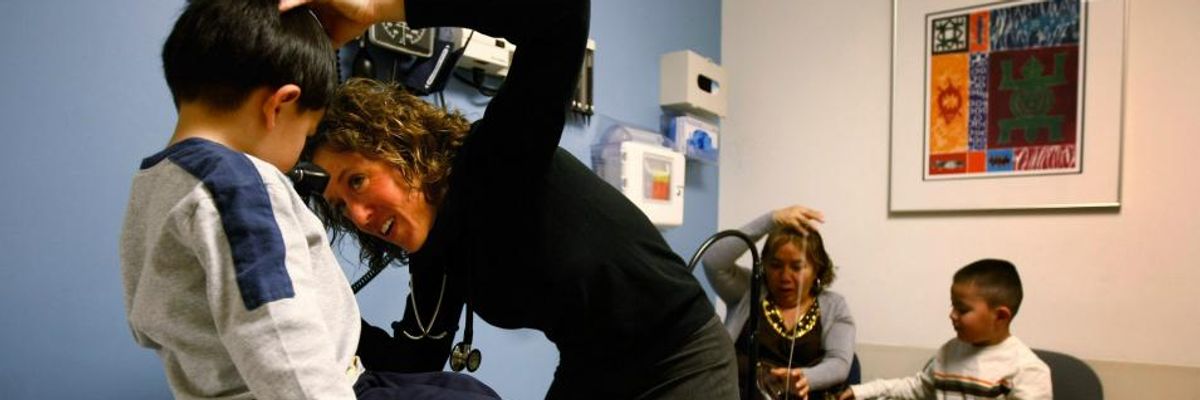
Physician's assistant Erin Frazier checks a young boy at a community health center for low-income patients on December 1, 2009 in Lakewood, Colorado. (Photo: John Moore/Getty Images)
Progressive members of Congress are raising alarm and publicly calling out Democratic colleagues who are pushing legislation that would significantly cut funding to community health centers, which currently provide essential care to around 30 million primarily poor and rural Americans.
As the Washington Post's Jeff Stein reported Wednesday, Rep. Frank Pallone Jr. (D-N.J.) is advancing a bipartisan measure that "would provide flat levels of federal funding for hundreds of community health centers nationwide, at about $4 billion for the next four years."
"We should be substantially increasing funding. I was very, very disappointed by Democratic leadership. We will do everything we can to rectify this."
--Sen. Bernie Sanders
Pallone denied that his bill calls for cuts, but progressives warned that because "flat" funding would not keep up with inflation, Pallone's bill would lead to lower budgets for health clinics across the nation.
"The plan backed by Pallone, while better than letting the funding expire altogether, would amount to a nearly 20 percent funding reduction over four years for the clinics, almost certainly cutting the amount of medical, vision, dental, and mental healthcare they can provide primarily low-income Americans," Stein reported, citing Sara Rosenbaum, a health expert at George Washington University.
Sen. Bernie Sanders (I-Vt.), who has played a major role in securing and expanding funding for community health centers over the past decade, expressed outrage that Democrats would pursue legislation that could jeopardize healthcare for millions of low-income Americans.
"I was, quite honestly, stunned. It's just absolutely disastrous, and moving in the wrong direction," Sanders, a 2020 Democratic presidential candidate, said of Pallone's bill in an interview with the Post. "We should be substantially increasing funding. I was very, very disappointed by Democratic leadership... We will do everything we can to rectify this."
Warren Gunnels, Sanders's staff director, echoed the senator's concerns in a series of tweets late Wednesday, saying Pallone's legislation could deny healthcare to more than three million people annually.
"The idea that the House would consider denying primary healthcare to over three million Americans through a 20 percent real cut to community health centers after 'finding' $733 billion in defense funding for the most dangerous president in our history should sicken and disgust every American," Gunnels wrote, referring to the House's passage of the 2020 National Defense Authorization Act last week. Just eight Democrats voted no.
Reps. Pramila Jayapal (D-Wash.), Ro Khanna (D-Calif.), and Alexandria Ocasio-Cortez (D-N.Y.) echoed the Sanders team's criticism of Pallone's legislation, which is similar to a bill Sens. Patty Murray (D-Wash.) and Lamar Alexander (R-Tenn.) are pushing in the Senate.
The funding dispute, Stein reported, "could have significant consequences for the nearly 30 million people nationwide who rely on the community health clinics, which serve poor people and those without sufficient access to medical care, including in rural areas."
Khanna warned in a statement to the Post that Pallone's bill--which easily passed out of the House Energy and Commerce Committee on Wednesday--could kick "three million low-income Americans off their care" entirely.
"If Democrats were serious about protecting every American's right to healthcare," Khanna tweeted, "this plan wouldn't even be on the table."
Ocasio-Cortez told the Post that House Democrats should be using their majority to negotiate a compromise bill with the Republican-controlled Senate from a position of strength, not calling for reduced funding from the jump.
"I want us to use our majority to fight for these families--not allow a 20 percent cut," said the New York Democrat.
As Stein reported, "Lawmakers face a September deadline for the community health centers, after which their funding would begin to expire, likely leading to steep cuts."
Instead of Pallone's legislation, Gunnels said House Democrats should line up behind a bill introduced in March by Sanders and House Majority Whip Jim Clyburn (D-S.C.), which would expand funding for community health centers and provide care to over five million more Americans.
"The good news," tweeted Gunnels, "is that there's still time for the House to pass a bill by Sen. Sanders and Rep. Clyburn to expand, not cut, community health centers and provide primary healthcare to 5.4 million more Americans."
"This isn't a hard call," Gunnels added, "but we'll need to fight like hell to get it done."
Dear Common Dreams reader, It’s been nearly 30 years since I co-founded Common Dreams with my late wife, Lina Newhouser. We had the radical notion that journalism should serve the public good, not corporate profits. It was clear to us from the outset what it would take to build such a project. No paid advertisements. No corporate sponsors. No millionaire publisher telling us what to think or do. Many people said we wouldn't last a year, but we proved those doubters wrong. Together with a tremendous team of journalists and dedicated staff, we built an independent media outlet free from the constraints of profits and corporate control. Our mission has always been simple: To inform. To inspire. To ignite change for the common good. Building Common Dreams was not easy. Our survival was never guaranteed. When you take on the most powerful forces—Wall Street greed, fossil fuel industry destruction, Big Tech lobbyists, and uber-rich oligarchs who have spent billions upon billions rigging the economy and democracy in their favor—the only bulwark you have is supporters who believe in your work. But here’s the urgent message from me today. It's never been this bad out there. And it's never been this hard to keep us going. At the very moment Common Dreams is most needed, the threats we face are intensifying. We need your support now more than ever. We don't accept corporate advertising and never will. We don't have a paywall because we don't think people should be blocked from critical news based on their ability to pay. Everything we do is funded by the donations of readers like you. When everyone does the little they can afford, we are strong. But if that support retreats or dries up, so do we. Will you donate now to make sure Common Dreams not only survives but thrives? —Craig Brown, Co-founder |
Progressive members of Congress are raising alarm and publicly calling out Democratic colleagues who are pushing legislation that would significantly cut funding to community health centers, which currently provide essential care to around 30 million primarily poor and rural Americans.
As the Washington Post's Jeff Stein reported Wednesday, Rep. Frank Pallone Jr. (D-N.J.) is advancing a bipartisan measure that "would provide flat levels of federal funding for hundreds of community health centers nationwide, at about $4 billion for the next four years."
"We should be substantially increasing funding. I was very, very disappointed by Democratic leadership. We will do everything we can to rectify this."
--Sen. Bernie Sanders
Pallone denied that his bill calls for cuts, but progressives warned that because "flat" funding would not keep up with inflation, Pallone's bill would lead to lower budgets for health clinics across the nation.
"The plan backed by Pallone, while better than letting the funding expire altogether, would amount to a nearly 20 percent funding reduction over four years for the clinics, almost certainly cutting the amount of medical, vision, dental, and mental healthcare they can provide primarily low-income Americans," Stein reported, citing Sara Rosenbaum, a health expert at George Washington University.
Sen. Bernie Sanders (I-Vt.), who has played a major role in securing and expanding funding for community health centers over the past decade, expressed outrage that Democrats would pursue legislation that could jeopardize healthcare for millions of low-income Americans.
"I was, quite honestly, stunned. It's just absolutely disastrous, and moving in the wrong direction," Sanders, a 2020 Democratic presidential candidate, said of Pallone's bill in an interview with the Post. "We should be substantially increasing funding. I was very, very disappointed by Democratic leadership... We will do everything we can to rectify this."
Warren Gunnels, Sanders's staff director, echoed the senator's concerns in a series of tweets late Wednesday, saying Pallone's legislation could deny healthcare to more than three million people annually.
"The idea that the House would consider denying primary healthcare to over three million Americans through a 20 percent real cut to community health centers after 'finding' $733 billion in defense funding for the most dangerous president in our history should sicken and disgust every American," Gunnels wrote, referring to the House's passage of the 2020 National Defense Authorization Act last week. Just eight Democrats voted no.
Reps. Pramila Jayapal (D-Wash.), Ro Khanna (D-Calif.), and Alexandria Ocasio-Cortez (D-N.Y.) echoed the Sanders team's criticism of Pallone's legislation, which is similar to a bill Sens. Patty Murray (D-Wash.) and Lamar Alexander (R-Tenn.) are pushing in the Senate.
The funding dispute, Stein reported, "could have significant consequences for the nearly 30 million people nationwide who rely on the community health clinics, which serve poor people and those without sufficient access to medical care, including in rural areas."
Khanna warned in a statement to the Post that Pallone's bill--which easily passed out of the House Energy and Commerce Committee on Wednesday--could kick "three million low-income Americans off their care" entirely.
"If Democrats were serious about protecting every American's right to healthcare," Khanna tweeted, "this plan wouldn't even be on the table."
Ocasio-Cortez told the Post that House Democrats should be using their majority to negotiate a compromise bill with the Republican-controlled Senate from a position of strength, not calling for reduced funding from the jump.
"I want us to use our majority to fight for these families--not allow a 20 percent cut," said the New York Democrat.
As Stein reported, "Lawmakers face a September deadline for the community health centers, after which their funding would begin to expire, likely leading to steep cuts."
Instead of Pallone's legislation, Gunnels said House Democrats should line up behind a bill introduced in March by Sanders and House Majority Whip Jim Clyburn (D-S.C.), which would expand funding for community health centers and provide care to over five million more Americans.
"The good news," tweeted Gunnels, "is that there's still time for the House to pass a bill by Sen. Sanders and Rep. Clyburn to expand, not cut, community health centers and provide primary healthcare to 5.4 million more Americans."
"This isn't a hard call," Gunnels added, "but we'll need to fight like hell to get it done."
Progressive members of Congress are raising alarm and publicly calling out Democratic colleagues who are pushing legislation that would significantly cut funding to community health centers, which currently provide essential care to around 30 million primarily poor and rural Americans.
As the Washington Post's Jeff Stein reported Wednesday, Rep. Frank Pallone Jr. (D-N.J.) is advancing a bipartisan measure that "would provide flat levels of federal funding for hundreds of community health centers nationwide, at about $4 billion for the next four years."
"We should be substantially increasing funding. I was very, very disappointed by Democratic leadership. We will do everything we can to rectify this."
--Sen. Bernie Sanders
Pallone denied that his bill calls for cuts, but progressives warned that because "flat" funding would not keep up with inflation, Pallone's bill would lead to lower budgets for health clinics across the nation.
"The plan backed by Pallone, while better than letting the funding expire altogether, would amount to a nearly 20 percent funding reduction over four years for the clinics, almost certainly cutting the amount of medical, vision, dental, and mental healthcare they can provide primarily low-income Americans," Stein reported, citing Sara Rosenbaum, a health expert at George Washington University.
Sen. Bernie Sanders (I-Vt.), who has played a major role in securing and expanding funding for community health centers over the past decade, expressed outrage that Democrats would pursue legislation that could jeopardize healthcare for millions of low-income Americans.
"I was, quite honestly, stunned. It's just absolutely disastrous, and moving in the wrong direction," Sanders, a 2020 Democratic presidential candidate, said of Pallone's bill in an interview with the Post. "We should be substantially increasing funding. I was very, very disappointed by Democratic leadership... We will do everything we can to rectify this."
Warren Gunnels, Sanders's staff director, echoed the senator's concerns in a series of tweets late Wednesday, saying Pallone's legislation could deny healthcare to more than three million people annually.
"The idea that the House would consider denying primary healthcare to over three million Americans through a 20 percent real cut to community health centers after 'finding' $733 billion in defense funding for the most dangerous president in our history should sicken and disgust every American," Gunnels wrote, referring to the House's passage of the 2020 National Defense Authorization Act last week. Just eight Democrats voted no.
Reps. Pramila Jayapal (D-Wash.), Ro Khanna (D-Calif.), and Alexandria Ocasio-Cortez (D-N.Y.) echoed the Sanders team's criticism of Pallone's legislation, which is similar to a bill Sens. Patty Murray (D-Wash.) and Lamar Alexander (R-Tenn.) are pushing in the Senate.
The funding dispute, Stein reported, "could have significant consequences for the nearly 30 million people nationwide who rely on the community health clinics, which serve poor people and those without sufficient access to medical care, including in rural areas."
Khanna warned in a statement to the Post that Pallone's bill--which easily passed out of the House Energy and Commerce Committee on Wednesday--could kick "three million low-income Americans off their care" entirely.
"If Democrats were serious about protecting every American's right to healthcare," Khanna tweeted, "this plan wouldn't even be on the table."
Ocasio-Cortez told the Post that House Democrats should be using their majority to negotiate a compromise bill with the Republican-controlled Senate from a position of strength, not calling for reduced funding from the jump.
"I want us to use our majority to fight for these families--not allow a 20 percent cut," said the New York Democrat.
As Stein reported, "Lawmakers face a September deadline for the community health centers, after which their funding would begin to expire, likely leading to steep cuts."
Instead of Pallone's legislation, Gunnels said House Democrats should line up behind a bill introduced in March by Sanders and House Majority Whip Jim Clyburn (D-S.C.), which would expand funding for community health centers and provide care to over five million more Americans.
"The good news," tweeted Gunnels, "is that there's still time for the House to pass a bill by Sen. Sanders and Rep. Clyburn to expand, not cut, community health centers and provide primary healthcare to 5.4 million more Americans."
"This isn't a hard call," Gunnels added, "but we'll need to fight like hell to get it done."