
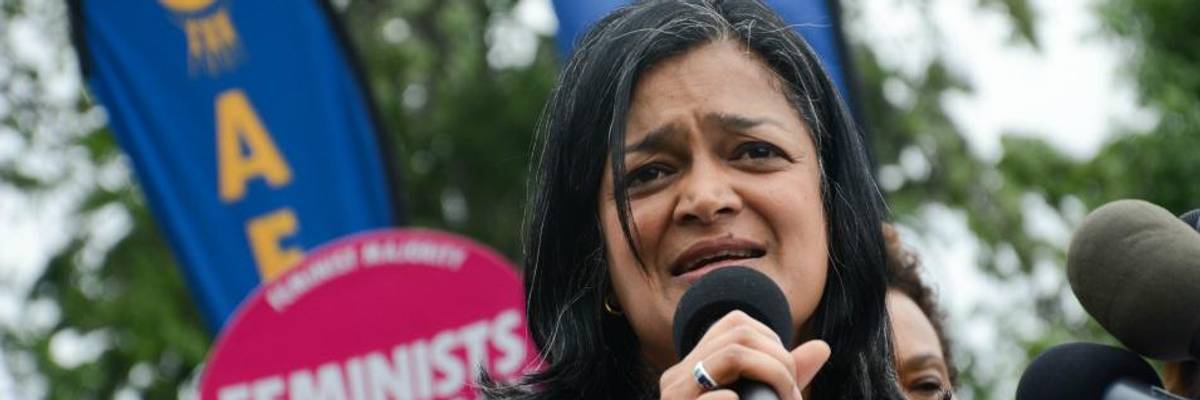
Community organizations, unions, and lawmakers--including Rep. Pramila Jayapal (D-Wash.)--gather on the grounds of the Capitol in May of 2017 to voice concerns about President Donald Trump's proposed budget. (Photo: AFGE/Flickr/cc)
Pramila Jayapal, Motivated by Wave of Right-Wing Attacks on Reproductive Rights, Draws Praise for Sharing Her Abortion Story
"I have never spoken publicly about my abortion. I'm speaking now because of intensified efforts to strip constitutional rights from pregnant people and to criminalize abortion."
Congresswoman Pramila Jayapal's decision to share the story of her abortion in a New York Times op-ed Thursday--as right-wing politicians enact a series of anti-choice laws that ultimately aim to end the right to terminate a pregnancy nationwide--was met with admiration and gratitude from fellow lawmakers, 2020 presidential candidates, reproductive rights advocates, healthcare providers, and the Washington Democrat's constituents.
"For me, terminating my pregnancy was not an easy choice, but it was my choice... And that is what must be preserved, for every pregnant person."
--Rep. Pramila Jayapal
"I have never spoken publicly about my abortion," the congresswoman writes, several years after her procedure. "In some ways, I have felt I should not have to, because it is an intensely personal decision. But I have decided to speak about it now because I am deeply concerned about the intensified efforts to strip choice and constitutional rights away from pregnant people and the simplistic ways of trying to criminalize abortion."
This year alone, legislators in nine states--Alabama, Arkansas, Georgia, Kentucky, Louisiana, Mississippi, Missouri, Ohio, and Utah--have passed extreme restrictions on abortion that are intended to provoke a court battle that forces the right-wing U.S. Supreme Court to consider overturning Roe v. Wade, the landmark 1973 ruling that affirmed the constitutional right to end a pregnancy.
Those developments motivated Jayapal to share her story--which begins with the birth of her child Janak, who was unexpectedly born in India at just 26.5 weeks. Janak subsequently "went through multiple blood transfusions and was unable to eat because their internal organs were not developed enough to take in or process milk."
In the months and years that followed, Janak experienced "endless trips to the emergency room because of weak lungs and repeated pneumonia, a seizure, and delays in speaking," and Jayapal endured both postpartum depression and post-traumatic stress disorder. Her doctors warned about the high risks of future pregnancies, and years later, she made the "excruciating" and "heartbreaking" decision to have an abortion, despite wanting more children.
"For me, terminating my pregnancy was not an easy choice, but it was my choice. That is the single thing that has allowed me to live with the consequences of my decisions," Jayapal concludes. "And that is what must be preserved, for every pregnant person."
Jayapal's "powerful personal story" provoked an outpouring of appreciation for her courage. Democratic Reps. Deb Haaland (N.M.) and Rashida Tlaib (Mich.) tweeted about the op-ed, as did multiple 2020 presidential candidates--among them, Sens. Kirsten Gillibrand (N.Y.), Kamala Harris (Calif.), Cory Booker (N.J.), and Bernie Sanders (I-Vt.).
"You shouldn't have to be so brave to share your story, and affirm why these decisions should stay between pregnant people and their doctors," Gillibrand said, "but I'm so grateful that you are."
Pro-choice advocates took to Twitter to celebrate Jayapal's courageous leadership:
Groups dedicated to protecting and expanding reproductive rights also welcomed her op-ed:
Constituents tweeted messages such as "Thank you for sharing your story. Proud to be represented by you," and "I love my representative." Some women even recalled their own decisions to have abortions:
Mckayla Wilkes, a progressive primary challenger to Democratic House Majority Leader Steny Hoyer (Md.), tweeted: "I disclosed my abortion story recently as well. It can be difficult to do, but it's so important that more women are telling their stories. This was and should remain OUR choice. Thank you, Congresswoman Jayapal."
Others thanked the congresswoman for not only speaking out about her abortion but also using gender inclusive language throughout the piece. Jayapal uses the terms "pregnant person" or "pregnant people" throughout the op-ed, recognizing that gender non-conforming and transgender patients also seek abortions.
In an interview with BuzzFeed News after her op-ed was published, Jayapal explained that her motivation to share her story "had been building" as she witnessed predominantly white male state legislators work to strip away reproductive rights.
"I continued to get more and more angry, and then I woke up one day after all this news about the ban and decided that I had been given this platform and I wanted to use it," Jayapal said. "My stomach was tied up in knots, but after the piece came out and the reactions were people being thankful and grateful that I was normalizing this, I had myself a good cry and now I feel very powerful in my story."
We are at a crossroads
This country and this world are at a monumental crossroads. In a few short weeks, US voters will have an opportunity to beat back the forces of fascism and confront the billionaires who are rigging the economy, our media system, and our democracy, making it increasingly impossible for ordinary people to get by. We’re not just talking about the election. We’re talking about what must be done once these fascist elements are vanquished from power. We need a bolder set of solutions than what either major party has so far been willing to offer and a working-class movement ready to fight like hell for it. Trump didn't emerge from nowhere. The conditions that fueled MAGA authoritarianism were created by decades of radical neoliberal economic policies and a corrupt political system dominated by corporate interests. They slashed taxes on the super-rich, promising that the benefits would trickle down. They said giveaways to the corporate titans would make life more affordable for the rest of us. It was all bullshit. And when a bitter, betrayed populace searches for someone to blame, right-wing demagogues have little trouble finding scapegoats. People know when they're being lied to, but you won't hear any of this from the corporate media. Only independent journalism—powered and funded by people who believe in building a better world—can deliver truly trustworthy daily news. Our Fall Campaign is underway, and we need your help. To power our newsroom through the rest of the year, we need to raise $125,000 by midnight on October 31. So if you share our vision, please contribute whatever you can to sustain our work. |
Congresswoman Pramila Jayapal's decision to share the story of her abortion in a New York Times op-ed Thursday--as right-wing politicians enact a series of anti-choice laws that ultimately aim to end the right to terminate a pregnancy nationwide--was met with admiration and gratitude from fellow lawmakers, 2020 presidential candidates, reproductive rights advocates, healthcare providers, and the Washington Democrat's constituents.
"For me, terminating my pregnancy was not an easy choice, but it was my choice... And that is what must be preserved, for every pregnant person."
--Rep. Pramila Jayapal
"I have never spoken publicly about my abortion," the congresswoman writes, several years after her procedure. "In some ways, I have felt I should not have to, because it is an intensely personal decision. But I have decided to speak about it now because I am deeply concerned about the intensified efforts to strip choice and constitutional rights away from pregnant people and the simplistic ways of trying to criminalize abortion."
This year alone, legislators in nine states--Alabama, Arkansas, Georgia, Kentucky, Louisiana, Mississippi, Missouri, Ohio, and Utah--have passed extreme restrictions on abortion that are intended to provoke a court battle that forces the right-wing U.S. Supreme Court to consider overturning Roe v. Wade, the landmark 1973 ruling that affirmed the constitutional right to end a pregnancy.
Those developments motivated Jayapal to share her story--which begins with the birth of her child Janak, who was unexpectedly born in India at just 26.5 weeks. Janak subsequently "went through multiple blood transfusions and was unable to eat because their internal organs were not developed enough to take in or process milk."
In the months and years that followed, Janak experienced "endless trips to the emergency room because of weak lungs and repeated pneumonia, a seizure, and delays in speaking," and Jayapal endured both postpartum depression and post-traumatic stress disorder. Her doctors warned about the high risks of future pregnancies, and years later, she made the "excruciating" and "heartbreaking" decision to have an abortion, despite wanting more children.
"For me, terminating my pregnancy was not an easy choice, but it was my choice. That is the single thing that has allowed me to live with the consequences of my decisions," Jayapal concludes. "And that is what must be preserved, for every pregnant person."
Jayapal's "powerful personal story" provoked an outpouring of appreciation for her courage. Democratic Reps. Deb Haaland (N.M.) and Rashida Tlaib (Mich.) tweeted about the op-ed, as did multiple 2020 presidential candidates--among them, Sens. Kirsten Gillibrand (N.Y.), Kamala Harris (Calif.), Cory Booker (N.J.), and Bernie Sanders (I-Vt.).
"You shouldn't have to be so brave to share your story, and affirm why these decisions should stay between pregnant people and their doctors," Gillibrand said, "but I'm so grateful that you are."
Pro-choice advocates took to Twitter to celebrate Jayapal's courageous leadership:
Groups dedicated to protecting and expanding reproductive rights also welcomed her op-ed:
Constituents tweeted messages such as "Thank you for sharing your story. Proud to be represented by you," and "I love my representative." Some women even recalled their own decisions to have abortions:
Mckayla Wilkes, a progressive primary challenger to Democratic House Majority Leader Steny Hoyer (Md.), tweeted: "I disclosed my abortion story recently as well. It can be difficult to do, but it's so important that more women are telling their stories. This was and should remain OUR choice. Thank you, Congresswoman Jayapal."
Others thanked the congresswoman for not only speaking out about her abortion but also using gender inclusive language throughout the piece. Jayapal uses the terms "pregnant person" or "pregnant people" throughout the op-ed, recognizing that gender non-conforming and transgender patients also seek abortions.
In an interview with BuzzFeed News after her op-ed was published, Jayapal explained that her motivation to share her story "had been building" as she witnessed predominantly white male state legislators work to strip away reproductive rights.
"I continued to get more and more angry, and then I woke up one day after all this news about the ban and decided that I had been given this platform and I wanted to use it," Jayapal said. "My stomach was tied up in knots, but after the piece came out and the reactions were people being thankful and grateful that I was normalizing this, I had myself a good cry and now I feel very powerful in my story."