SUBSCRIBE TO OUR FREE NEWSLETTER
Daily news & progressive opinion—funded by the people, not the corporations—delivered straight to your inbox.
5
#000000
#FFFFFF
To donate by check, phone, or other method, see our More Ways to Give page.
Daily news & progressive opinion—funded by the people, not the corporations—delivered straight to your inbox.
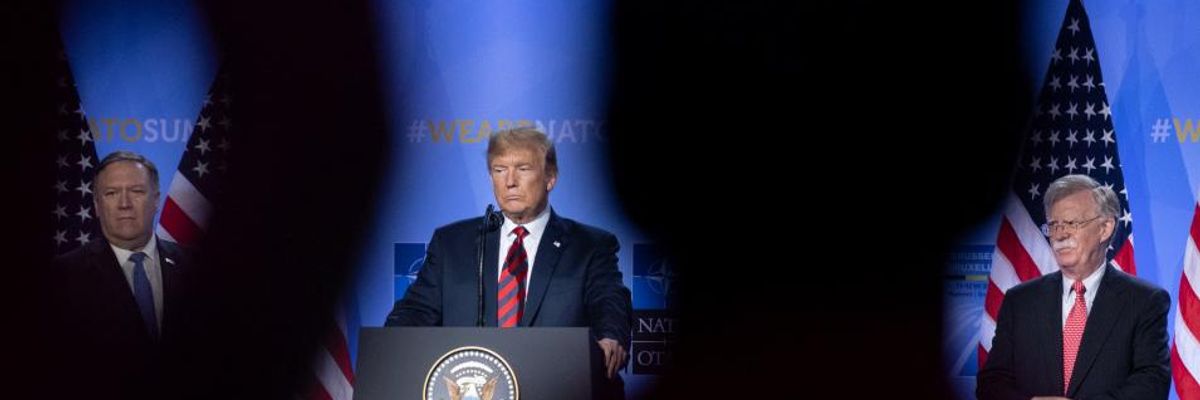
President Donald Trump listens in between U.S. Secretary of State Mike Pompeo and national security adviser John Bolton during a news conference at the 2018 NATO Summit at NATO headquarters on July 12, 2018 in Brussels, Belgium. (Photo: Jasper Juinen/Getty Images)
As "murky" intelligence reports swirl and the White House works overtime to establish its narrative with evidence-free warnings of a supposedly growing Iranian threat, foreign policy experts and analysts are attempting to set the record straight by establishing precisely who is responsible for the dangerously high tensions in the Middle East that could spark a catastrophic war.
"The current crisis atmosphere in U.S.-Iranian relations, in which the risk of open warfare appears greater than it has been in years, is solely and unequivocally due to the policies and actions of the Trump administration."
--Paul Pillar
The unequivocal answer, according to former CIA Middle East analyst Paul Pillar, is the Trump administration.
"The current crisis atmosphere in U.S.-Iranian relations, in which the risk of open warfare appears greater than it has been in years, is solely and unequivocally due to the policies and actions of the Trump administration," Pillar wrote in a Thursday column for Lobe Log.
"To point this out does not mean that actions of the Iranian regime have not come to be part of the crisis atmosphere as well," Pillar added. "It instead means that such an atmosphere would never have existed in the first place if the administration had not turned its obsession with Iran into the relentless campaign of hostility."
Pillar's assessment of the growing threat of yet another U.S.-led war in the Middle East seemed to be bolstered by a Wall Street Journal report late Thursday, which suggested that intelligence collected by the American government shows "Iran's leaders believe the U.S. planned to attack them, prompting preparation by Tehran for possible counterstrikes."
"That view of the intelligence," the Journal reported, "could help explain why Iranian forces and their allies took action that was seen as threatening to U.S. forces in Iraq and elsewhere, prompting a U.S. military buildup in the Persian Gulf region and a drawdown of U.S. diplomats in Iraq."
"There you have it," Farnaz Fassihi, a senior writer for the Journal, tweeted in response to the new reporting. "Trump action provokes Iran reaction provokes U.S. reaction and suddenly march to another quagmire catastrophic war."
This timeline of events--which was echoed by reporting from The Daily Beast Thursday--flatly contradicts the Trump administration's insistence that Iranian aggression prompted the United States' recent militaristic actions and threats, the most prominent of which have been issued by Secretary of State Mike Pompeo and national security adviser John Bolton.
Rep. Jim Himes (D-Conn.), a member of the House Intelligence Committee, told The Daily Beast that the intelligence he has reviewed, which he characterized as "murky," has led him to believe "that most of the activities that the Iranians are undertaking are in response to our very aggressive posture in the region."
Based on the latest reporting on the intelligence community's findings, Washington Post Middle East correspondent Louisa Loveluck outlined the series of events that led to the dangerously high tensions of the present moment:
Anti-war voices and analysts have been warning that the Trump administration could attempt to start a war with Iran at least since the president decided in March of last year to hire Bolton--the man who in 2015 penned a New York Times op-ed headlined "To Stop Iran's Bomb, Bomb Iran"--as his national security adviser.
Less than two months later, Trump violated the Iran nuclear accord by unilaterally withdrawing the U.S. from the agreement.
"This is how the Iran war started," Trita Parsi, founder of the National Iranian American Council (NIAC), tweeted at the time.
Now, fearing that their ominous predictions are dangerously close to coming true, anti-war advocacy groups and members of Congress are moving to prevent what would be a devastating military conflict.
"Time is running out," warns a NIAC petition. "Iraq-war architect John Bolton and his cabal of hawks are doing everything in their power to stoke a war with Iran. Our community must act now to prevent history from repeating itself."
Sen. Bernie Sanders (I-Vt.), a 2020 presidential candidate, circulated a petition of his own on Thursday, urging Congress to pass legislation to forestall the possibility of war with Iran.
"If we turn our backs on a non-violent solution in favor of more military conflict, that we will find ourselves in perpetual warfare," Sanders wrote in an email to supporters. "Mark my words. A war in Iran would make the Iraq war look like a walk in the park. It will be an unmitigated disaster. So Congress must intervene and utilize its constitutional authority--before it's too late."
Dear Common Dreams reader, It’s been nearly 30 years since I co-founded Common Dreams with my late wife, Lina Newhouser. We had the radical notion that journalism should serve the public good, not corporate profits. It was clear to us from the outset what it would take to build such a project. No paid advertisements. No corporate sponsors. No millionaire publisher telling us what to think or do. Many people said we wouldn't last a year, but we proved those doubters wrong. Together with a tremendous team of journalists and dedicated staff, we built an independent media outlet free from the constraints of profits and corporate control. Our mission has always been simple: To inform. To inspire. To ignite change for the common good. Building Common Dreams was not easy. Our survival was never guaranteed. When you take on the most powerful forces—Wall Street greed, fossil fuel industry destruction, Big Tech lobbyists, and uber-rich oligarchs who have spent billions upon billions rigging the economy and democracy in their favor—the only bulwark you have is supporters who believe in your work. But here’s the urgent message from me today. It's never been this bad out there. And it's never been this hard to keep us going. At the very moment Common Dreams is most needed, the threats we face are intensifying. We need your support now more than ever. We don't accept corporate advertising and never will. We don't have a paywall because we don't think people should be blocked from critical news based on their ability to pay. Everything we do is funded by the donations of readers like you. When everyone does the little they can afford, we are strong. But if that support retreats or dries up, so do we. Will you donate now to make sure Common Dreams not only survives but thrives? —Craig Brown, Co-founder |
As "murky" intelligence reports swirl and the White House works overtime to establish its narrative with evidence-free warnings of a supposedly growing Iranian threat, foreign policy experts and analysts are attempting to set the record straight by establishing precisely who is responsible for the dangerously high tensions in the Middle East that could spark a catastrophic war.
"The current crisis atmosphere in U.S.-Iranian relations, in which the risk of open warfare appears greater than it has been in years, is solely and unequivocally due to the policies and actions of the Trump administration."
--Paul Pillar
The unequivocal answer, according to former CIA Middle East analyst Paul Pillar, is the Trump administration.
"The current crisis atmosphere in U.S.-Iranian relations, in which the risk of open warfare appears greater than it has been in years, is solely and unequivocally due to the policies and actions of the Trump administration," Pillar wrote in a Thursday column for Lobe Log.
"To point this out does not mean that actions of the Iranian regime have not come to be part of the crisis atmosphere as well," Pillar added. "It instead means that such an atmosphere would never have existed in the first place if the administration had not turned its obsession with Iran into the relentless campaign of hostility."
Pillar's assessment of the growing threat of yet another U.S.-led war in the Middle East seemed to be bolstered by a Wall Street Journal report late Thursday, which suggested that intelligence collected by the American government shows "Iran's leaders believe the U.S. planned to attack them, prompting preparation by Tehran for possible counterstrikes."
"That view of the intelligence," the Journal reported, "could help explain why Iranian forces and their allies took action that was seen as threatening to U.S. forces in Iraq and elsewhere, prompting a U.S. military buildup in the Persian Gulf region and a drawdown of U.S. diplomats in Iraq."
"There you have it," Farnaz Fassihi, a senior writer for the Journal, tweeted in response to the new reporting. "Trump action provokes Iran reaction provokes U.S. reaction and suddenly march to another quagmire catastrophic war."
This timeline of events--which was echoed by reporting from The Daily Beast Thursday--flatly contradicts the Trump administration's insistence that Iranian aggression prompted the United States' recent militaristic actions and threats, the most prominent of which have been issued by Secretary of State Mike Pompeo and national security adviser John Bolton.
Rep. Jim Himes (D-Conn.), a member of the House Intelligence Committee, told The Daily Beast that the intelligence he has reviewed, which he characterized as "murky," has led him to believe "that most of the activities that the Iranians are undertaking are in response to our very aggressive posture in the region."
Based on the latest reporting on the intelligence community's findings, Washington Post Middle East correspondent Louisa Loveluck outlined the series of events that led to the dangerously high tensions of the present moment:
Anti-war voices and analysts have been warning that the Trump administration could attempt to start a war with Iran at least since the president decided in March of last year to hire Bolton--the man who in 2015 penned a New York Times op-ed headlined "To Stop Iran's Bomb, Bomb Iran"--as his national security adviser.
Less than two months later, Trump violated the Iran nuclear accord by unilaterally withdrawing the U.S. from the agreement.
"This is how the Iran war started," Trita Parsi, founder of the National Iranian American Council (NIAC), tweeted at the time.
Now, fearing that their ominous predictions are dangerously close to coming true, anti-war advocacy groups and members of Congress are moving to prevent what would be a devastating military conflict.
"Time is running out," warns a NIAC petition. "Iraq-war architect John Bolton and his cabal of hawks are doing everything in their power to stoke a war with Iran. Our community must act now to prevent history from repeating itself."
Sen. Bernie Sanders (I-Vt.), a 2020 presidential candidate, circulated a petition of his own on Thursday, urging Congress to pass legislation to forestall the possibility of war with Iran.
"If we turn our backs on a non-violent solution in favor of more military conflict, that we will find ourselves in perpetual warfare," Sanders wrote in an email to supporters. "Mark my words. A war in Iran would make the Iraq war look like a walk in the park. It will be an unmitigated disaster. So Congress must intervene and utilize its constitutional authority--before it's too late."
As "murky" intelligence reports swirl and the White House works overtime to establish its narrative with evidence-free warnings of a supposedly growing Iranian threat, foreign policy experts and analysts are attempting to set the record straight by establishing precisely who is responsible for the dangerously high tensions in the Middle East that could spark a catastrophic war.
"The current crisis atmosphere in U.S.-Iranian relations, in which the risk of open warfare appears greater than it has been in years, is solely and unequivocally due to the policies and actions of the Trump administration."
--Paul Pillar
The unequivocal answer, according to former CIA Middle East analyst Paul Pillar, is the Trump administration.
"The current crisis atmosphere in U.S.-Iranian relations, in which the risk of open warfare appears greater than it has been in years, is solely and unequivocally due to the policies and actions of the Trump administration," Pillar wrote in a Thursday column for Lobe Log.
"To point this out does not mean that actions of the Iranian regime have not come to be part of the crisis atmosphere as well," Pillar added. "It instead means that such an atmosphere would never have existed in the first place if the administration had not turned its obsession with Iran into the relentless campaign of hostility."
Pillar's assessment of the growing threat of yet another U.S.-led war in the Middle East seemed to be bolstered by a Wall Street Journal report late Thursday, which suggested that intelligence collected by the American government shows "Iran's leaders believe the U.S. planned to attack them, prompting preparation by Tehran for possible counterstrikes."
"That view of the intelligence," the Journal reported, "could help explain why Iranian forces and their allies took action that was seen as threatening to U.S. forces in Iraq and elsewhere, prompting a U.S. military buildup in the Persian Gulf region and a drawdown of U.S. diplomats in Iraq."
"There you have it," Farnaz Fassihi, a senior writer for the Journal, tweeted in response to the new reporting. "Trump action provokes Iran reaction provokes U.S. reaction and suddenly march to another quagmire catastrophic war."
This timeline of events--which was echoed by reporting from The Daily Beast Thursday--flatly contradicts the Trump administration's insistence that Iranian aggression prompted the United States' recent militaristic actions and threats, the most prominent of which have been issued by Secretary of State Mike Pompeo and national security adviser John Bolton.
Rep. Jim Himes (D-Conn.), a member of the House Intelligence Committee, told The Daily Beast that the intelligence he has reviewed, which he characterized as "murky," has led him to believe "that most of the activities that the Iranians are undertaking are in response to our very aggressive posture in the region."
Based on the latest reporting on the intelligence community's findings, Washington Post Middle East correspondent Louisa Loveluck outlined the series of events that led to the dangerously high tensions of the present moment:
Anti-war voices and analysts have been warning that the Trump administration could attempt to start a war with Iran at least since the president decided in March of last year to hire Bolton--the man who in 2015 penned a New York Times op-ed headlined "To Stop Iran's Bomb, Bomb Iran"--as his national security adviser.
Less than two months later, Trump violated the Iran nuclear accord by unilaterally withdrawing the U.S. from the agreement.
"This is how the Iran war started," Trita Parsi, founder of the National Iranian American Council (NIAC), tweeted at the time.
Now, fearing that their ominous predictions are dangerously close to coming true, anti-war advocacy groups and members of Congress are moving to prevent what would be a devastating military conflict.
"Time is running out," warns a NIAC petition. "Iraq-war architect John Bolton and his cabal of hawks are doing everything in their power to stoke a war with Iran. Our community must act now to prevent history from repeating itself."
Sen. Bernie Sanders (I-Vt.), a 2020 presidential candidate, circulated a petition of his own on Thursday, urging Congress to pass legislation to forestall the possibility of war with Iran.
"If we turn our backs on a non-violent solution in favor of more military conflict, that we will find ourselves in perpetual warfare," Sanders wrote in an email to supporters. "Mark my words. A war in Iran would make the Iraq war look like a walk in the park. It will be an unmitigated disaster. So Congress must intervene and utilize its constitutional authority--before it's too late."