SUBSCRIBE TO OUR FREE NEWSLETTER
Daily news & progressive opinion—funded by the people, not the corporations—delivered straight to your inbox.
5
#000000
#FFFFFF
To donate by check, phone, or other method, see our More Ways to Give page.
Daily news & progressive opinion—funded by the people, not the corporations—delivered straight to your inbox.
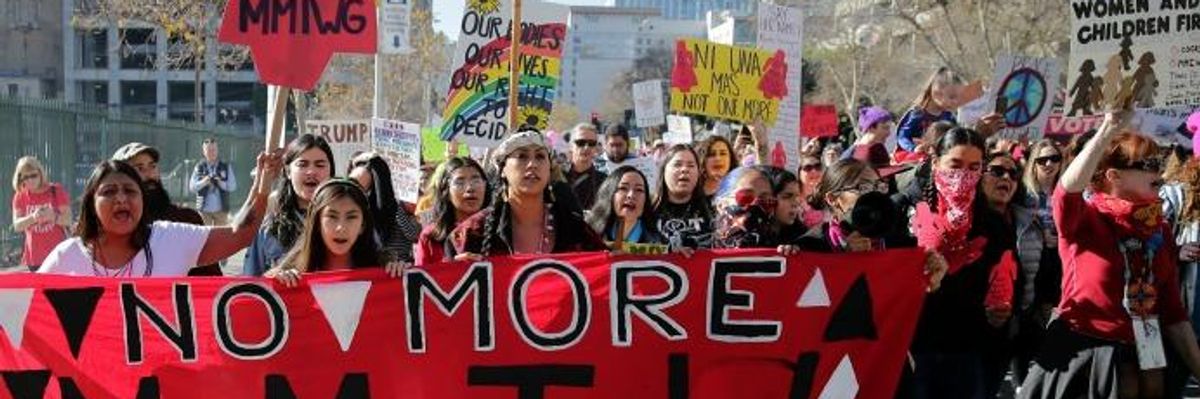
Activists march for missing and murdered indigenous women and girls at the Women's March California 2019 on January 19, 2019 in Los Angeles. (Photo: Sarah Morris/Getty Images)
Newly-proposed federal legislation tackles a silent crisis--the epidemic of missing and murdered indigenous women and girls.
Rep. Deb Haaland (D-N.M.) introduced H.R. 2438--the Not Invisible Act of 2019--on Wednesday, just ahead of the National Day of Awareness for Missing and Murdered Indigenous Women and Girls. Last month, a bipartisan group of senators introduced similar legislation in the upper chamber.
"Women are disappearing and dying in Indian country. We must act," Haaland said Sunday.
The Not Invisible Act (pdf) would create an advisory committee composed of law enforcement, tribal leaders, federal partners, service providers, and survivors tasked with making recommendations to the Department of Interior and Department of Justice; establish best practices for law enforcement on the epidemic; and establish a position within the Bureau of Indian Affairs to be filled by an expert in charge of improving coordination of violent crime prevention efforts across federal agencies.
To mark the day of awareness, Cherokee writer Rebecca Nagle provided statistics to outline the shocking scope of the problem. Her Twitter thread Sunday noted, in part:
Haaland also noted the bleak situation and issued a call-to-action in an op-ed at The Guardian on Thursday.
"The epidemic of missing and murdered indigenous women has been overlooked for far too long, but we're finally giving a voice to this silent crisis," Haaland wrote.
"When your community is at risk--when it could be your daughter, your sister or your mom--the issue demands urgency," she added, and praised indigenous women for sounding alarm about the crisis.
"The attention this issue has received wouldn't have been possible without the women in Indian country saying, 'enough is enough, we deserve to feel safe too,'" wrote Haaland. "It was a call for Congress to direct real resources to the problem."
The bill's bipartisan backers include Reps. Tom Cole (R-Okla.), Sharice Davids (D-Kan.), and Markwayne Mullin (R-Okla.). As such, says a statement from Haaland's office, H.R. 2438 is the first bill ever to be introduced by four enrolled members of federally recognized tribes.
The bill has support from groups including the National Indigenous Women's Resource Center, Urban Indian Health Institute, and Navajo Nation Council Delegate Amber Kanazbah Crotty, who called the bill an important step.
Stamping out the epidemic, however, will require more far-reaching efforts, said Leanne Guy, executive director of the Southwest Indigenous Women's Coalition.
"If we are to truly address violence against indigenous women and girls," she said at a rally in Phoenix Sunday, "we must also acknowledge and address and eradicate the racism, patriarchy, capitalism, and misogyny that is deeply rooted in the founding of this country and that currently permeates the very systems that are built to protect this country's citizens."
"As long as we're seen as relics, mascots, and exotic objects of sexual conquest," Guy added, "we will continue to be rapeable, beatable, takeable, and killable."
Dear Common Dreams reader, It’s been nearly 30 years since I co-founded Common Dreams with my late wife, Lina Newhouser. We had the radical notion that journalism should serve the public good, not corporate profits. It was clear to us from the outset what it would take to build such a project. No paid advertisements. No corporate sponsors. No millionaire publisher telling us what to think or do. Many people said we wouldn't last a year, but we proved those doubters wrong. Together with a tremendous team of journalists and dedicated staff, we built an independent media outlet free from the constraints of profits and corporate control. Our mission has always been simple: To inform. To inspire. To ignite change for the common good. Building Common Dreams was not easy. Our survival was never guaranteed. When you take on the most powerful forces—Wall Street greed, fossil fuel industry destruction, Big Tech lobbyists, and uber-rich oligarchs who have spent billions upon billions rigging the economy and democracy in their favor—the only bulwark you have is supporters who believe in your work. But here’s the urgent message from me today. It's never been this bad out there. And it's never been this hard to keep us going. At the very moment Common Dreams is most needed, the threats we face are intensifying. We need your support now more than ever. We don't accept corporate advertising and never will. We don't have a paywall because we don't think people should be blocked from critical news based on their ability to pay. Everything we do is funded by the donations of readers like you. When everyone does the little they can afford, we are strong. But if that support retreats or dries up, so do we. Will you donate now to make sure Common Dreams not only survives but thrives? —Craig Brown, Co-founder |
Newly-proposed federal legislation tackles a silent crisis--the epidemic of missing and murdered indigenous women and girls.
Rep. Deb Haaland (D-N.M.) introduced H.R. 2438--the Not Invisible Act of 2019--on Wednesday, just ahead of the National Day of Awareness for Missing and Murdered Indigenous Women and Girls. Last month, a bipartisan group of senators introduced similar legislation in the upper chamber.
"Women are disappearing and dying in Indian country. We must act," Haaland said Sunday.
The Not Invisible Act (pdf) would create an advisory committee composed of law enforcement, tribal leaders, federal partners, service providers, and survivors tasked with making recommendations to the Department of Interior and Department of Justice; establish best practices for law enforcement on the epidemic; and establish a position within the Bureau of Indian Affairs to be filled by an expert in charge of improving coordination of violent crime prevention efforts across federal agencies.
To mark the day of awareness, Cherokee writer Rebecca Nagle provided statistics to outline the shocking scope of the problem. Her Twitter thread Sunday noted, in part:
Haaland also noted the bleak situation and issued a call-to-action in an op-ed at The Guardian on Thursday.
"The epidemic of missing and murdered indigenous women has been overlooked for far too long, but we're finally giving a voice to this silent crisis," Haaland wrote.
"When your community is at risk--when it could be your daughter, your sister or your mom--the issue demands urgency," she added, and praised indigenous women for sounding alarm about the crisis.
"The attention this issue has received wouldn't have been possible without the women in Indian country saying, 'enough is enough, we deserve to feel safe too,'" wrote Haaland. "It was a call for Congress to direct real resources to the problem."
The bill's bipartisan backers include Reps. Tom Cole (R-Okla.), Sharice Davids (D-Kan.), and Markwayne Mullin (R-Okla.). As such, says a statement from Haaland's office, H.R. 2438 is the first bill ever to be introduced by four enrolled members of federally recognized tribes.
The bill has support from groups including the National Indigenous Women's Resource Center, Urban Indian Health Institute, and Navajo Nation Council Delegate Amber Kanazbah Crotty, who called the bill an important step.
Stamping out the epidemic, however, will require more far-reaching efforts, said Leanne Guy, executive director of the Southwest Indigenous Women's Coalition.
"If we are to truly address violence against indigenous women and girls," she said at a rally in Phoenix Sunday, "we must also acknowledge and address and eradicate the racism, patriarchy, capitalism, and misogyny that is deeply rooted in the founding of this country and that currently permeates the very systems that are built to protect this country's citizens."
"As long as we're seen as relics, mascots, and exotic objects of sexual conquest," Guy added, "we will continue to be rapeable, beatable, takeable, and killable."
Newly-proposed federal legislation tackles a silent crisis--the epidemic of missing and murdered indigenous women and girls.
Rep. Deb Haaland (D-N.M.) introduced H.R. 2438--the Not Invisible Act of 2019--on Wednesday, just ahead of the National Day of Awareness for Missing and Murdered Indigenous Women and Girls. Last month, a bipartisan group of senators introduced similar legislation in the upper chamber.
"Women are disappearing and dying in Indian country. We must act," Haaland said Sunday.
The Not Invisible Act (pdf) would create an advisory committee composed of law enforcement, tribal leaders, federal partners, service providers, and survivors tasked with making recommendations to the Department of Interior and Department of Justice; establish best practices for law enforcement on the epidemic; and establish a position within the Bureau of Indian Affairs to be filled by an expert in charge of improving coordination of violent crime prevention efforts across federal agencies.
To mark the day of awareness, Cherokee writer Rebecca Nagle provided statistics to outline the shocking scope of the problem. Her Twitter thread Sunday noted, in part:
Haaland also noted the bleak situation and issued a call-to-action in an op-ed at The Guardian on Thursday.
"The epidemic of missing and murdered indigenous women has been overlooked for far too long, but we're finally giving a voice to this silent crisis," Haaland wrote.
"When your community is at risk--when it could be your daughter, your sister or your mom--the issue demands urgency," she added, and praised indigenous women for sounding alarm about the crisis.
"The attention this issue has received wouldn't have been possible without the women in Indian country saying, 'enough is enough, we deserve to feel safe too,'" wrote Haaland. "It was a call for Congress to direct real resources to the problem."
The bill's bipartisan backers include Reps. Tom Cole (R-Okla.), Sharice Davids (D-Kan.), and Markwayne Mullin (R-Okla.). As such, says a statement from Haaland's office, H.R. 2438 is the first bill ever to be introduced by four enrolled members of federally recognized tribes.
The bill has support from groups including the National Indigenous Women's Resource Center, Urban Indian Health Institute, and Navajo Nation Council Delegate Amber Kanazbah Crotty, who called the bill an important step.
Stamping out the epidemic, however, will require more far-reaching efforts, said Leanne Guy, executive director of the Southwest Indigenous Women's Coalition.
"If we are to truly address violence against indigenous women and girls," she said at a rally in Phoenix Sunday, "we must also acknowledge and address and eradicate the racism, patriarchy, capitalism, and misogyny that is deeply rooted in the founding of this country and that currently permeates the very systems that are built to protect this country's citizens."
"As long as we're seen as relics, mascots, and exotic objects of sexual conquest," Guy added, "we will continue to be rapeable, beatable, takeable, and killable."