SUBSCRIBE TO OUR FREE NEWSLETTER
Daily news & progressive opinion—funded by the people, not the corporations—delivered straight to your inbox.
5
#000000
#FFFFFF
To donate by check, phone, or other method, see our More Ways to Give page.
Daily news & progressive opinion—funded by the people, not the corporations—delivered straight to your inbox.
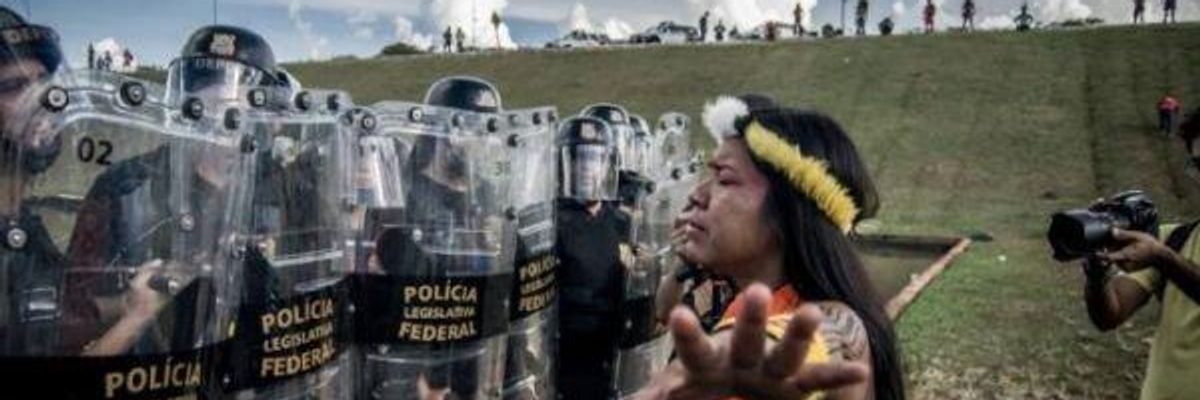
Up to 5,000 indigenous activists are expected in the city of Brasilia between Wednesday and Friday. As of Wednesday afternoon, at least 2,000 people had shown up and most were encamped in the heart of the city. (Photo: via Avaaz/Twitter)
Thousands of indigenous Brazilians are marching on the country's capital for three days of lobbying and activism to protect the South American country's vast natural resources--which are under heightened threat from President Jair Bolsonaro's pro-exploitation regime.
Up to 5,000 indigenous activists are expected in the city of Brasilia between Wednesday and Friday. As of Wednesday afternoon, at least 2,000 people had shown up and most were encamped in the heart of the city.
"We are defenders of the land, we are defenders of the Amazon, of the forest," Alessandra Munduruku, a representative of the Munduruku tribe from the northern state of Para, told The Guardian. "The white man is our finishing off our planet and we want to defend it."
The Guardian detailed the grievances against the Bolsonaro government that prompted the protest.
Indigenous leaders are incensed by the Bolsonaro government's decision to transfer responsibility for demarcation of indigenous reserves to Brazil's agriculture ministry, which is controlled by members of a powerful farming lobby that has long opposed indigenous land rights. They also object to a decision to hand control of Brazil's cash-strapped indigenous agency Funai to a new ministry of women, family and human rights presided over by a conservative evangelical pastor.
The effort to stem the tide of opening the Amazon rainforest and other tribal lands to development comes as Bolsonaro faces pushback over his environmental policies from across the world.
Earlier this month, as Common Dreams reported, an event to honor the Brazilian leader was moved from the American Museum of Natural History in large part because of Bolsonaro's positions on the Amazon.
The Brazilian activists hope they can add to the pressure.
"We came here for an important cause," said Camila Silveiro, who came to the city from the southern Brazilian state of Parana. "It was very difficult for us, our ancestors, to win these rights and little by little they are decreasing."
The protest has backing from across the world.
A petition at the site Avaaz showed signatures from six continents expressing support and solidarity.
In Austria, Greenpeace activists held a protest outside the Brazilian Embassy in solidarity with the indigenous activists.
Indigenous leaders and allies protested in front of the Brazilian Mission to the U.N. in New York.
"Let's stand with them," said Scottish language activist Adhamh O Broin.
The protests will continue until Friday. Glenn Shepard, an anthropologist at the Emilio Goeldi Museum in Belem, capital of Para, told The Financial Times that the stewardship of the indigenous people of Brazil has thus far stopped deforestation.
"This is their land," said Shepard, "they owe nothing to anybody."
Dear Common Dreams reader, It’s been nearly 30 years since I co-founded Common Dreams with my late wife, Lina Newhouser. We had the radical notion that journalism should serve the public good, not corporate profits. It was clear to us from the outset what it would take to build such a project. No paid advertisements. No corporate sponsors. No millionaire publisher telling us what to think or do. Many people said we wouldn't last a year, but we proved those doubters wrong. Together with a tremendous team of journalists and dedicated staff, we built an independent media outlet free from the constraints of profits and corporate control. Our mission has always been simple: To inform. To inspire. To ignite change for the common good. Building Common Dreams was not easy. Our survival was never guaranteed. When you take on the most powerful forces—Wall Street greed, fossil fuel industry destruction, Big Tech lobbyists, and uber-rich oligarchs who have spent billions upon billions rigging the economy and democracy in their favor—the only bulwark you have is supporters who believe in your work. But here’s the urgent message from me today. It's never been this bad out there. And it's never been this hard to keep us going. At the very moment Common Dreams is most needed, the threats we face are intensifying. We need your support now more than ever. We don't accept corporate advertising and never will. We don't have a paywall because we don't think people should be blocked from critical news based on their ability to pay. Everything we do is funded by the donations of readers like you. When everyone does the little they can afford, we are strong. But if that support retreats or dries up, so do we. Will you donate now to make sure Common Dreams not only survives but thrives? —Craig Brown, Co-founder |
Thousands of indigenous Brazilians are marching on the country's capital for three days of lobbying and activism to protect the South American country's vast natural resources--which are under heightened threat from President Jair Bolsonaro's pro-exploitation regime.
Up to 5,000 indigenous activists are expected in the city of Brasilia between Wednesday and Friday. As of Wednesday afternoon, at least 2,000 people had shown up and most were encamped in the heart of the city.
"We are defenders of the land, we are defenders of the Amazon, of the forest," Alessandra Munduruku, a representative of the Munduruku tribe from the northern state of Para, told The Guardian. "The white man is our finishing off our planet and we want to defend it."
The Guardian detailed the grievances against the Bolsonaro government that prompted the protest.
Indigenous leaders are incensed by the Bolsonaro government's decision to transfer responsibility for demarcation of indigenous reserves to Brazil's agriculture ministry, which is controlled by members of a powerful farming lobby that has long opposed indigenous land rights. They also object to a decision to hand control of Brazil's cash-strapped indigenous agency Funai to a new ministry of women, family and human rights presided over by a conservative evangelical pastor.
The effort to stem the tide of opening the Amazon rainforest and other tribal lands to development comes as Bolsonaro faces pushback over his environmental policies from across the world.
Earlier this month, as Common Dreams reported, an event to honor the Brazilian leader was moved from the American Museum of Natural History in large part because of Bolsonaro's positions on the Amazon.
The Brazilian activists hope they can add to the pressure.
"We came here for an important cause," said Camila Silveiro, who came to the city from the southern Brazilian state of Parana. "It was very difficult for us, our ancestors, to win these rights and little by little they are decreasing."
The protest has backing from across the world.
A petition at the site Avaaz showed signatures from six continents expressing support and solidarity.
In Austria, Greenpeace activists held a protest outside the Brazilian Embassy in solidarity with the indigenous activists.
Indigenous leaders and allies protested in front of the Brazilian Mission to the U.N. in New York.
"Let's stand with them," said Scottish language activist Adhamh O Broin.
The protests will continue until Friday. Glenn Shepard, an anthropologist at the Emilio Goeldi Museum in Belem, capital of Para, told The Financial Times that the stewardship of the indigenous people of Brazil has thus far stopped deforestation.
"This is their land," said Shepard, "they owe nothing to anybody."
Thousands of indigenous Brazilians are marching on the country's capital for three days of lobbying and activism to protect the South American country's vast natural resources--which are under heightened threat from President Jair Bolsonaro's pro-exploitation regime.
Up to 5,000 indigenous activists are expected in the city of Brasilia between Wednesday and Friday. As of Wednesday afternoon, at least 2,000 people had shown up and most were encamped in the heart of the city.
"We are defenders of the land, we are defenders of the Amazon, of the forest," Alessandra Munduruku, a representative of the Munduruku tribe from the northern state of Para, told The Guardian. "The white man is our finishing off our planet and we want to defend it."
The Guardian detailed the grievances against the Bolsonaro government that prompted the protest.
Indigenous leaders are incensed by the Bolsonaro government's decision to transfer responsibility for demarcation of indigenous reserves to Brazil's agriculture ministry, which is controlled by members of a powerful farming lobby that has long opposed indigenous land rights. They also object to a decision to hand control of Brazil's cash-strapped indigenous agency Funai to a new ministry of women, family and human rights presided over by a conservative evangelical pastor.
The effort to stem the tide of opening the Amazon rainforest and other tribal lands to development comes as Bolsonaro faces pushback over his environmental policies from across the world.
Earlier this month, as Common Dreams reported, an event to honor the Brazilian leader was moved from the American Museum of Natural History in large part because of Bolsonaro's positions on the Amazon.
The Brazilian activists hope they can add to the pressure.
"We came here for an important cause," said Camila Silveiro, who came to the city from the southern Brazilian state of Parana. "It was very difficult for us, our ancestors, to win these rights and little by little they are decreasing."
The protest has backing from across the world.
A petition at the site Avaaz showed signatures from six continents expressing support and solidarity.
In Austria, Greenpeace activists held a protest outside the Brazilian Embassy in solidarity with the indigenous activists.
Indigenous leaders and allies protested in front of the Brazilian Mission to the U.N. in New York.
"Let's stand with them," said Scottish language activist Adhamh O Broin.
The protests will continue until Friday. Glenn Shepard, an anthropologist at the Emilio Goeldi Museum in Belem, capital of Para, told The Financial Times that the stewardship of the indigenous people of Brazil has thus far stopped deforestation.
"This is their land," said Shepard, "they owe nothing to anybody."