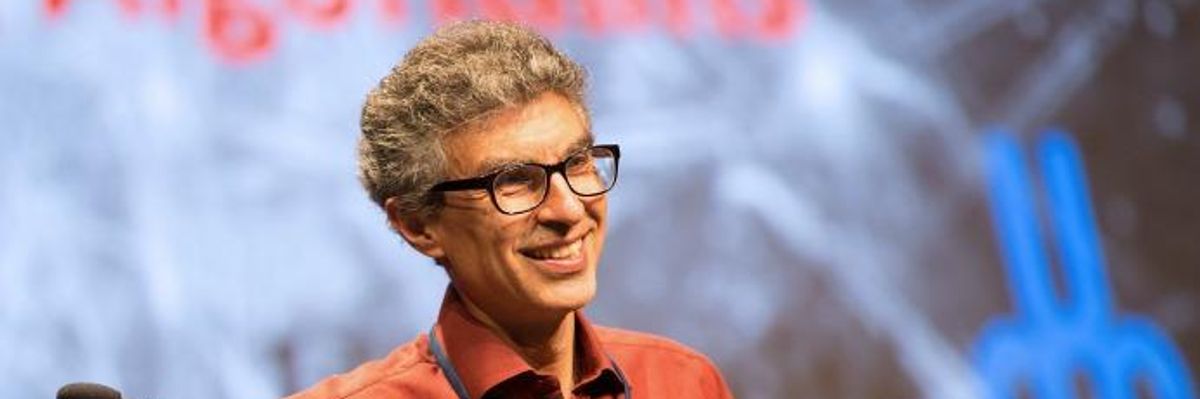
AI pioneer Yoshua Bengio, seen here in 2017, told the journal Nature that "we have to raise flags before bad things happen" in terms of irresponsible use of artificial intelligence.(Photo: Ecole polytechnique/flickr/cc)
Pioneer in Field Warns Dangers Posed by Artificial Intelligence 'Very Real'
"What is most concerning is not happening in broad daylight"
A pioneer in the field of artificial intelligence warned that "dangers of abuse" of AI "are very real."
The warning from Canadian computer science professor and leading AI researcher Yoshua Bengio came in a Q&A with the journal Nature published Thursday.
The interview was conducted back in January, before Bengio was named along with two others the latest recipients of the Turing Award, a prize dubbed the "Nobel Prize of Computing."
Bengio told Nature that "we have to raise flags before bad things happen" in terms of irresponsible use of AI.
Unfortunately, "what is most concerning is not happening in broad daylight" but "in military labs, in security organizations, in private companies providing services to governments or the police," he said.
In particular, Bengio said, he is concerned with so-called killer drones--lethal autonomous weapons--and surveillance, which can be abused by authoritarian governments.
AI "can be used by those in power to keep that power, and to increase it," said Bengio, and be used "to worsen gender or racial discrimination."
Some sort of government or international regulatory framework needs to be in place to put a check on AI, added Bengio: "Self-regulation is not going to work."
It's not the first time Bengio expressed concerns about possible abuse of AI. This week he joined over two dozen other AI researchers in calling on Amazon to stop selling its facial-recognition software Rekognition to police departments.
The group of "concerned researchers" wrote in a post on Medium that "legislation and safeguards to prevent misuse are not in place."
Bengio also served on the steering committee for the recently-unveiled Montreal Declaration for Responsible Development of Artificial Intelligence. Among the declaration's 10 principles are that the "development and use of [artificial intelligence systems] AIS must contribute to the creation of a just and equitable society."
"Generally speaking," he wrote at The Conversation highlighting the need for the declaration, "scientists tend to avoid getting too involved in politics. But when there are issues that concern them and that will have a major impact on society, they must assume their responsibility and become part of the debate."
"And in this debate, I have come to realize that society has given me a voice--that governments and the media were interested in what I had to say on these topics because of my role as a pioneer in the scientific development of AI."
"So, for me, it is now more than a responsibility," he said. "It is my duty. I have no choice."
We are at a crossroads
This country and this world are at a monumental crossroads. In a few short weeks, US voters will have an opportunity to beat back the forces of fascism and confront the billionaires who are rigging the economy, our media system, and our democracy, making it increasingly impossible for ordinary people to get by. We’re not just talking about the election. We’re talking about what must be done once these fascist elements are vanquished from power. We need a bolder set of solutions than what either major party has so far been willing to offer and a working-class movement ready to fight like hell for it. Trump didn't emerge from nowhere. The conditions that fueled MAGA authoritarianism were created by decades of radical neoliberal economic policies and a corrupt political system dominated by corporate interests. They slashed taxes on the super-rich, promising that the benefits would trickle down. They said giveaways to the corporate titans would make life more affordable for the rest of us. It was all bullshit. And when a bitter, betrayed populace searches for someone to blame, right-wing demagogues have little trouble finding scapegoats. People know when they're being lied to, but you won't hear any of this from the corporate media. Only independent journalism—powered and funded by people who believe in building a better world—can deliver truly trustworthy daily news. Our Fall Campaign is underway, and we need your help. To power our newsroom through the rest of the year, we need to raise $125,000 by midnight on October 31. So if you share our vision, please contribute whatever you can to sustain our work. |
A pioneer in the field of artificial intelligence warned that "dangers of abuse" of AI "are very real."
The warning from Canadian computer science professor and leading AI researcher Yoshua Bengio came in a Q&A with the journal Nature published Thursday.
The interview was conducted back in January, before Bengio was named along with two others the latest recipients of the Turing Award, a prize dubbed the "Nobel Prize of Computing."
Bengio told Nature that "we have to raise flags before bad things happen" in terms of irresponsible use of AI.
Unfortunately, "what is most concerning is not happening in broad daylight" but "in military labs, in security organizations, in private companies providing services to governments or the police," he said.
In particular, Bengio said, he is concerned with so-called killer drones--lethal autonomous weapons--and surveillance, which can be abused by authoritarian governments.
AI "can be used by those in power to keep that power, and to increase it," said Bengio, and be used "to worsen gender or racial discrimination."
Some sort of government or international regulatory framework needs to be in place to put a check on AI, added Bengio: "Self-regulation is not going to work."
It's not the first time Bengio expressed concerns about possible abuse of AI. This week he joined over two dozen other AI researchers in calling on Amazon to stop selling its facial-recognition software Rekognition to police departments.
The group of "concerned researchers" wrote in a post on Medium that "legislation and safeguards to prevent misuse are not in place."
Bengio also served on the steering committee for the recently-unveiled Montreal Declaration for Responsible Development of Artificial Intelligence. Among the declaration's 10 principles are that the "development and use of [artificial intelligence systems] AIS must contribute to the creation of a just and equitable society."
"Generally speaking," he wrote at The Conversation highlighting the need for the declaration, "scientists tend to avoid getting too involved in politics. But when there are issues that concern them and that will have a major impact on society, they must assume their responsibility and become part of the debate."
"And in this debate, I have come to realize that society has given me a voice--that governments and the media were interested in what I had to say on these topics because of my role as a pioneer in the scientific development of AI."
"So, for me, it is now more than a responsibility," he said. "It is my duty. I have no choice."
A pioneer in the field of artificial intelligence warned that "dangers of abuse" of AI "are very real."
The warning from Canadian computer science professor and leading AI researcher Yoshua Bengio came in a Q&A with the journal Nature published Thursday.
The interview was conducted back in January, before Bengio was named along with two others the latest recipients of the Turing Award, a prize dubbed the "Nobel Prize of Computing."
Bengio told Nature that "we have to raise flags before bad things happen" in terms of irresponsible use of AI.
Unfortunately, "what is most concerning is not happening in broad daylight" but "in military labs, in security organizations, in private companies providing services to governments or the police," he said.
In particular, Bengio said, he is concerned with so-called killer drones--lethal autonomous weapons--and surveillance, which can be abused by authoritarian governments.
AI "can be used by those in power to keep that power, and to increase it," said Bengio, and be used "to worsen gender or racial discrimination."
Some sort of government or international regulatory framework needs to be in place to put a check on AI, added Bengio: "Self-regulation is not going to work."
It's not the first time Bengio expressed concerns about possible abuse of AI. This week he joined over two dozen other AI researchers in calling on Amazon to stop selling its facial-recognition software Rekognition to police departments.
The group of "concerned researchers" wrote in a post on Medium that "legislation and safeguards to prevent misuse are not in place."
Bengio also served on the steering committee for the recently-unveiled Montreal Declaration for Responsible Development of Artificial Intelligence. Among the declaration's 10 principles are that the "development and use of [artificial intelligence systems] AIS must contribute to the creation of a just and equitable society."
"Generally speaking," he wrote at The Conversation highlighting the need for the declaration, "scientists tend to avoid getting too involved in politics. But when there are issues that concern them and that will have a major impact on society, they must assume their responsibility and become part of the debate."
"And in this debate, I have come to realize that society has given me a voice--that governments and the media were interested in what I had to say on these topics because of my role as a pioneer in the scientific development of AI."
"So, for me, it is now more than a responsibility," he said. "It is my duty. I have no choice."