SUBSCRIBE TO OUR FREE NEWSLETTER
Daily news & progressive opinion—funded by the people, not the corporations—delivered straight to your inbox.
5
#000000
#FFFFFF
To donate by check, phone, or other method, see our More Ways to Give page.
Daily news & progressive opinion—funded by the people, not the corporations—delivered straight to your inbox.
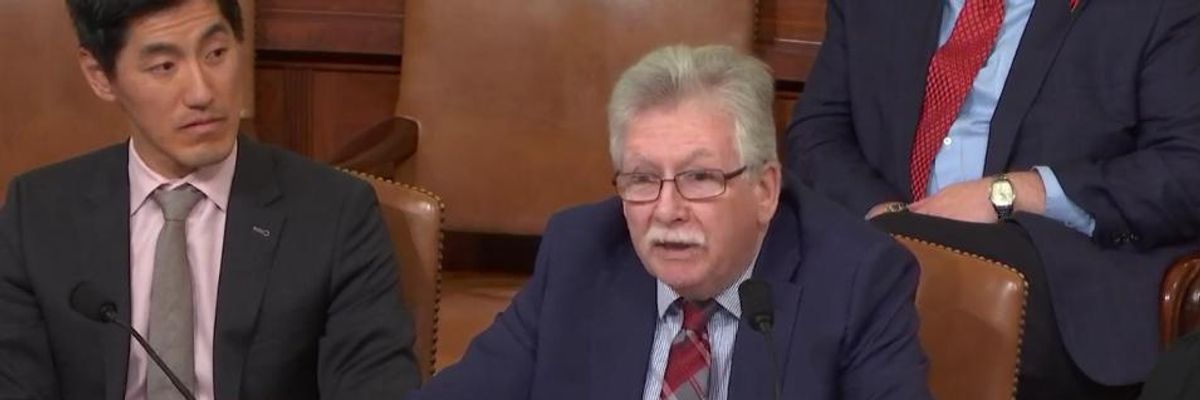
Chris Shelton, president of Communications Workers of America (CWA), testified before the House Ways and Means Committee on Wednesday. (Photo: YouTube)
Testifying before Congress on Wednesday, the leader of the nation's largest communications and media labor union urged lawmakers to pursue tax law reforms that serve the people of "main street," not the rich.
"Across the economy, large corporations are retaining profits for wealthy executives and shareholders rather than investing in the U.S. economy."
--Chris Shelton, CWA
Chris Shelton, president of Communications Workers of America (CWA), said in a written testimony (pdf) to the House Ways and Means Committee that recent tax cuts for the wealthy aren't benefiting the working class.
To illustrate his point, Shelton used telecommunications giant AT&T's treatment of its workers--including CWA members--post-tax cuts as an example.
"For too long, the tax code has been structured to benefit the super wealthy, private equity, major corporations, and Wall Street rather than working people and main street," Shelton said.
His remarks came as part of a hearing on the Tax Cuts and Jobs Act (TCJA)--which critics call the Trump or GOP "tax scam"--that the GOP enacted in December of 2017.
When President Donald Trump signed the TCJA into law over a year ago, he infamously said, "Corporations are literally going wild over this." One of the many ways the law benefited the nation's ultra wealthy was slashing the corporate tax rate from 35 to 21 percent.
In an unprecedented and undemocratic approach to crafting tax legislation, Republican lawmakers--who, at the time, controlled both chambers of Congress--forced through the TCJA in just 51 days without holding any hearings on the actual substance of the bill, which was written in private.
After Democrats took control of the House in the 2018 midterms, they vowed to take a closer look at the consequences of the TCJA. On Wednesday, the tax-writing House Ways and Means Committee held a hearing entitled "The 2017 Tax Law and Who It Left Behind."
"Let's not pretend that stock market gains and corporate profits tell the whole story of today's economy. This country also includes many middle-class and lower-income people who are working hard but struggling to get by."
--Rep. Richard Neal
"We will hear from some today that the economy is booming," committee Chairman Rep. Richard Neal (D-Mass.) said in his opening remarks. "And to an extent that is true. Investors are doing very well. Corporate CEOs have it great. Wealthy heirs couldn't be doing better."
However, Neal said, the benefits of the national wealth are not being shared equally--leading to an America with "two economies."
"Let's not pretend that stock market gains and corporate profits tell the whole story of today's economy," Neal said. "This country also includes many middle-class and lower-income people who are working hard but struggling to get by."
Shelton spoke about the struggles that CWA members are facing, in spite of Trump and GOP lawmakers' proclamations that the TCJA was "a bill for the middle class and a bill for jobs"--claims which several analyses have challenged since even before the law took effect.
As a case study, Shelton pointed to AT&T, the largest employer of CWA members. AT&T CEO Randall Stephenson supported the TCJA's corporate tax cuts and claimed the legislation would generate more jobs at his company. However, as Common Dreams reported in January, a CWA analysis--which AT&T disputed--showed the company "cut over 10,000 jobs and announced the closure of three call centers in 2018 despite receiving a $20 billion boost from the deeply unpopular tax law."
Another CWA analysis, released Tuesday, suggested the company "paid no cash income taxes in 2018 and slashed capital investments." The analysis relied on AT&T's latest annual report, which CWA acknowledged "does not provide adequate detail to fully understand AT&T's tax expenditures."
Given the limitations of the public information, the union called on AT&T "to provide a detailed disclosure of its tax liabilities, expenditures, and refunds over the past three years to give Congress and the public better insight into the true impact of the Tax Cut and Jobs Act."
"It's disgraceful that AT&T got the massive tax break it lobbied for, may have paid no cash income taxes, and then turned around and shattered people's livelihoods," Shelton said in a statement on Tuesday. "AT&T provided cover for legislators to pass the tax bill with its promise of investing in workers, but AT&T's own data shows those promises were just veils for corporate greed. I'm encouraged that Congress is finally digging into how companies like AT&T are harming American workers."
"Unfortunately, AT&T is not unique," Shelton told lawmakers in open testimony on Wednesday. "Across the economy, large corporations are retaining profits for wealthy executives and shareholders rather than investing in the U.S. economy," according to his testimony. He pointed to General Motors and Wells Fargo as other examples.
The hearing also featured testimonies from Elise Gould, a senior economist at the Economic Policy Institute; Jason Oh, a professor at the University of California Los Angeles School of Law; Nancy Abramowitz, a professor at the American University Washington College of Law and director of the Janet R. Spragens Federal Tax Clinic; and Douglas Holtz-Eakin, president of the American Action Forum.
"Going forward," Gould argued in her testimony (pdf), "policymakers should prioritize keeping labor markets tight while also strengthening institutions and policies that provide workers the leverage they will need to achieve decent wage growth even when the economy is not at full employment."
"These policies and institutions," Gould said, "include strengthening and enforcing labor standards, making it easier for workers to collectively bargain, and raising the federal minimum wage."
Dear Common Dreams reader, It’s been nearly 30 years since I co-founded Common Dreams with my late wife, Lina Newhouser. We had the radical notion that journalism should serve the public good, not corporate profits. It was clear to us from the outset what it would take to build such a project. No paid advertisements. No corporate sponsors. No millionaire publisher telling us what to think or do. Many people said we wouldn't last a year, but we proved those doubters wrong. Together with a tremendous team of journalists and dedicated staff, we built an independent media outlet free from the constraints of profits and corporate control. Our mission has always been simple: To inform. To inspire. To ignite change for the common good. Building Common Dreams was not easy. Our survival was never guaranteed. When you take on the most powerful forces—Wall Street greed, fossil fuel industry destruction, Big Tech lobbyists, and uber-rich oligarchs who have spent billions upon billions rigging the economy and democracy in their favor—the only bulwark you have is supporters who believe in your work. But here’s the urgent message from me today. It's never been this bad out there. And it's never been this hard to keep us going. At the very moment Common Dreams is most needed, the threats we face are intensifying. We need your support now more than ever. We don't accept corporate advertising and never will. We don't have a paywall because we don't think people should be blocked from critical news based on their ability to pay. Everything we do is funded by the donations of readers like you. When everyone does the little they can afford, we are strong. But if that support retreats or dries up, so do we. Will you donate now to make sure Common Dreams not only survives but thrives? —Craig Brown, Co-founder |
Testifying before Congress on Wednesday, the leader of the nation's largest communications and media labor union urged lawmakers to pursue tax law reforms that serve the people of "main street," not the rich.
"Across the economy, large corporations are retaining profits for wealthy executives and shareholders rather than investing in the U.S. economy."
--Chris Shelton, CWA
Chris Shelton, president of Communications Workers of America (CWA), said in a written testimony (pdf) to the House Ways and Means Committee that recent tax cuts for the wealthy aren't benefiting the working class.
To illustrate his point, Shelton used telecommunications giant AT&T's treatment of its workers--including CWA members--post-tax cuts as an example.
"For too long, the tax code has been structured to benefit the super wealthy, private equity, major corporations, and Wall Street rather than working people and main street," Shelton said.
His remarks came as part of a hearing on the Tax Cuts and Jobs Act (TCJA)--which critics call the Trump or GOP "tax scam"--that the GOP enacted in December of 2017.
When President Donald Trump signed the TCJA into law over a year ago, he infamously said, "Corporations are literally going wild over this." One of the many ways the law benefited the nation's ultra wealthy was slashing the corporate tax rate from 35 to 21 percent.
In an unprecedented and undemocratic approach to crafting tax legislation, Republican lawmakers--who, at the time, controlled both chambers of Congress--forced through the TCJA in just 51 days without holding any hearings on the actual substance of the bill, which was written in private.
After Democrats took control of the House in the 2018 midterms, they vowed to take a closer look at the consequences of the TCJA. On Wednesday, the tax-writing House Ways and Means Committee held a hearing entitled "The 2017 Tax Law and Who It Left Behind."
"Let's not pretend that stock market gains and corporate profits tell the whole story of today's economy. This country also includes many middle-class and lower-income people who are working hard but struggling to get by."
--Rep. Richard Neal
"We will hear from some today that the economy is booming," committee Chairman Rep. Richard Neal (D-Mass.) said in his opening remarks. "And to an extent that is true. Investors are doing very well. Corporate CEOs have it great. Wealthy heirs couldn't be doing better."
However, Neal said, the benefits of the national wealth are not being shared equally--leading to an America with "two economies."
"Let's not pretend that stock market gains and corporate profits tell the whole story of today's economy," Neal said. "This country also includes many middle-class and lower-income people who are working hard but struggling to get by."
Shelton spoke about the struggles that CWA members are facing, in spite of Trump and GOP lawmakers' proclamations that the TCJA was "a bill for the middle class and a bill for jobs"--claims which several analyses have challenged since even before the law took effect.
As a case study, Shelton pointed to AT&T, the largest employer of CWA members. AT&T CEO Randall Stephenson supported the TCJA's corporate tax cuts and claimed the legislation would generate more jobs at his company. However, as Common Dreams reported in January, a CWA analysis--which AT&T disputed--showed the company "cut over 10,000 jobs and announced the closure of three call centers in 2018 despite receiving a $20 billion boost from the deeply unpopular tax law."
Another CWA analysis, released Tuesday, suggested the company "paid no cash income taxes in 2018 and slashed capital investments." The analysis relied on AT&T's latest annual report, which CWA acknowledged "does not provide adequate detail to fully understand AT&T's tax expenditures."
Given the limitations of the public information, the union called on AT&T "to provide a detailed disclosure of its tax liabilities, expenditures, and refunds over the past three years to give Congress and the public better insight into the true impact of the Tax Cut and Jobs Act."
"It's disgraceful that AT&T got the massive tax break it lobbied for, may have paid no cash income taxes, and then turned around and shattered people's livelihoods," Shelton said in a statement on Tuesday. "AT&T provided cover for legislators to pass the tax bill with its promise of investing in workers, but AT&T's own data shows those promises were just veils for corporate greed. I'm encouraged that Congress is finally digging into how companies like AT&T are harming American workers."
"Unfortunately, AT&T is not unique," Shelton told lawmakers in open testimony on Wednesday. "Across the economy, large corporations are retaining profits for wealthy executives and shareholders rather than investing in the U.S. economy," according to his testimony. He pointed to General Motors and Wells Fargo as other examples.
The hearing also featured testimonies from Elise Gould, a senior economist at the Economic Policy Institute; Jason Oh, a professor at the University of California Los Angeles School of Law; Nancy Abramowitz, a professor at the American University Washington College of Law and director of the Janet R. Spragens Federal Tax Clinic; and Douglas Holtz-Eakin, president of the American Action Forum.
"Going forward," Gould argued in her testimony (pdf), "policymakers should prioritize keeping labor markets tight while also strengthening institutions and policies that provide workers the leverage they will need to achieve decent wage growth even when the economy is not at full employment."
"These policies and institutions," Gould said, "include strengthening and enforcing labor standards, making it easier for workers to collectively bargain, and raising the federal minimum wage."
Testifying before Congress on Wednesday, the leader of the nation's largest communications and media labor union urged lawmakers to pursue tax law reforms that serve the people of "main street," not the rich.
"Across the economy, large corporations are retaining profits for wealthy executives and shareholders rather than investing in the U.S. economy."
--Chris Shelton, CWA
Chris Shelton, president of Communications Workers of America (CWA), said in a written testimony (pdf) to the House Ways and Means Committee that recent tax cuts for the wealthy aren't benefiting the working class.
To illustrate his point, Shelton used telecommunications giant AT&T's treatment of its workers--including CWA members--post-tax cuts as an example.
"For too long, the tax code has been structured to benefit the super wealthy, private equity, major corporations, and Wall Street rather than working people and main street," Shelton said.
His remarks came as part of a hearing on the Tax Cuts and Jobs Act (TCJA)--which critics call the Trump or GOP "tax scam"--that the GOP enacted in December of 2017.
When President Donald Trump signed the TCJA into law over a year ago, he infamously said, "Corporations are literally going wild over this." One of the many ways the law benefited the nation's ultra wealthy was slashing the corporate tax rate from 35 to 21 percent.
In an unprecedented and undemocratic approach to crafting tax legislation, Republican lawmakers--who, at the time, controlled both chambers of Congress--forced through the TCJA in just 51 days without holding any hearings on the actual substance of the bill, which was written in private.
After Democrats took control of the House in the 2018 midterms, they vowed to take a closer look at the consequences of the TCJA. On Wednesday, the tax-writing House Ways and Means Committee held a hearing entitled "The 2017 Tax Law and Who It Left Behind."
"Let's not pretend that stock market gains and corporate profits tell the whole story of today's economy. This country also includes many middle-class and lower-income people who are working hard but struggling to get by."
--Rep. Richard Neal
"We will hear from some today that the economy is booming," committee Chairman Rep. Richard Neal (D-Mass.) said in his opening remarks. "And to an extent that is true. Investors are doing very well. Corporate CEOs have it great. Wealthy heirs couldn't be doing better."
However, Neal said, the benefits of the national wealth are not being shared equally--leading to an America with "two economies."
"Let's not pretend that stock market gains and corporate profits tell the whole story of today's economy," Neal said. "This country also includes many middle-class and lower-income people who are working hard but struggling to get by."
Shelton spoke about the struggles that CWA members are facing, in spite of Trump and GOP lawmakers' proclamations that the TCJA was "a bill for the middle class and a bill for jobs"--claims which several analyses have challenged since even before the law took effect.
As a case study, Shelton pointed to AT&T, the largest employer of CWA members. AT&T CEO Randall Stephenson supported the TCJA's corporate tax cuts and claimed the legislation would generate more jobs at his company. However, as Common Dreams reported in January, a CWA analysis--which AT&T disputed--showed the company "cut over 10,000 jobs and announced the closure of three call centers in 2018 despite receiving a $20 billion boost from the deeply unpopular tax law."
Another CWA analysis, released Tuesday, suggested the company "paid no cash income taxes in 2018 and slashed capital investments." The analysis relied on AT&T's latest annual report, which CWA acknowledged "does not provide adequate detail to fully understand AT&T's tax expenditures."
Given the limitations of the public information, the union called on AT&T "to provide a detailed disclosure of its tax liabilities, expenditures, and refunds over the past three years to give Congress and the public better insight into the true impact of the Tax Cut and Jobs Act."
"It's disgraceful that AT&T got the massive tax break it lobbied for, may have paid no cash income taxes, and then turned around and shattered people's livelihoods," Shelton said in a statement on Tuesday. "AT&T provided cover for legislators to pass the tax bill with its promise of investing in workers, but AT&T's own data shows those promises were just veils for corporate greed. I'm encouraged that Congress is finally digging into how companies like AT&T are harming American workers."
"Unfortunately, AT&T is not unique," Shelton told lawmakers in open testimony on Wednesday. "Across the economy, large corporations are retaining profits for wealthy executives and shareholders rather than investing in the U.S. economy," according to his testimony. He pointed to General Motors and Wells Fargo as other examples.
The hearing also featured testimonies from Elise Gould, a senior economist at the Economic Policy Institute; Jason Oh, a professor at the University of California Los Angeles School of Law; Nancy Abramowitz, a professor at the American University Washington College of Law and director of the Janet R. Spragens Federal Tax Clinic; and Douglas Holtz-Eakin, president of the American Action Forum.
"Going forward," Gould argued in her testimony (pdf), "policymakers should prioritize keeping labor markets tight while also strengthening institutions and policies that provide workers the leverage they will need to achieve decent wage growth even when the economy is not at full employment."
"These policies and institutions," Gould said, "include strengthening and enforcing labor standards, making it easier for workers to collectively bargain, and raising the federal minimum wage."