SUBSCRIBE TO OUR FREE NEWSLETTER
Daily news & progressive opinion—funded by the people, not the corporations—delivered straight to your inbox.
5
#000000
#FFFFFF
To donate by check, phone, or other method, see our More Ways to Give page.
Daily news & progressive opinion—funded by the people, not the corporations—delivered straight to your inbox.
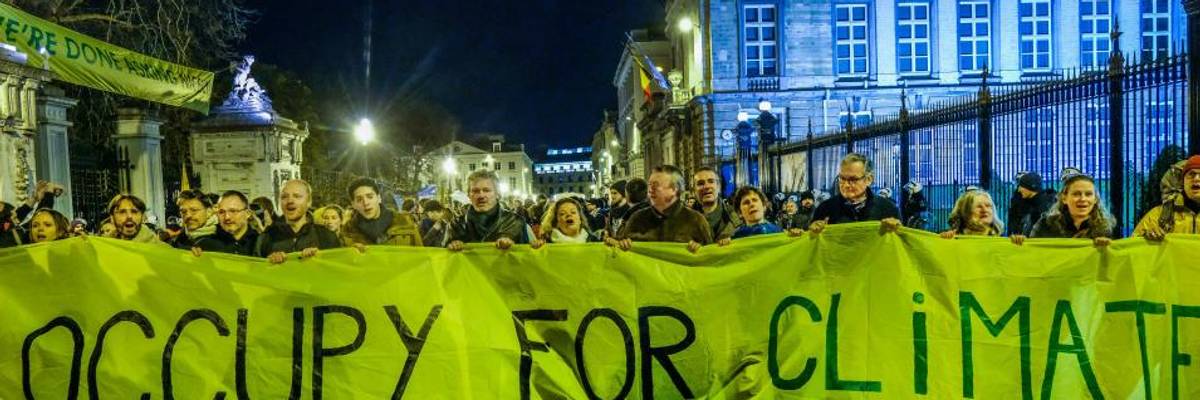
Climate campaigners blocked off the road in front of the Belgian Parliament on Sunday to demand a constitutional revision that will allow a bold climate law to take effect. (Photo: Greenpeace Belgium)
Belgian activists in Brussels are participating in Occupy for Climate to pressure members of parliament to support a constitutional revision that would allow the country to adopt an ambitious climate law with binding targets.
"We are done asking nicely" is the rallying cry of the movement, led by national chapters of Greenpeace and Extinction Rebellion as well as other youth and environmental groups.
After camping out overnight on the Rue de la Loi/Wetstraat--a road that's home to many Belgian and European Union (EU) governmental buildings, including the federal parliament--activists relocated to the nearby Place du Trone/Troonplein, where they plan to stay until a vote on the proposal, scheduled for Tuesday.
"Last night was a tremendous success. Some 100 people spent the night here," Greenpeace campaigner Joeri Thijs told VRT, a national public broadcaster. "In consultation with the police we've decided to switch to the Troonplein. There we're organizing a breakfast and we're asking the people of Brussels to join us."
Outlining the constitutional revision and subsequent climate law sought by occupiers, Flanders Today, an online English-language newspaper, reported:
The proposal would add a single sentence to Belgium's constitution to allow the federal parliament to embark on an ambitious climate plan that has already been prepared. While concrete policies would still need to be created from the plan, the plan itself cannot be considered until the constitution is altered.
If the proposal doesn't pass on Tuesday, it would be for the next legislature in 2024.
"That would be a disaster," Thijs said about the proposed amendment's potential failure. "Climate policy can provide a structure in this very complex country. It can provide a very clear focus in tackling the climate goals that were already agreed to in Paris," referring to the international climate accord from 2015.
"This climate law must be introduced. If it isn't, it's an insult to all the people who take to the streets every week."
--Anuna De Wever, Youth For Climate
Belgium is a federal parliamentary democracy under a constitutional monarchy with many levels of government. As VRT explained, the push to amend the constitution came after "Belgium's council of state ruled that a federal climate law setting out binding targets would be unconstitutional as environment is a regional power."
The climate law, as Brussels Express detailed,
was developed by a group of academics from various universities and presented on February 1 at the Chamber of Representatives. It contains 20 articles and highlights the creation of several new institutions to coordinate the climate policy of the federal state, regions, and language communities of Belgium.
The most controversial sections involve raising the greenhouse gas reduction targets to at least 65 percent by 2030 and 95 percent by 2050 from 1990 levels; increasing the share of renewable energy in gross final energy consumption to 32 percent; and improving energy efficiency by at least 32.5 percent by 2030.
"This climate law must be introduced. If it isn't, it's an insult to all the people who take to the streets every week," Anuna De Wever of Youth For Climate told VRT.
In recent months, Belgium has seen mass mobilizations of youth as part of the global movement for bold climate action, largely inspired by Swedish teenager and Nobel Peace Prize nominee Greta Thunberg. In late January, tens of thousands of people joined a weekend march in Brussels, the EU's de facto capital, to call for urgent action on the climate crisis.
"We're not doing this for fun!" said De Wever. "We'll make our point until they listen."
Passing the revision that will allow the climate law to take effect will require, according to Brussels Express, "a two-thirds majority in the parliament, and a simple majority in both the Flemish-speaking and French-speaking language groups."
Last week, the party MR (Reformist Movement) had indicated it would not support the constitutional amendment, with MR Prime Minister Charles Michel instead favoring a nonbinding agreement. However, under pressure from occupiers on Monday, the party announced its support for the revision:
"Despite months of protests against climate change, our politicians are about to bury the climate law," Greenpeace said in a statement in French on Sunday. "After years of stagnation in climate policy due to a lack of ambition and cooperation, we have arrived at a crucial moment."
"We now need a convincing climate policy that puts Belgium back on track to deliver on the promises of the Paris climate agreement," the group concluded. "We are done asking nicely!"
Dear Common Dreams reader, It’s been nearly 30 years since I co-founded Common Dreams with my late wife, Lina Newhouser. We had the radical notion that journalism should serve the public good, not corporate profits. It was clear to us from the outset what it would take to build such a project. No paid advertisements. No corporate sponsors. No millionaire publisher telling us what to think or do. Many people said we wouldn't last a year, but we proved those doubters wrong. Together with a tremendous team of journalists and dedicated staff, we built an independent media outlet free from the constraints of profits and corporate control. Our mission has always been simple: To inform. To inspire. To ignite change for the common good. Building Common Dreams was not easy. Our survival was never guaranteed. When you take on the most powerful forces—Wall Street greed, fossil fuel industry destruction, Big Tech lobbyists, and uber-rich oligarchs who have spent billions upon billions rigging the economy and democracy in their favor—the only bulwark you have is supporters who believe in your work. But here’s the urgent message from me today. It's never been this bad out there. And it's never been this hard to keep us going. At the very moment Common Dreams is most needed, the threats we face are intensifying. We need your support now more than ever. We don't accept corporate advertising and never will. We don't have a paywall because we don't think people should be blocked from critical news based on their ability to pay. Everything we do is funded by the donations of readers like you. When everyone does the little they can afford, we are strong. But if that support retreats or dries up, so do we. Will you donate now to make sure Common Dreams not only survives but thrives? —Craig Brown, Co-founder |
Belgian activists in Brussels are participating in Occupy for Climate to pressure members of parliament to support a constitutional revision that would allow the country to adopt an ambitious climate law with binding targets.
"We are done asking nicely" is the rallying cry of the movement, led by national chapters of Greenpeace and Extinction Rebellion as well as other youth and environmental groups.
After camping out overnight on the Rue de la Loi/Wetstraat--a road that's home to many Belgian and European Union (EU) governmental buildings, including the federal parliament--activists relocated to the nearby Place du Trone/Troonplein, where they plan to stay until a vote on the proposal, scheduled for Tuesday.
"Last night was a tremendous success. Some 100 people spent the night here," Greenpeace campaigner Joeri Thijs told VRT, a national public broadcaster. "In consultation with the police we've decided to switch to the Troonplein. There we're organizing a breakfast and we're asking the people of Brussels to join us."
Outlining the constitutional revision and subsequent climate law sought by occupiers, Flanders Today, an online English-language newspaper, reported:
The proposal would add a single sentence to Belgium's constitution to allow the federal parliament to embark on an ambitious climate plan that has already been prepared. While concrete policies would still need to be created from the plan, the plan itself cannot be considered until the constitution is altered.
If the proposal doesn't pass on Tuesday, it would be for the next legislature in 2024.
"That would be a disaster," Thijs said about the proposed amendment's potential failure. "Climate policy can provide a structure in this very complex country. It can provide a very clear focus in tackling the climate goals that were already agreed to in Paris," referring to the international climate accord from 2015.
"This climate law must be introduced. If it isn't, it's an insult to all the people who take to the streets every week."
--Anuna De Wever, Youth For Climate
Belgium is a federal parliamentary democracy under a constitutional monarchy with many levels of government. As VRT explained, the push to amend the constitution came after "Belgium's council of state ruled that a federal climate law setting out binding targets would be unconstitutional as environment is a regional power."
The climate law, as Brussels Express detailed,
was developed by a group of academics from various universities and presented on February 1 at the Chamber of Representatives. It contains 20 articles and highlights the creation of several new institutions to coordinate the climate policy of the federal state, regions, and language communities of Belgium.
The most controversial sections involve raising the greenhouse gas reduction targets to at least 65 percent by 2030 and 95 percent by 2050 from 1990 levels; increasing the share of renewable energy in gross final energy consumption to 32 percent; and improving energy efficiency by at least 32.5 percent by 2030.
"This climate law must be introduced. If it isn't, it's an insult to all the people who take to the streets every week," Anuna De Wever of Youth For Climate told VRT.
In recent months, Belgium has seen mass mobilizations of youth as part of the global movement for bold climate action, largely inspired by Swedish teenager and Nobel Peace Prize nominee Greta Thunberg. In late January, tens of thousands of people joined a weekend march in Brussels, the EU's de facto capital, to call for urgent action on the climate crisis.
"We're not doing this for fun!" said De Wever. "We'll make our point until they listen."
Passing the revision that will allow the climate law to take effect will require, according to Brussels Express, "a two-thirds majority in the parliament, and a simple majority in both the Flemish-speaking and French-speaking language groups."
Last week, the party MR (Reformist Movement) had indicated it would not support the constitutional amendment, with MR Prime Minister Charles Michel instead favoring a nonbinding agreement. However, under pressure from occupiers on Monday, the party announced its support for the revision:
"Despite months of protests against climate change, our politicians are about to bury the climate law," Greenpeace said in a statement in French on Sunday. "After years of stagnation in climate policy due to a lack of ambition and cooperation, we have arrived at a crucial moment."
"We now need a convincing climate policy that puts Belgium back on track to deliver on the promises of the Paris climate agreement," the group concluded. "We are done asking nicely!"
Belgian activists in Brussels are participating in Occupy for Climate to pressure members of parliament to support a constitutional revision that would allow the country to adopt an ambitious climate law with binding targets.
"We are done asking nicely" is the rallying cry of the movement, led by national chapters of Greenpeace and Extinction Rebellion as well as other youth and environmental groups.
After camping out overnight on the Rue de la Loi/Wetstraat--a road that's home to many Belgian and European Union (EU) governmental buildings, including the federal parliament--activists relocated to the nearby Place du Trone/Troonplein, where they plan to stay until a vote on the proposal, scheduled for Tuesday.
"Last night was a tremendous success. Some 100 people spent the night here," Greenpeace campaigner Joeri Thijs told VRT, a national public broadcaster. "In consultation with the police we've decided to switch to the Troonplein. There we're organizing a breakfast and we're asking the people of Brussels to join us."
Outlining the constitutional revision and subsequent climate law sought by occupiers, Flanders Today, an online English-language newspaper, reported:
The proposal would add a single sentence to Belgium's constitution to allow the federal parliament to embark on an ambitious climate plan that has already been prepared. While concrete policies would still need to be created from the plan, the plan itself cannot be considered until the constitution is altered.
If the proposal doesn't pass on Tuesday, it would be for the next legislature in 2024.
"That would be a disaster," Thijs said about the proposed amendment's potential failure. "Climate policy can provide a structure in this very complex country. It can provide a very clear focus in tackling the climate goals that were already agreed to in Paris," referring to the international climate accord from 2015.
"This climate law must be introduced. If it isn't, it's an insult to all the people who take to the streets every week."
--Anuna De Wever, Youth For Climate
Belgium is a federal parliamentary democracy under a constitutional monarchy with many levels of government. As VRT explained, the push to amend the constitution came after "Belgium's council of state ruled that a federal climate law setting out binding targets would be unconstitutional as environment is a regional power."
The climate law, as Brussels Express detailed,
was developed by a group of academics from various universities and presented on February 1 at the Chamber of Representatives. It contains 20 articles and highlights the creation of several new institutions to coordinate the climate policy of the federal state, regions, and language communities of Belgium.
The most controversial sections involve raising the greenhouse gas reduction targets to at least 65 percent by 2030 and 95 percent by 2050 from 1990 levels; increasing the share of renewable energy in gross final energy consumption to 32 percent; and improving energy efficiency by at least 32.5 percent by 2030.
"This climate law must be introduced. If it isn't, it's an insult to all the people who take to the streets every week," Anuna De Wever of Youth For Climate told VRT.
In recent months, Belgium has seen mass mobilizations of youth as part of the global movement for bold climate action, largely inspired by Swedish teenager and Nobel Peace Prize nominee Greta Thunberg. In late January, tens of thousands of people joined a weekend march in Brussels, the EU's de facto capital, to call for urgent action on the climate crisis.
"We're not doing this for fun!" said De Wever. "We'll make our point until they listen."
Passing the revision that will allow the climate law to take effect will require, according to Brussels Express, "a two-thirds majority in the parliament, and a simple majority in both the Flemish-speaking and French-speaking language groups."
Last week, the party MR (Reformist Movement) had indicated it would not support the constitutional amendment, with MR Prime Minister Charles Michel instead favoring a nonbinding agreement. However, under pressure from occupiers on Monday, the party announced its support for the revision:
"Despite months of protests against climate change, our politicians are about to bury the climate law," Greenpeace said in a statement in French on Sunday. "After years of stagnation in climate policy due to a lack of ambition and cooperation, we have arrived at a crucial moment."
"We now need a convincing climate policy that puts Belgium back on track to deliver on the promises of the Paris climate agreement," the group concluded. "We are done asking nicely!"