SUBSCRIBE TO OUR FREE NEWSLETTER
Daily news & progressive opinion—funded by the people, not the corporations—delivered straight to your inbox.
5
#000000
#FFFFFF
To donate by check, phone, or other method, see our More Ways to Give page.
Daily news & progressive opinion—funded by the people, not the corporations—delivered straight to your inbox.
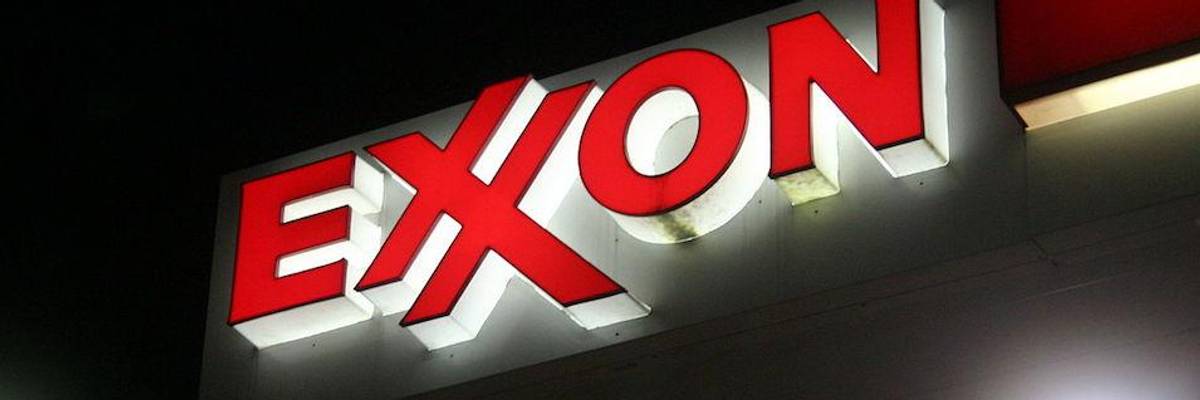
An Exxon sign in Framingham, MA. (Photo: Brian Katt, Wikimedia Commons)
ExxonMobil could soon join Monsanto as one of the only two companies not allowed to lobby European Union lawmakers.
The oil giant, one of the world's largest energy companies, was a no-show at a climate change denial hearing in Brussels Thursday, prompting the action.
In a statement, ExxonMobil said that it was unable to attend because of "ongoing climate change-related litigation in the U.S."
That wasn't good enough for Molly Scott Cato, a Green Party member of the European Parliament. In a statement, Green said a company which had spent millions on climate denial and then ducked responsibility for its actions didn't deserve the right to promote itself in the EU.
"We cannot allow the lobbyists from such corporations free access to the corridors of the European parliament," said Cato. "We must remove their badges immediately."
ExxonMobil spent over EUR35 million on lobbying efforts in the EU since 2010. If the vote goes against the energy giant, it would lose that right in the European Parliament.
Agribusiness and chemical conglomerate Monsanto lost EU lobbying rights in 2017 after the company refused to attend a hearing on the safety of the chemical glyphosate in the weedkiller RoundUp and Monsanto's role in attempting to manipulate the regulatory process around the product.
"Those who ignore the rules of democracy also lose their rights as a lobbyist in the European parliament," Green party president Philippe Lamberts said at the time.
In a letter to the committee announcing its refusal to attend Thursday's hearing, ExxonMobil said that it was certain a review of the facts would exonerate the company from accusations that it secretly knew the dangers of carbon emissions for decades while continuing to fund and promote climate denialism.
"We are confident that a neutral review of the facts will refute the allegations made by the company's critics that are distortions of ExxonMobil's nearly 40-year history of climate research," the company wrote.
Internal documents provided to the hearing by Harvard University research fellow Geoffrey Supran told a different story--that ExxonMobil knew of the damage its product was causing the planet since at least 1977 but pushed forward with promoting climate change denialism anyway.
"It is the overwhelming consensus of experts studying the history of fossil fuel funding that companies, including ExxonMobil, have orchestrated, funded and perpetuated climate misinformation to mislead the public and politicians, and stifle action," Supran said. "Unfortunately, they largely succeeded."
Advocates for climate responsibility celebrated the move against ExxonMobil.
" Big Oil is the new Big Tobacco," said environmentalist Bill McKibben.
Sinn Fein member Lynn Boylan pointed out that the company has spent millions on a movement to stop or slow climate action.
Watch Supran's testimony here:
Dear Common Dreams reader, It’s been nearly 30 years since I co-founded Common Dreams with my late wife, Lina Newhouser. We had the radical notion that journalism should serve the public good, not corporate profits. It was clear to us from the outset what it would take to build such a project. No paid advertisements. No corporate sponsors. No millionaire publisher telling us what to think or do. Many people said we wouldn't last a year, but we proved those doubters wrong. Together with a tremendous team of journalists and dedicated staff, we built an independent media outlet free from the constraints of profits and corporate control. Our mission has always been simple: To inform. To inspire. To ignite change for the common good. Building Common Dreams was not easy. Our survival was never guaranteed. When you take on the most powerful forces—Wall Street greed, fossil fuel industry destruction, Big Tech lobbyists, and uber-rich oligarchs who have spent billions upon billions rigging the economy and democracy in their favor—the only bulwark you have is supporters who believe in your work. But here’s the urgent message from me today. It's never been this bad out there. And it's never been this hard to keep us going. At the very moment Common Dreams is most needed, the threats we face are intensifying. We need your support now more than ever. We don't accept corporate advertising and never will. We don't have a paywall because we don't think people should be blocked from critical news based on their ability to pay. Everything we do is funded by the donations of readers like you. When everyone does the little they can afford, we are strong. But if that support retreats or dries up, so do we. Will you donate now to make sure Common Dreams not only survives but thrives? —Craig Brown, Co-founder |
ExxonMobil could soon join Monsanto as one of the only two companies not allowed to lobby European Union lawmakers.
The oil giant, one of the world's largest energy companies, was a no-show at a climate change denial hearing in Brussels Thursday, prompting the action.
In a statement, ExxonMobil said that it was unable to attend because of "ongoing climate change-related litigation in the U.S."
That wasn't good enough for Molly Scott Cato, a Green Party member of the European Parliament. In a statement, Green said a company which had spent millions on climate denial and then ducked responsibility for its actions didn't deserve the right to promote itself in the EU.
"We cannot allow the lobbyists from such corporations free access to the corridors of the European parliament," said Cato. "We must remove their badges immediately."
ExxonMobil spent over EUR35 million on lobbying efforts in the EU since 2010. If the vote goes against the energy giant, it would lose that right in the European Parliament.
Agribusiness and chemical conglomerate Monsanto lost EU lobbying rights in 2017 after the company refused to attend a hearing on the safety of the chemical glyphosate in the weedkiller RoundUp and Monsanto's role in attempting to manipulate the regulatory process around the product.
"Those who ignore the rules of democracy also lose their rights as a lobbyist in the European parliament," Green party president Philippe Lamberts said at the time.
In a letter to the committee announcing its refusal to attend Thursday's hearing, ExxonMobil said that it was certain a review of the facts would exonerate the company from accusations that it secretly knew the dangers of carbon emissions for decades while continuing to fund and promote climate denialism.
"We are confident that a neutral review of the facts will refute the allegations made by the company's critics that are distortions of ExxonMobil's nearly 40-year history of climate research," the company wrote.
Internal documents provided to the hearing by Harvard University research fellow Geoffrey Supran told a different story--that ExxonMobil knew of the damage its product was causing the planet since at least 1977 but pushed forward with promoting climate change denialism anyway.
"It is the overwhelming consensus of experts studying the history of fossil fuel funding that companies, including ExxonMobil, have orchestrated, funded and perpetuated climate misinformation to mislead the public and politicians, and stifle action," Supran said. "Unfortunately, they largely succeeded."
Advocates for climate responsibility celebrated the move against ExxonMobil.
" Big Oil is the new Big Tobacco," said environmentalist Bill McKibben.
Sinn Fein member Lynn Boylan pointed out that the company has spent millions on a movement to stop or slow climate action.
Watch Supran's testimony here:
ExxonMobil could soon join Monsanto as one of the only two companies not allowed to lobby European Union lawmakers.
The oil giant, one of the world's largest energy companies, was a no-show at a climate change denial hearing in Brussels Thursday, prompting the action.
In a statement, ExxonMobil said that it was unable to attend because of "ongoing climate change-related litigation in the U.S."
That wasn't good enough for Molly Scott Cato, a Green Party member of the European Parliament. In a statement, Green said a company which had spent millions on climate denial and then ducked responsibility for its actions didn't deserve the right to promote itself in the EU.
"We cannot allow the lobbyists from such corporations free access to the corridors of the European parliament," said Cato. "We must remove their badges immediately."
ExxonMobil spent over EUR35 million on lobbying efforts in the EU since 2010. If the vote goes against the energy giant, it would lose that right in the European Parliament.
Agribusiness and chemical conglomerate Monsanto lost EU lobbying rights in 2017 after the company refused to attend a hearing on the safety of the chemical glyphosate in the weedkiller RoundUp and Monsanto's role in attempting to manipulate the regulatory process around the product.
"Those who ignore the rules of democracy also lose their rights as a lobbyist in the European parliament," Green party president Philippe Lamberts said at the time.
In a letter to the committee announcing its refusal to attend Thursday's hearing, ExxonMobil said that it was certain a review of the facts would exonerate the company from accusations that it secretly knew the dangers of carbon emissions for decades while continuing to fund and promote climate denialism.
"We are confident that a neutral review of the facts will refute the allegations made by the company's critics that are distortions of ExxonMobil's nearly 40-year history of climate research," the company wrote.
Internal documents provided to the hearing by Harvard University research fellow Geoffrey Supran told a different story--that ExxonMobil knew of the damage its product was causing the planet since at least 1977 but pushed forward with promoting climate change denialism anyway.
"It is the overwhelming consensus of experts studying the history of fossil fuel funding that companies, including ExxonMobil, have orchestrated, funded and perpetuated climate misinformation to mislead the public and politicians, and stifle action," Supran said. "Unfortunately, they largely succeeded."
Advocates for climate responsibility celebrated the move against ExxonMobil.
" Big Oil is the new Big Tobacco," said environmentalist Bill McKibben.
Sinn Fein member Lynn Boylan pointed out that the company has spent millions on a movement to stop or slow climate action.
Watch Supran's testimony here: