SUBSCRIBE TO OUR FREE NEWSLETTER
Daily news & progressive opinion—funded by the people, not the corporations—delivered straight to your inbox.
5
#000000
#FFFFFF
To donate by check, phone, or other method, see our More Ways to Give page.
Daily news & progressive opinion—funded by the people, not the corporations—delivered straight to your inbox.
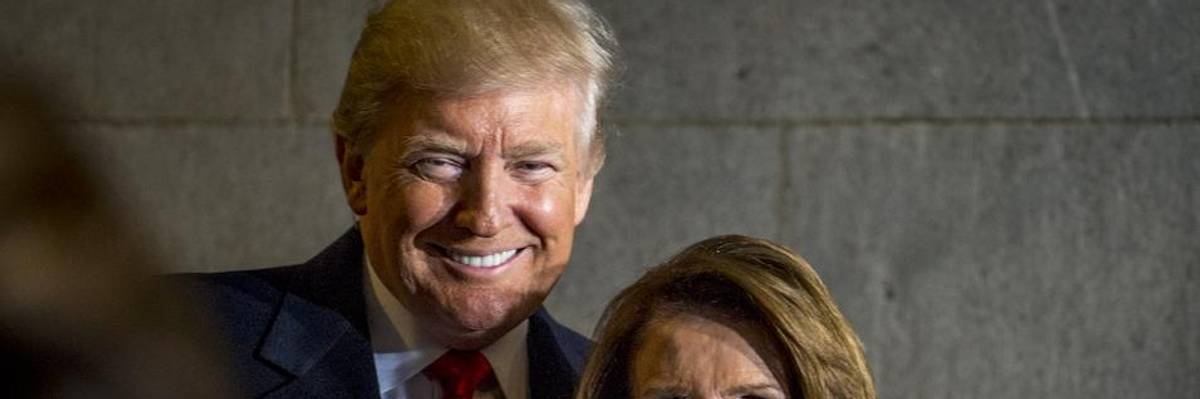
President-elect Donald J. Trump and House Minority Leader Nancy Pelosi share a friendly moment on January 20, 2017. (Photo: Wikimedia Commons)
President Donald Trump's requested military budget is another record breaker--and Democrats are countering with their own increase.
The Trump administration unveiled the details of its proposal to the public on March 12. At $750 billion, the military seeks to receive $36 billion more than last year's record $714 billion budget--an increase that experts say is aimed at China and Russia. Democrats have signaled that the increase is a nonstarter, but their counter-offer of $733 billion isn't exactly a difference in more than degrees, Matt Taibbi wrote in Rolling Stone.
"The Democrats want to lower Trump's number," said Taibbi, "but still give the Pentagon a raise."
The budget increase marks a new direction on a number of levels. Trump is breaking with tradition on federal spending by increasing the military budget while slashing social services. That's deceptive, wrote Lindsay Koshgarian, program director at the budget research organization National Priorities Project.
"If Trump pretends that the Pentagon is also subject to strict spending limits," Koshgarian said, "he can argue that his more than $50 billion in cuts to programs like the Environmental Protection Agency and Legal Aid are honest attempts to control federal spending."
Pentagon spending proposed in the new military budget will double the discretionary war funds the military uses while cutting the standing Pentagon budget by $71 billion. The sharp increase in Overseas Contingency Operations (OCO) funding, or "war funding," is adding to the so-called "Pentagon slush fund." It's just a way of getting around budget caps, said Taibbi.
"OCO funding is mainly used as a means to increase military spending above caps designated by Congress," Taibbi explained. "Thanks to the Budget Control Act of 2011, Congress can only spend a certain percentage of overall appropriations on defense versus non-defense programs. In 2018, the cap was roughly 54 percent."
The increase in spending appears set to pass Congress. That's "appalling" in a chamber now controlled by Democrats, journalist David Dayen wrote on Twitter.
The Democrats proposed $733 billion budget would give the military most of what it wants in 2020, House Armed Services Committee Chairman Adam Smith (D-Wash.) said in comments to the Federal News Network's Scott Maucione.
"The House Budget Committee, the number that they've talked about for defense is $733 billion," said Smith. "It's a not insubstantial number."
While some commentators argued in favor of the defense budget, or, at least, in favor of not fighting it, progressive critics fought back.
"I think it'd be a bad idea to use their limited leverage for a fight over the DOD budget," said Nation writer Joshua Holland, referring to Democrats in Congress.
At Bloomberg, Henry Kissinger Distinguished Professor at Johns Hopkins University's School of Advanced International Studies Hal Brand went further, framing the increase as somehow "progressive" and the right thing to do for working people.
" Progressives should learn to love, or at least tolerate, high levels of military spending," wrote Brand, "precisely because it tends to advance a key progressive goal: Improving the economic fortunes of the middle class."
The argument was roundly rejected by critics
Journalist Ben Norton sarcastically noted the use of an economic argument to further the war machine.
"Military Keynesianism is back!" Norton tweeted. "And these 'progressives' want you to know that killing people in the Global South is 'Good for the Economy'(tm)"
"Democrats must not allow one penny over the budget caps if we want to stop endless wars," said Rep. Ro Khanna (D-Calif.).
Activist group CODEPINK suggested the money could be spent better elsewhere in a call to action.
"Spend our tax dollars on healthcare, food, housing, and money for a Green New Deal," the group tweeted.
This country and this world are at a monumental crossroads. US voters have an opportunity to beat back the forces of fascism and confront the billionaires who are rigging the economy, our media system, and our democracy, making it increasingly impossible for ordinary people to get by. We’re not just talking about the election. We’re talking about what must be done once these fascist elements are vanquished from power. We need a bolder set of solutions than what either major party has so far been willing to offer and a working-class movement ready to fight like hell for it. Trump didn't emerge from nowhere. The conditions that fueled MAGA authoritarianism were created by decades of radical neoliberal economic policies and a corrupt political system dominated by corporate interests. They slashed taxes on the super-rich, promising that the benefits would trickle down. They said giveaways to the corporate titans would make life more affordable for the rest of us. It was all bullshit. And when a bitter, betrayed populace searches for someone to blame, right-wing demagogues have little trouble finding scapegoats. People know when they're being lied to, but you won't hear any of this from the corporate media. Only independent journalism—powered and funded by people who believe in building a better world—can deliver truly trustworthy daily news. If you share our vision, please contribute whatever you can to sustain our work. |
President Donald Trump's requested military budget is another record breaker--and Democrats are countering with their own increase.
The Trump administration unveiled the details of its proposal to the public on March 12. At $750 billion, the military seeks to receive $36 billion more than last year's record $714 billion budget--an increase that experts say is aimed at China and Russia. Democrats have signaled that the increase is a nonstarter, but their counter-offer of $733 billion isn't exactly a difference in more than degrees, Matt Taibbi wrote in Rolling Stone.
"The Democrats want to lower Trump's number," said Taibbi, "but still give the Pentagon a raise."
The budget increase marks a new direction on a number of levels. Trump is breaking with tradition on federal spending by increasing the military budget while slashing social services. That's deceptive, wrote Lindsay Koshgarian, program director at the budget research organization National Priorities Project.
"If Trump pretends that the Pentagon is also subject to strict spending limits," Koshgarian said, "he can argue that his more than $50 billion in cuts to programs like the Environmental Protection Agency and Legal Aid are honest attempts to control federal spending."
Pentagon spending proposed in the new military budget will double the discretionary war funds the military uses while cutting the standing Pentagon budget by $71 billion. The sharp increase in Overseas Contingency Operations (OCO) funding, or "war funding," is adding to the so-called "Pentagon slush fund." It's just a way of getting around budget caps, said Taibbi.
"OCO funding is mainly used as a means to increase military spending above caps designated by Congress," Taibbi explained. "Thanks to the Budget Control Act of 2011, Congress can only spend a certain percentage of overall appropriations on defense versus non-defense programs. In 2018, the cap was roughly 54 percent."
The increase in spending appears set to pass Congress. That's "appalling" in a chamber now controlled by Democrats, journalist David Dayen wrote on Twitter.
The Democrats proposed $733 billion budget would give the military most of what it wants in 2020, House Armed Services Committee Chairman Adam Smith (D-Wash.) said in comments to the Federal News Network's Scott Maucione.
"The House Budget Committee, the number that they've talked about for defense is $733 billion," said Smith. "It's a not insubstantial number."
While some commentators argued in favor of the defense budget, or, at least, in favor of not fighting it, progressive critics fought back.
"I think it'd be a bad idea to use their limited leverage for a fight over the DOD budget," said Nation writer Joshua Holland, referring to Democrats in Congress.
At Bloomberg, Henry Kissinger Distinguished Professor at Johns Hopkins University's School of Advanced International Studies Hal Brand went further, framing the increase as somehow "progressive" and the right thing to do for working people.
" Progressives should learn to love, or at least tolerate, high levels of military spending," wrote Brand, "precisely because it tends to advance a key progressive goal: Improving the economic fortunes of the middle class."
The argument was roundly rejected by critics
Journalist Ben Norton sarcastically noted the use of an economic argument to further the war machine.
"Military Keynesianism is back!" Norton tweeted. "And these 'progressives' want you to know that killing people in the Global South is 'Good for the Economy'(tm)"
"Democrats must not allow one penny over the budget caps if we want to stop endless wars," said Rep. Ro Khanna (D-Calif.).
Activist group CODEPINK suggested the money could be spent better elsewhere in a call to action.
"Spend our tax dollars on healthcare, food, housing, and money for a Green New Deal," the group tweeted.