
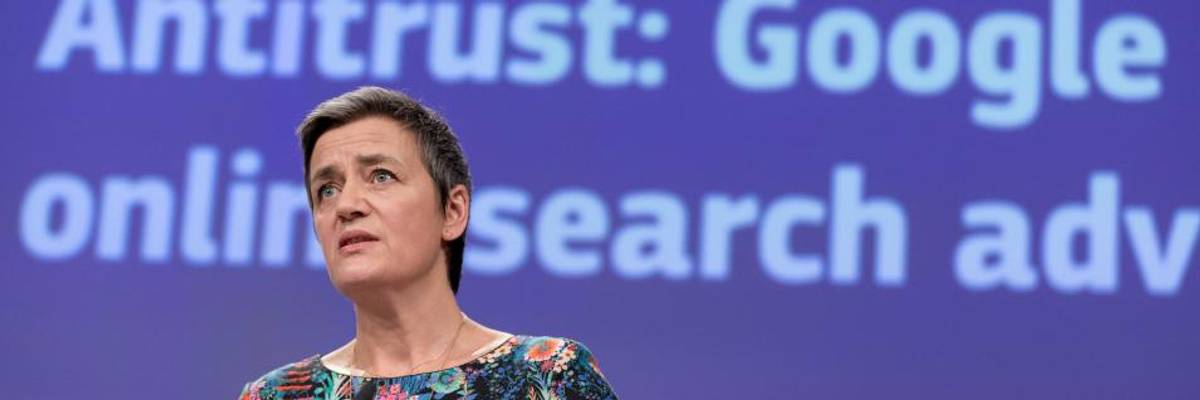
European Commissioner for Competition Margrethe Vestager talks to the media during a news conference about a new antitrust fine targeting Google. (Photo: Thierry Monasse/Getty Images)
Calls for Breaking Up Tech Giants Grow Louder After EU Hits Google With $1.7 Billion Antitrust Fine
Some praised Europe for "cracking down on Google's corrupt business model." Others called the fine "another useless parking ticket."
In a move that elevated growing calls for breaking up tech giants, European regulators on Wednesday hit Alphabet's Google with its third antitrust fine in two years--this time, fining the company nearly $1.7 billion.
"Breaking up big tech isn't the only solution, but it's the necessary first step to actually addressing the problem of big tech."
--Matt Stoller, Open Markets Institute
The new penalty comes in response to Google's "illegal practices in search advertising brokering to cement its dominant market position," in violation of European Union (EU) anti-competition rules.
It follows fines of $2.7 billion for Google's online shopping search results in 2017 and $5 billion for its Android mobile operating system and applications last year--bringing the two-year total to more than $9 billion.
"Google is dominant when it comes to online advertising brokerage market, with market shares in Europe of above 70 percent," said Margrethe Vestager, the EU commissioner for competition. "Google abused its dominance to stop websites using brokers other than the AdSense platform."
Former New York attorney general candidate Zephyr Teachout celebrated the penalty. "Europe is cracking down on Google's corrupt business model," she tweeted. "The abuse of power is real. But the tide has changed."
"The U.S. should act too," Teachout said, pointing to Sen. Elizabeth Warren's (D-Mass.) plan to break up tech giants. While unveiling her plan this month, the senator and 2020 presidential candidate charged that companies such as Google, Amazon, and Facebook have " too much power over our economy, our society, and our democracy."
In a series of tweets on Wednesday, Matt Stoller, a fellow at the Open Markets Institute, concurred with Teachout and Warren. "Breaking up big tech isn't the only solution," he said, "but it's the necessary first step to actually addressing the problem of big tech."
Google has been at odds with the EU over antitrust rules for the past decade. As Vestager was investigating Google for antitrust violations in November of 2014, members of the European Parliament voted 384-174 for the European Commission to consider "unbundling search engines from other commercial services."
However, as Stoller noted, Vestager does not agree with Warren's approach to regulating big tech. "When it comes to the very far reaching proposal to split up companies, for us, from a European perspective, that would be a measure of last resort," the EU commissioner said, explaining that she favors antitrust probes and fines to "change the marketplace to make it a fair place."
While the EU's fines targeting Google far outweigh any actions by U.S. regulators, Stoller dimissed the latest penalty as "another useless parking ticket" and suggested that given the company's continued dominance of the digital world, Europe's current rules and penalties "aren't working."
Though the impact of the EU's fines is debatable, they have forced some reforms. The Associated Press reported that "Google, which is appealing both of the earlier cases, said ahead of Wednesday's announcement that it has put in place remedies required by the commission."
"We've already made a wide range of changes to our products to address the commission's concerns," said Kent Walker, Google's senior vice president of global affairs. "Over the next few months, we'll be making further updates to give more visibility to rivals in Europe."
We are at a crossroads
This country and this world are at a monumental crossroads. US voters have an opportunity to beat back the forces of fascism and confront the billionaires who are rigging the economy, our media system, and our democracy, making it increasingly impossible for ordinary people to get by. We’re not just talking about the election. We’re talking about what must be done once these fascist elements are vanquished from power. We need a bolder set of solutions than what either major party has so far been willing to offer and a working-class movement ready to fight like hell for it. Trump didn't emerge from nowhere. The conditions that fueled MAGA authoritarianism were created by decades of radical neoliberal economic policies and a corrupt political system dominated by corporate interests. They slashed taxes on the super-rich, promising that the benefits would trickle down. They said giveaways to the corporate titans would make life more affordable for the rest of us. It was all bullshit. And when a bitter, betrayed populace searches for someone to blame, right-wing demagogues have little trouble finding scapegoats. People know when they're being lied to, but you won't hear any of this from the corporate media. Only independent journalism—powered and funded by people who believe in building a better world—can deliver truly trustworthy daily news. Our Fall Campaign is underway, and we need your help. To power our newsroom through the rest of the year, we need to raise $125,000 by midnight on October 31. So if you share our vision, please contribute whatever you can to sustain our work. |
In a move that elevated growing calls for breaking up tech giants, European regulators on Wednesday hit Alphabet's Google with its third antitrust fine in two years--this time, fining the company nearly $1.7 billion.
"Breaking up big tech isn't the only solution, but it's the necessary first step to actually addressing the problem of big tech."
--Matt Stoller, Open Markets Institute
The new penalty comes in response to Google's "illegal practices in search advertising brokering to cement its dominant market position," in violation of European Union (EU) anti-competition rules.
It follows fines of $2.7 billion for Google's online shopping search results in 2017 and $5 billion for its Android mobile operating system and applications last year--bringing the two-year total to more than $9 billion.
"Google is dominant when it comes to online advertising brokerage market, with market shares in Europe of above 70 percent," said Margrethe Vestager, the EU commissioner for competition. "Google abused its dominance to stop websites using brokers other than the AdSense platform."
Former New York attorney general candidate Zephyr Teachout celebrated the penalty. "Europe is cracking down on Google's corrupt business model," she tweeted. "The abuse of power is real. But the tide has changed."
"The U.S. should act too," Teachout said, pointing to Sen. Elizabeth Warren's (D-Mass.) plan to break up tech giants. While unveiling her plan this month, the senator and 2020 presidential candidate charged that companies such as Google, Amazon, and Facebook have " too much power over our economy, our society, and our democracy."
In a series of tweets on Wednesday, Matt Stoller, a fellow at the Open Markets Institute, concurred with Teachout and Warren. "Breaking up big tech isn't the only solution," he said, "but it's the necessary first step to actually addressing the problem of big tech."
Google has been at odds with the EU over antitrust rules for the past decade. As Vestager was investigating Google for antitrust violations in November of 2014, members of the European Parliament voted 384-174 for the European Commission to consider "unbundling search engines from other commercial services."
However, as Stoller noted, Vestager does not agree with Warren's approach to regulating big tech. "When it comes to the very far reaching proposal to split up companies, for us, from a European perspective, that would be a measure of last resort," the EU commissioner said, explaining that she favors antitrust probes and fines to "change the marketplace to make it a fair place."
While the EU's fines targeting Google far outweigh any actions by U.S. regulators, Stoller dimissed the latest penalty as "another useless parking ticket" and suggested that given the company's continued dominance of the digital world, Europe's current rules and penalties "aren't working."
Though the impact of the EU's fines is debatable, they have forced some reforms. The Associated Press reported that "Google, which is appealing both of the earlier cases, said ahead of Wednesday's announcement that it has put in place remedies required by the commission."
"We've already made a wide range of changes to our products to address the commission's concerns," said Kent Walker, Google's senior vice president of global affairs. "Over the next few months, we'll be making further updates to give more visibility to rivals in Europe."