

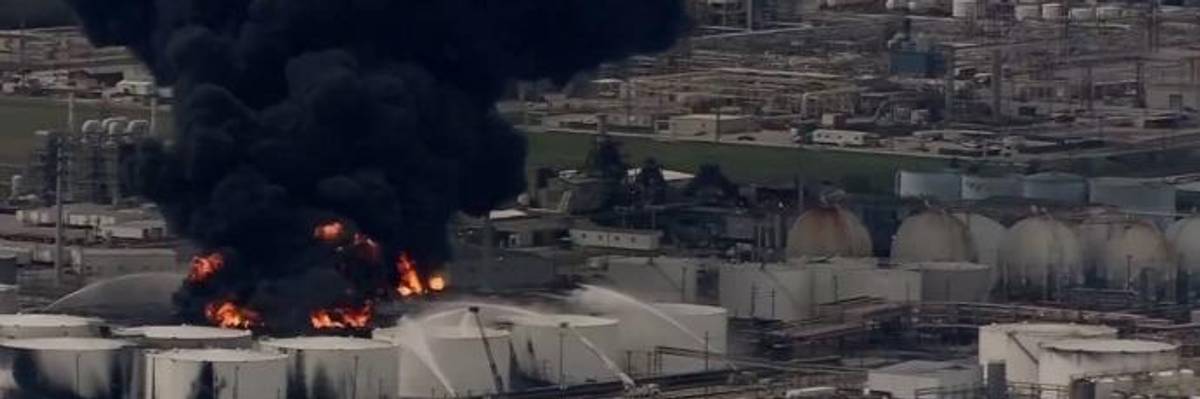
A fire erupted Sunday at a petrochemical plant in Deer Park, Texas. (Screengrab via @NowThis)
Fire at Houston-Area Petrochemical Plant Rages as Company's History of Violations Gets Renewed Scrutiny
Fire could take two more days to burn out, authorities say
A petrochemical plant near Houston continued to burn for a second day on Monday, raising questions about the quality and safety of the air.
The Deer Park facility is owned by Intercontinental Terminals Company (ITC), which said the fire broke out at roughly 10:30am Sunday. Seven tanks are involved, the company said, and they contain naptha, xylene, "gas blend stocks," and "base oil."
"It's going to have to burn out at the tank," Ray Russell, communications officer for Channel Industries Mutual Aid, which is aiding the response effort, said at a news conference. It could take "probably two days" for that to happen, he added.
No injuries were immediately reported.
"Although the risk of explosion is minimal, we continue to take precautions to further reduce this possibility," the company said (pdf) in a statemnt.
An order to shelter in place for the city of Deer Park was lifted Monday morning.
Filming outside the plant on Monday, local ABC13 reporter Miya Shay said that despite the assertion by the city, informed by results from a private air monitoring contractor, that the air quality was safe, it is "hard to believe it's all fine."
As Luke Metzger, executive director of Environment Texas, pointed out, "Intercontinental Terminals estimates the fire has already resulted in 3.1 million pounds of unauthorized emissions. That's more than all the facilities in the Houston area put out during Harvey."
What's more, he said, the company "has a history of violations. For example, the company discharged cyanide in to the impaired Tucker Creek eight times above permitted levels--once as high as 1138 percent above the permit."
The Deer Park incident erupted just one day after a fire broke out roughly a dozen miles away at ExxonMobil's massive refinery in Baytown. That fire has been contained.
The Texas arm of advocacy group Public Citizen pointed to the recent incidents as evidence that the Environment Protection Agency and Texas Commission on Environmental Quality should do a better job at protecting public health:
We are at a crossroads
This country and this world are at a monumental crossroads. In a few short weeks, US voters will have an opportunity to beat back the forces of fascism and confront the billionaires who are rigging the economy, our media system, and our democracy, making it increasingly impossible for ordinary people to get by. We’re not just talking about the election. We’re talking about what must be done once these fascist elements are vanquished from power. We need a bolder set of solutions than what either major party has so far been willing to offer and a working-class movement ready to fight like hell for it. Trump didn't emerge from nowhere. The conditions that fueled MAGA authoritarianism were created by decades of radical neoliberal economic policies and a corrupt political system dominated by corporate interests. They slashed taxes on the super-rich, promising that the benefits would trickle down. They said giveaways to the corporate titans would make life more affordable for the rest of us. It was all bullshit. And when a bitter, betrayed populace searches for someone to blame, right-wing demagogues have little trouble finding scapegoats. People know when they're being lied to, but you won't hear any of this from the corporate media. Only independent journalism—powered and funded by people who believe in building a better world—can deliver truly trustworthy daily news. Our Fall Campaign is underway, and we need your help. To power our newsroom through the rest of the year, we need to raise $125,000 by midnight on October 31. So if you share our vision, please contribute whatever you can to sustain our work. |
A petrochemical plant near Houston continued to burn for a second day on Monday, raising questions about the quality and safety of the air.
The Deer Park facility is owned by Intercontinental Terminals Company (ITC), which said the fire broke out at roughly 10:30am Sunday. Seven tanks are involved, the company said, and they contain naptha, xylene, "gas blend stocks," and "base oil."
"It's going to have to burn out at the tank," Ray Russell, communications officer for Channel Industries Mutual Aid, which is aiding the response effort, said at a news conference. It could take "probably two days" for that to happen, he added.
No injuries were immediately reported.
"Although the risk of explosion is minimal, we continue to take precautions to further reduce this possibility," the company said (pdf) in a statemnt.
An order to shelter in place for the city of Deer Park was lifted Monday morning.
Filming outside the plant on Monday, local ABC13 reporter Miya Shay said that despite the assertion by the city, informed by results from a private air monitoring contractor, that the air quality was safe, it is "hard to believe it's all fine."
As Luke Metzger, executive director of Environment Texas, pointed out, "Intercontinental Terminals estimates the fire has already resulted in 3.1 million pounds of unauthorized emissions. That's more than all the facilities in the Houston area put out during Harvey."
What's more, he said, the company "has a history of violations. For example, the company discharged cyanide in to the impaired Tucker Creek eight times above permitted levels--once as high as 1138 percent above the permit."
The Deer Park incident erupted just one day after a fire broke out roughly a dozen miles away at ExxonMobil's massive refinery in Baytown. That fire has been contained.
The Texas arm of advocacy group Public Citizen pointed to the recent incidents as evidence that the Environment Protection Agency and Texas Commission on Environmental Quality should do a better job at protecting public health:
A petrochemical plant near Houston continued to burn for a second day on Monday, raising questions about the quality and safety of the air.
The Deer Park facility is owned by Intercontinental Terminals Company (ITC), which said the fire broke out at roughly 10:30am Sunday. Seven tanks are involved, the company said, and they contain naptha, xylene, "gas blend stocks," and "base oil."
"It's going to have to burn out at the tank," Ray Russell, communications officer for Channel Industries Mutual Aid, which is aiding the response effort, said at a news conference. It could take "probably two days" for that to happen, he added.
No injuries were immediately reported.
"Although the risk of explosion is minimal, we continue to take precautions to further reduce this possibility," the company said (pdf) in a statemnt.
An order to shelter in place for the city of Deer Park was lifted Monday morning.
Filming outside the plant on Monday, local ABC13 reporter Miya Shay said that despite the assertion by the city, informed by results from a private air monitoring contractor, that the air quality was safe, it is "hard to believe it's all fine."
As Luke Metzger, executive director of Environment Texas, pointed out, "Intercontinental Terminals estimates the fire has already resulted in 3.1 million pounds of unauthorized emissions. That's more than all the facilities in the Houston area put out during Harvey."
What's more, he said, the company "has a history of violations. For example, the company discharged cyanide in to the impaired Tucker Creek eight times above permitted levels--once as high as 1138 percent above the permit."
The Deer Park incident erupted just one day after a fire broke out roughly a dozen miles away at ExxonMobil's massive refinery in Baytown. That fire has been contained.
The Texas arm of advocacy group Public Citizen pointed to the recent incidents as evidence that the Environment Protection Agency and Texas Commission on Environmental Quality should do a better job at protecting public health: