SUBSCRIBE TO OUR FREE NEWSLETTER
Daily news & progressive opinion—funded by the people, not the corporations—delivered straight to your inbox.
5
#000000
#FFFFFF
To donate by check, phone, or other method, see our More Ways to Give page.
Daily news & progressive opinion—funded by the people, not the corporations—delivered straight to your inbox.
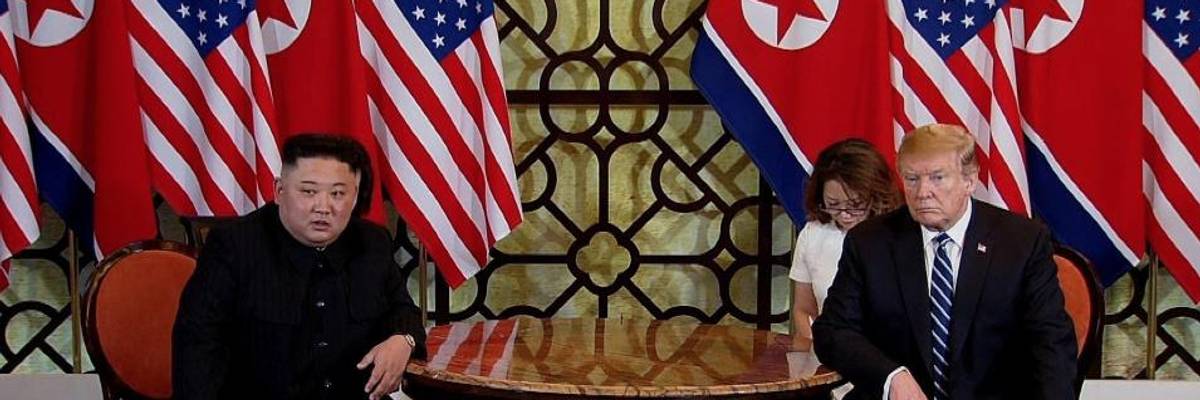
North Korean leader Kim Jong Un and U.S. President Donald Trump met for a second summit meeting in Hanoi, Vietnam. (Photo: Vietnam News Agency/Handout/Getty Images)
Peace leaders and international observers expressed disappointment on Thursday that President Donald Trump and North Korean leader Kim Jong Un cut short their second summit after they reached an impasse over the easing of economic sanctions.
The talks concluded abruptly without Trump and Kim formally ending the decades-long war or finalizing a nuclear deal.
"This is a huge missed opportunity and a disappointment to Koreans waiting 67 years to see a decisive end to the Korean War," said Christine Ahn, executive director of Women Cross DMZ, who traveled to Hanoi, Vietnam for the meeting. "Declaring an end to the Korean War will be an important step to demonstrate their commitment to transforming the relationship from one of war to peace."
Trump confirmed to reporters that the disagreement over sanctions led to the breakdown. "It was about the sanctions," he said. "Basically they wanted the sanctions lifted in their entirety, but we couldn't do that."
As Trump put it, "We had some options, but at this time we decided not to do any of the options."
As the Washington Post reported:
Kim said he was prepared in principle to denuclearize, and Trump said an agreement was "ready to sign." But Trump said the main impediment to a deal was Kim's requirement that the United States lift all economic sanctions on North Korea in exchange for the closure of only one North Korean nuclear facility, which still would have left Pyongyang with a large arsenal of missiles and warheads...
For Trump, the surprising turn of events amounted to a diplomatic failure. The president flew 20 hours to Vietnam with hopes of producing demonstrable progress toward North Korea's denuclearization, building upon his first summit meeting with Kim last summer in Singapore.
Reports from South Korea have suggested that John Bolton, Trump's hawkish national security advisor who has been skeptical about negotiations with Kim, might have played a role in the breakdown by adding demands that North Korea also report chemical and biological weapons.
Bolton's role notwithstanding, Trump's conclusion after two days was, as he told reporters, "Sometimes you have to walk, and this was just one of those times."
However, "this wasn't a walkaway like you get up and walk out," the president added. "No, this was very friendly. We shook hands... There's a warmth that we have, and I hope that stays. I think it will. But we're positioned to do something very special."
That optimism about future progress was echoed by some of the disappointed peace advocates, including Liz Bernstein, executive director of Nobel Women's Initiative.
"The past two summits have been important building blocks," Bernstein said. "Going forward, there must be a more robust official diplomatic process, as well as the inclusion of civil society, especially women, that have on-the-ground expertise and insight that can help both governments come to greater understanding."
Kevin Martin, president of Peace Action and coordinator of the Korea Peace Network, called on members of Congress to back legislation introduced by Rep. Ro Khanna (D-Calif.), which urges the Trump administration to end the Korean War and craft a clear roadmap to fostering long-term peace in the region.
"Diplomacy has done far more to advance the security of the U.S. and the Korean Peninsula than economic coercion and threats of military force," Martin emphasized. "It's unfortunate that the Hanoi Summit did not lead to an agreement, however, failure to reach an agreement should not be taken as a sign that diplomacy is not working."
As Ahn noted, "Transforming 70 years of enmity doesn't happen overnight."
"Trump and Kim have clearly made strides in building trust, which was exemplified by Trump's acknowledgement of the harmful effects of sanctions on the North Korean people," Ahn concluded. "We believe the groundwork has been laid."
Ahn appeared on Democracy Now! Thursday morning to discuss the developments in Hanoi.
Dear Common Dreams reader, It’s been nearly 30 years since I co-founded Common Dreams with my late wife, Lina Newhouser. We had the radical notion that journalism should serve the public good, not corporate profits. It was clear to us from the outset what it would take to build such a project. No paid advertisements. No corporate sponsors. No millionaire publisher telling us what to think or do. Many people said we wouldn't last a year, but we proved those doubters wrong. Together with a tremendous team of journalists and dedicated staff, we built an independent media outlet free from the constraints of profits and corporate control. Our mission has always been simple: To inform. To inspire. To ignite change for the common good. Building Common Dreams was not easy. Our survival was never guaranteed. When you take on the most powerful forces—Wall Street greed, fossil fuel industry destruction, Big Tech lobbyists, and uber-rich oligarchs who have spent billions upon billions rigging the economy and democracy in their favor—the only bulwark you have is supporters who believe in your work. But here’s the urgent message from me today. It's never been this bad out there. And it's never been this hard to keep us going. At the very moment Common Dreams is most needed, the threats we face are intensifying. We need your support now more than ever. We don't accept corporate advertising and never will. We don't have a paywall because we don't think people should be blocked from critical news based on their ability to pay. Everything we do is funded by the donations of readers like you. When everyone does the little they can afford, we are strong. But if that support retreats or dries up, so do we. Will you donate now to make sure Common Dreams not only survives but thrives? —Craig Brown, Co-founder |
Peace leaders and international observers expressed disappointment on Thursday that President Donald Trump and North Korean leader Kim Jong Un cut short their second summit after they reached an impasse over the easing of economic sanctions.
The talks concluded abruptly without Trump and Kim formally ending the decades-long war or finalizing a nuclear deal.
"This is a huge missed opportunity and a disappointment to Koreans waiting 67 years to see a decisive end to the Korean War," said Christine Ahn, executive director of Women Cross DMZ, who traveled to Hanoi, Vietnam for the meeting. "Declaring an end to the Korean War will be an important step to demonstrate their commitment to transforming the relationship from one of war to peace."
Trump confirmed to reporters that the disagreement over sanctions led to the breakdown. "It was about the sanctions," he said. "Basically they wanted the sanctions lifted in their entirety, but we couldn't do that."
As Trump put it, "We had some options, but at this time we decided not to do any of the options."
As the Washington Post reported:
Kim said he was prepared in principle to denuclearize, and Trump said an agreement was "ready to sign." But Trump said the main impediment to a deal was Kim's requirement that the United States lift all economic sanctions on North Korea in exchange for the closure of only one North Korean nuclear facility, which still would have left Pyongyang with a large arsenal of missiles and warheads...
For Trump, the surprising turn of events amounted to a diplomatic failure. The president flew 20 hours to Vietnam with hopes of producing demonstrable progress toward North Korea's denuclearization, building upon his first summit meeting with Kim last summer in Singapore.
Reports from South Korea have suggested that John Bolton, Trump's hawkish national security advisor who has been skeptical about negotiations with Kim, might have played a role in the breakdown by adding demands that North Korea also report chemical and biological weapons.
Bolton's role notwithstanding, Trump's conclusion after two days was, as he told reporters, "Sometimes you have to walk, and this was just one of those times."
However, "this wasn't a walkaway like you get up and walk out," the president added. "No, this was very friendly. We shook hands... There's a warmth that we have, and I hope that stays. I think it will. But we're positioned to do something very special."
That optimism about future progress was echoed by some of the disappointed peace advocates, including Liz Bernstein, executive director of Nobel Women's Initiative.
"The past two summits have been important building blocks," Bernstein said. "Going forward, there must be a more robust official diplomatic process, as well as the inclusion of civil society, especially women, that have on-the-ground expertise and insight that can help both governments come to greater understanding."
Kevin Martin, president of Peace Action and coordinator of the Korea Peace Network, called on members of Congress to back legislation introduced by Rep. Ro Khanna (D-Calif.), which urges the Trump administration to end the Korean War and craft a clear roadmap to fostering long-term peace in the region.
"Diplomacy has done far more to advance the security of the U.S. and the Korean Peninsula than economic coercion and threats of military force," Martin emphasized. "It's unfortunate that the Hanoi Summit did not lead to an agreement, however, failure to reach an agreement should not be taken as a sign that diplomacy is not working."
As Ahn noted, "Transforming 70 years of enmity doesn't happen overnight."
"Trump and Kim have clearly made strides in building trust, which was exemplified by Trump's acknowledgement of the harmful effects of sanctions on the North Korean people," Ahn concluded. "We believe the groundwork has been laid."
Ahn appeared on Democracy Now! Thursday morning to discuss the developments in Hanoi.
Peace leaders and international observers expressed disappointment on Thursday that President Donald Trump and North Korean leader Kim Jong Un cut short their second summit after they reached an impasse over the easing of economic sanctions.
The talks concluded abruptly without Trump and Kim formally ending the decades-long war or finalizing a nuclear deal.
"This is a huge missed opportunity and a disappointment to Koreans waiting 67 years to see a decisive end to the Korean War," said Christine Ahn, executive director of Women Cross DMZ, who traveled to Hanoi, Vietnam for the meeting. "Declaring an end to the Korean War will be an important step to demonstrate their commitment to transforming the relationship from one of war to peace."
Trump confirmed to reporters that the disagreement over sanctions led to the breakdown. "It was about the sanctions," he said. "Basically they wanted the sanctions lifted in their entirety, but we couldn't do that."
As Trump put it, "We had some options, but at this time we decided not to do any of the options."
As the Washington Post reported:
Kim said he was prepared in principle to denuclearize, and Trump said an agreement was "ready to sign." But Trump said the main impediment to a deal was Kim's requirement that the United States lift all economic sanctions on North Korea in exchange for the closure of only one North Korean nuclear facility, which still would have left Pyongyang with a large arsenal of missiles and warheads...
For Trump, the surprising turn of events amounted to a diplomatic failure. The president flew 20 hours to Vietnam with hopes of producing demonstrable progress toward North Korea's denuclearization, building upon his first summit meeting with Kim last summer in Singapore.
Reports from South Korea have suggested that John Bolton, Trump's hawkish national security advisor who has been skeptical about negotiations with Kim, might have played a role in the breakdown by adding demands that North Korea also report chemical and biological weapons.
Bolton's role notwithstanding, Trump's conclusion after two days was, as he told reporters, "Sometimes you have to walk, and this was just one of those times."
However, "this wasn't a walkaway like you get up and walk out," the president added. "No, this was very friendly. We shook hands... There's a warmth that we have, and I hope that stays. I think it will. But we're positioned to do something very special."
That optimism about future progress was echoed by some of the disappointed peace advocates, including Liz Bernstein, executive director of Nobel Women's Initiative.
"The past two summits have been important building blocks," Bernstein said. "Going forward, there must be a more robust official diplomatic process, as well as the inclusion of civil society, especially women, that have on-the-ground expertise and insight that can help both governments come to greater understanding."
Kevin Martin, president of Peace Action and coordinator of the Korea Peace Network, called on members of Congress to back legislation introduced by Rep. Ro Khanna (D-Calif.), which urges the Trump administration to end the Korean War and craft a clear roadmap to fostering long-term peace in the region.
"Diplomacy has done far more to advance the security of the U.S. and the Korean Peninsula than economic coercion and threats of military force," Martin emphasized. "It's unfortunate that the Hanoi Summit did not lead to an agreement, however, failure to reach an agreement should not be taken as a sign that diplomacy is not working."
As Ahn noted, "Transforming 70 years of enmity doesn't happen overnight."
"Trump and Kim have clearly made strides in building trust, which was exemplified by Trump's acknowledgement of the harmful effects of sanctions on the North Korean people," Ahn concluded. "We believe the groundwork has been laid."
Ahn appeared on Democracy Now! Thursday morning to discuss the developments in Hanoi.