SUBSCRIBE TO OUR FREE NEWSLETTER
Daily news & progressive opinion—funded by the people, not the corporations—delivered straight to your inbox.
5
#000000
#FFFFFF
To donate by check, phone, or other method, see our More Ways to Give page.
Daily news & progressive opinion—funded by the people, not the corporations—delivered straight to your inbox.
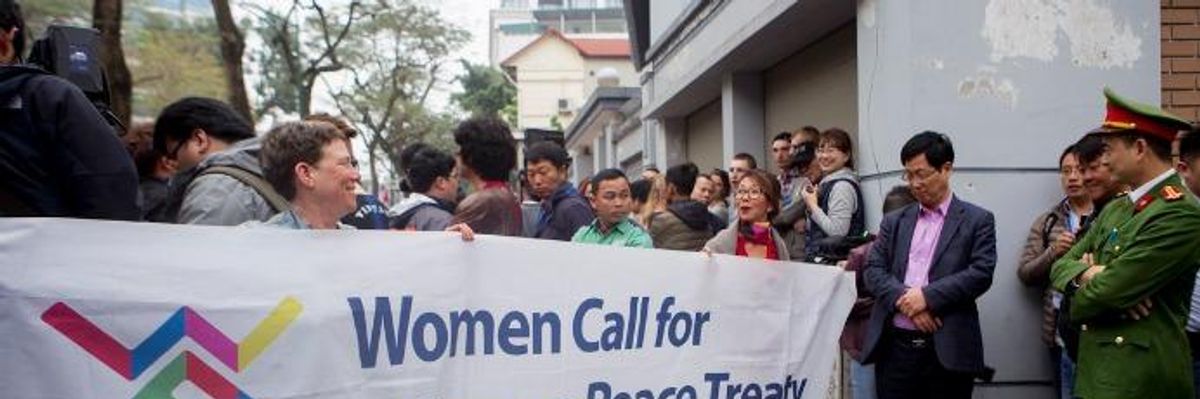
As North Korea's leader Kim Jong-un and U.S President Donald Trump meet in Vietnam ahead for their second summit meeting, a global women-led campaign is demanding "a new era of peace." (Photo: @NobelWomen)
As President Donald Trump and North Korean leader Kim Jong Un went head-to-head Wednesday for their second summit, an international coalition of anti-war women laid out a blueprint for "achieving lasting peace" on the Korean peninsula.
"We must ensure that our voices, our faces are heard; otherwise, we'll always cede ground to the patriarchs and to the militarists," said Christine Ahn, founder and executive director of Women Cross DMZ, who's on the ground in Hanoi for the summit. "We know that when women are involved in the peace process, not only does it lead to a peace agreement, but it leads to one that lasts."
Ahn's group is part of the global Korea Peace Now! campaign, which also brings together the Nobel Women's Initiativee, the Korean Women's Movement for Peace, and Women's International League for Peace and Freedom (WILPF). They issued their demands to the world leaders in a letter last week, and reiterated them in a Twitter thread on Wednesday:
Their sustained call comes a day after the introduction of a House resolution that calls for an end--after nearly seven decades--to the Korean war. It was sponsored by Rep. Ro Khanna (D-Calif.) and backed by 18 other Democratic lawmakers.
"Historic engagement between South and North Korea has created a once-in-a-generation opportunity to formally end this war," Khanna, a member of the House Armed Services Committee, declared in media statement on Tuesday. "President Trump must not squander this rare chance for peace. He should work hand in hand with our ally, South Korean President Moon Jae-in, to bring the war to a close and advance toward the denuclearization of the peninsula."
For Trump, the meeting was also a chance to once again crack down on freedom of the press, drawing the ire of the White House Correspondents' Association.
Trump, as Politico reported,
was hit with a spray of shouted questions on Wednesday evening in Vietnam, including one about his former fixer Michael Cohen's salacious testimony, as North Korean dictator Kim Jong Un sat alongside him, chuckling and looking bemused at the media outburst.
Minutes later, the White House barred four American journalists from covering their next event.
"This summit provides an opportunity for the American presidency to display its strength by facing vigorous questioning from a free and independent news media, not telegraph weakness by retreating behind arbitrary last-minute restrictions on coverage," responded Olivier Knox, WHCA president.
Physicist and disarmament activist Zia Mian, meanwhile, welcomed the Wednesday Trump-Kim meeting as a sign of diplomacy between the two nations but stressed that "the larger issue we need to focus on is the fact that nuclear weapons are too important to be left to the whims of leaders like Donald Trump and Kim Jong-un."
"Having North Korea continue to commit to a diplomatic process going forward would be a good thing," Mian said. "But neither of these are going to solve the underlying problem," which is "the existence of nuclear weapons."
Dear Common Dreams reader, It’s been nearly 30 years since I co-founded Common Dreams with my late wife, Lina Newhouser. We had the radical notion that journalism should serve the public good, not corporate profits. It was clear to us from the outset what it would take to build such a project. No paid advertisements. No corporate sponsors. No millionaire publisher telling us what to think or do. Many people said we wouldn't last a year, but we proved those doubters wrong. Together with a tremendous team of journalists and dedicated staff, we built an independent media outlet free from the constraints of profits and corporate control. Our mission has always been simple: To inform. To inspire. To ignite change for the common good. Building Common Dreams was not easy. Our survival was never guaranteed. When you take on the most powerful forces—Wall Street greed, fossil fuel industry destruction, Big Tech lobbyists, and uber-rich oligarchs who have spent billions upon billions rigging the economy and democracy in their favor—the only bulwark you have is supporters who believe in your work. But here’s the urgent message from me today. It's never been this bad out there. And it's never been this hard to keep us going. At the very moment Common Dreams is most needed, the threats we face are intensifying. We need your support now more than ever. We don't accept corporate advertising and never will. We don't have a paywall because we don't think people should be blocked from critical news based on their ability to pay. Everything we do is funded by the donations of readers like you. When everyone does the little they can afford, we are strong. But if that support retreats or dries up, so do we. Will you donate now to make sure Common Dreams not only survives but thrives? —Craig Brown, Co-founder |
As President Donald Trump and North Korean leader Kim Jong Un went head-to-head Wednesday for their second summit, an international coalition of anti-war women laid out a blueprint for "achieving lasting peace" on the Korean peninsula.
"We must ensure that our voices, our faces are heard; otherwise, we'll always cede ground to the patriarchs and to the militarists," said Christine Ahn, founder and executive director of Women Cross DMZ, who's on the ground in Hanoi for the summit. "We know that when women are involved in the peace process, not only does it lead to a peace agreement, but it leads to one that lasts."
Ahn's group is part of the global Korea Peace Now! campaign, which also brings together the Nobel Women's Initiativee, the Korean Women's Movement for Peace, and Women's International League for Peace and Freedom (WILPF). They issued their demands to the world leaders in a letter last week, and reiterated them in a Twitter thread on Wednesday:
Their sustained call comes a day after the introduction of a House resolution that calls for an end--after nearly seven decades--to the Korean war. It was sponsored by Rep. Ro Khanna (D-Calif.) and backed by 18 other Democratic lawmakers.
"Historic engagement between South and North Korea has created a once-in-a-generation opportunity to formally end this war," Khanna, a member of the House Armed Services Committee, declared in media statement on Tuesday. "President Trump must not squander this rare chance for peace. He should work hand in hand with our ally, South Korean President Moon Jae-in, to bring the war to a close and advance toward the denuclearization of the peninsula."
For Trump, the meeting was also a chance to once again crack down on freedom of the press, drawing the ire of the White House Correspondents' Association.
Trump, as Politico reported,
was hit with a spray of shouted questions on Wednesday evening in Vietnam, including one about his former fixer Michael Cohen's salacious testimony, as North Korean dictator Kim Jong Un sat alongside him, chuckling and looking bemused at the media outburst.
Minutes later, the White House barred four American journalists from covering their next event.
"This summit provides an opportunity for the American presidency to display its strength by facing vigorous questioning from a free and independent news media, not telegraph weakness by retreating behind arbitrary last-minute restrictions on coverage," responded Olivier Knox, WHCA president.
Physicist and disarmament activist Zia Mian, meanwhile, welcomed the Wednesday Trump-Kim meeting as a sign of diplomacy between the two nations but stressed that "the larger issue we need to focus on is the fact that nuclear weapons are too important to be left to the whims of leaders like Donald Trump and Kim Jong-un."
"Having North Korea continue to commit to a diplomatic process going forward would be a good thing," Mian said. "But neither of these are going to solve the underlying problem," which is "the existence of nuclear weapons."
As President Donald Trump and North Korean leader Kim Jong Un went head-to-head Wednesday for their second summit, an international coalition of anti-war women laid out a blueprint for "achieving lasting peace" on the Korean peninsula.
"We must ensure that our voices, our faces are heard; otherwise, we'll always cede ground to the patriarchs and to the militarists," said Christine Ahn, founder and executive director of Women Cross DMZ, who's on the ground in Hanoi for the summit. "We know that when women are involved in the peace process, not only does it lead to a peace agreement, but it leads to one that lasts."
Ahn's group is part of the global Korea Peace Now! campaign, which also brings together the Nobel Women's Initiativee, the Korean Women's Movement for Peace, and Women's International League for Peace and Freedom (WILPF). They issued their demands to the world leaders in a letter last week, and reiterated them in a Twitter thread on Wednesday:
Their sustained call comes a day after the introduction of a House resolution that calls for an end--after nearly seven decades--to the Korean war. It was sponsored by Rep. Ro Khanna (D-Calif.) and backed by 18 other Democratic lawmakers.
"Historic engagement between South and North Korea has created a once-in-a-generation opportunity to formally end this war," Khanna, a member of the House Armed Services Committee, declared in media statement on Tuesday. "President Trump must not squander this rare chance for peace. He should work hand in hand with our ally, South Korean President Moon Jae-in, to bring the war to a close and advance toward the denuclearization of the peninsula."
For Trump, the meeting was also a chance to once again crack down on freedom of the press, drawing the ire of the White House Correspondents' Association.
Trump, as Politico reported,
was hit with a spray of shouted questions on Wednesday evening in Vietnam, including one about his former fixer Michael Cohen's salacious testimony, as North Korean dictator Kim Jong Un sat alongside him, chuckling and looking bemused at the media outburst.
Minutes later, the White House barred four American journalists from covering their next event.
"This summit provides an opportunity for the American presidency to display its strength by facing vigorous questioning from a free and independent news media, not telegraph weakness by retreating behind arbitrary last-minute restrictions on coverage," responded Olivier Knox, WHCA president.
Physicist and disarmament activist Zia Mian, meanwhile, welcomed the Wednesday Trump-Kim meeting as a sign of diplomacy between the two nations but stressed that "the larger issue we need to focus on is the fact that nuclear weapons are too important to be left to the whims of leaders like Donald Trump and Kim Jong-un."
"Having North Korea continue to commit to a diplomatic process going forward would be a good thing," Mian said. "But neither of these are going to solve the underlying problem," which is "the existence of nuclear weapons."