SUBSCRIBE TO OUR FREE NEWSLETTER
Daily news & progressive opinion—funded by the people, not the corporations—delivered straight to your inbox.
5
#000000
#FFFFFF
To donate by check, phone, or other method, see our More Ways to Give page.
Daily news & progressive opinion—funded by the people, not the corporations—delivered straight to your inbox.
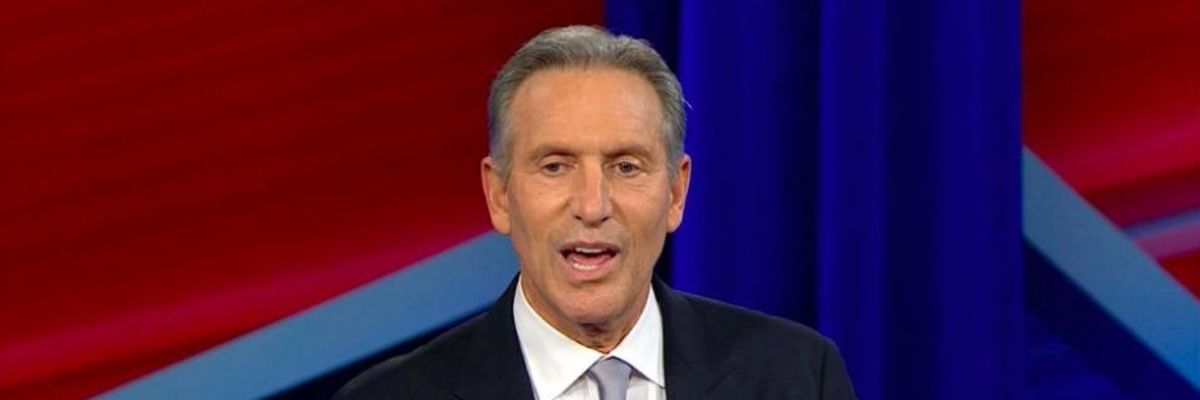
Former Starbucks CEO Howard Schultz declined to outline a tax plan of his own at a CNN Town Hall on Tuesday night, while attacking Rep. Alexandria Ocasio-Cortez's proposal to tax income over $10 million at 70 percent. (Photo: CNN)
It did not take Rep. Alexandria Ocasio-Cortez (D-N.Y.) long to figure out why former Starbucks CEO and "independent centrist" Howard Schultz didn't want to talk about the specifics of higher tax rates on the ultra-wealthy during his CNN town hall Tuesday night.
The reason, she noted on Twitter, is because for billionaires like Schultz "things are already going fine"--and therefore, his real plan for higher taxation on the rich is that there is no plan at all.
Schultz, who has embarked in recent weeks on a so-called "listening tour" ahead of a potential 2020 presidential campaign, became the second possible candidate to be granted extensive airtime by CNN on Tuesday when the network hosted the Town Hall.
When an audience member pointed out that Schultz has attacked Ocasio-Cortez's proposal to tax income over $10 million at 70 percent to combat income inequality and raise revenue to invest in programs like a Green New Deal, and asked the businessman what his alternative plan would be, Schultz repeatedly avoided specifics.
Assuring the Texas constituent that he believes the wealthy should be taxed at a higher rate, Schultz refused to propose a percentage number for a top marginal tax rate, becoming defensive when CNN host Poppy Harlow pressed him for details.
"I think what's being proposed at 70 percent is a punitive number and I think there are better way to do this," Schultz said. "I don't know what the number is. I think what I'm saying is we need comprehensive tax reform."
Watch:
Schultz attempted to bolster his argument by claiming that "most people in America" have lost trust in the government and therefore are against spending "twenty or 30 or 40 trillion dollars on a Green New Deal that we can't afford," suggesting that Americans would be opposed to taxing the wealthiest households at a much higher rate to fund the plan.
In fact, polls have found that a majority of Americans support a 70 percent top marginal tax rate and that 80 percent back a Green New Deal.
Critics on social media slammed Schultz for moving toward a major political campaign without taking the time to devise any substantive proposals.
At the Columbia Journalism Review, Jon Allsop wrote that Schultz's lack of any substantive policy proposals should more than disqualify him from receiving more news coverage like CNN's heavily promoted town hall.
"Shutting out uber-wealthy candidates, or at least waiting a minute until they've proven they're serious, isn't censorship or bias--it's the media's responsibility to conserve a level political playing field, organized around substantive issues of concern to the voting public," wrote Allsop.
Dear Common Dreams reader, It’s been nearly 30 years since I co-founded Common Dreams with my late wife, Lina Newhouser. We had the radical notion that journalism should serve the public good, not corporate profits. It was clear to us from the outset what it would take to build such a project. No paid advertisements. No corporate sponsors. No millionaire publisher telling us what to think or do. Many people said we wouldn't last a year, but we proved those doubters wrong. Together with a tremendous team of journalists and dedicated staff, we built an independent media outlet free from the constraints of profits and corporate control. Our mission has always been simple: To inform. To inspire. To ignite change for the common good. Building Common Dreams was not easy. Our survival was never guaranteed. When you take on the most powerful forces—Wall Street greed, fossil fuel industry destruction, Big Tech lobbyists, and uber-rich oligarchs who have spent billions upon billions rigging the economy and democracy in their favor—the only bulwark you have is supporters who believe in your work. But here’s the urgent message from me today. It's never been this bad out there. And it's never been this hard to keep us going. At the very moment Common Dreams is most needed, the threats we face are intensifying. We need your support now more than ever. We don't accept corporate advertising and never will. We don't have a paywall because we don't think people should be blocked from critical news based on their ability to pay. Everything we do is funded by the donations of readers like you. When everyone does the little they can afford, we are strong. But if that support retreats or dries up, so do we. Will you donate now to make sure Common Dreams not only survives but thrives? —Craig Brown, Co-founder |
It did not take Rep. Alexandria Ocasio-Cortez (D-N.Y.) long to figure out why former Starbucks CEO and "independent centrist" Howard Schultz didn't want to talk about the specifics of higher tax rates on the ultra-wealthy during his CNN town hall Tuesday night.
The reason, she noted on Twitter, is because for billionaires like Schultz "things are already going fine"--and therefore, his real plan for higher taxation on the rich is that there is no plan at all.
Schultz, who has embarked in recent weeks on a so-called "listening tour" ahead of a potential 2020 presidential campaign, became the second possible candidate to be granted extensive airtime by CNN on Tuesday when the network hosted the Town Hall.
When an audience member pointed out that Schultz has attacked Ocasio-Cortez's proposal to tax income over $10 million at 70 percent to combat income inequality and raise revenue to invest in programs like a Green New Deal, and asked the businessman what his alternative plan would be, Schultz repeatedly avoided specifics.
Assuring the Texas constituent that he believes the wealthy should be taxed at a higher rate, Schultz refused to propose a percentage number for a top marginal tax rate, becoming defensive when CNN host Poppy Harlow pressed him for details.
"I think what's being proposed at 70 percent is a punitive number and I think there are better way to do this," Schultz said. "I don't know what the number is. I think what I'm saying is we need comprehensive tax reform."
Watch:
Schultz attempted to bolster his argument by claiming that "most people in America" have lost trust in the government and therefore are against spending "twenty or 30 or 40 trillion dollars on a Green New Deal that we can't afford," suggesting that Americans would be opposed to taxing the wealthiest households at a much higher rate to fund the plan.
In fact, polls have found that a majority of Americans support a 70 percent top marginal tax rate and that 80 percent back a Green New Deal.
Critics on social media slammed Schultz for moving toward a major political campaign without taking the time to devise any substantive proposals.
At the Columbia Journalism Review, Jon Allsop wrote that Schultz's lack of any substantive policy proposals should more than disqualify him from receiving more news coverage like CNN's heavily promoted town hall.
"Shutting out uber-wealthy candidates, or at least waiting a minute until they've proven they're serious, isn't censorship or bias--it's the media's responsibility to conserve a level political playing field, organized around substantive issues of concern to the voting public," wrote Allsop.
It did not take Rep. Alexandria Ocasio-Cortez (D-N.Y.) long to figure out why former Starbucks CEO and "independent centrist" Howard Schultz didn't want to talk about the specifics of higher tax rates on the ultra-wealthy during his CNN town hall Tuesday night.
The reason, she noted on Twitter, is because for billionaires like Schultz "things are already going fine"--and therefore, his real plan for higher taxation on the rich is that there is no plan at all.
Schultz, who has embarked in recent weeks on a so-called "listening tour" ahead of a potential 2020 presidential campaign, became the second possible candidate to be granted extensive airtime by CNN on Tuesday when the network hosted the Town Hall.
When an audience member pointed out that Schultz has attacked Ocasio-Cortez's proposal to tax income over $10 million at 70 percent to combat income inequality and raise revenue to invest in programs like a Green New Deal, and asked the businessman what his alternative plan would be, Schultz repeatedly avoided specifics.
Assuring the Texas constituent that he believes the wealthy should be taxed at a higher rate, Schultz refused to propose a percentage number for a top marginal tax rate, becoming defensive when CNN host Poppy Harlow pressed him for details.
"I think what's being proposed at 70 percent is a punitive number and I think there are better way to do this," Schultz said. "I don't know what the number is. I think what I'm saying is we need comprehensive tax reform."
Watch:
Schultz attempted to bolster his argument by claiming that "most people in America" have lost trust in the government and therefore are against spending "twenty or 30 or 40 trillion dollars on a Green New Deal that we can't afford," suggesting that Americans would be opposed to taxing the wealthiest households at a much higher rate to fund the plan.
In fact, polls have found that a majority of Americans support a 70 percent top marginal tax rate and that 80 percent back a Green New Deal.
Critics on social media slammed Schultz for moving toward a major political campaign without taking the time to devise any substantive proposals.
At the Columbia Journalism Review, Jon Allsop wrote that Schultz's lack of any substantive policy proposals should more than disqualify him from receiving more news coverage like CNN's heavily promoted town hall.
"Shutting out uber-wealthy candidates, or at least waiting a minute until they've proven they're serious, isn't censorship or bias--it's the media's responsibility to conserve a level political playing field, organized around substantive issues of concern to the voting public," wrote Allsop.