SUBSCRIBE TO OUR FREE NEWSLETTER
Daily news & progressive opinion—funded by the people, not the corporations—delivered straight to your inbox.
5
#000000
#FFFFFF
To donate by check, phone, or other method, see our More Ways to Give page.
Daily news & progressive opinion—funded by the people, not the corporations—delivered straight to your inbox.
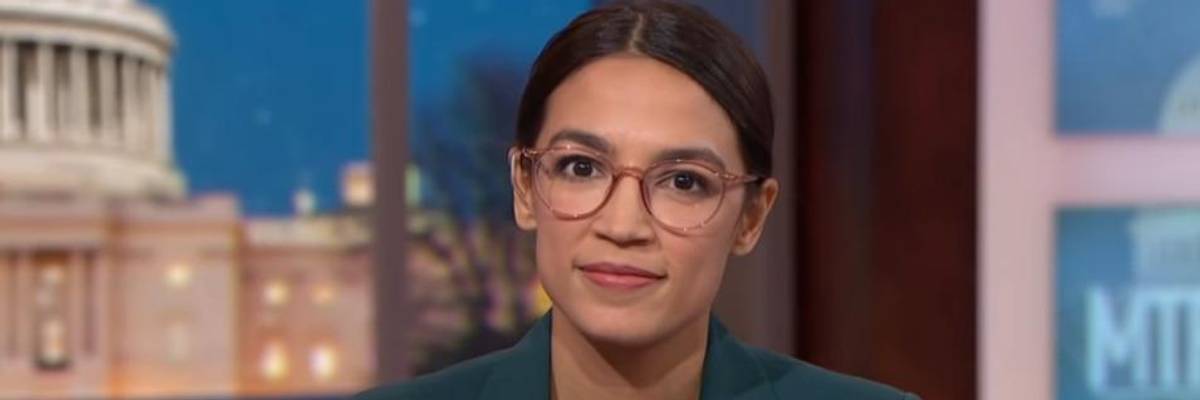
Rep. Alexandria Ocasio-Cortez (D-NY) appearing on MSNBC's MTP Daily with Chuck Todd on Thursday, February 7, 2019.
Fresh off an introduction of a historic resolution on the Green New Deal, Rep. Alexandria Ocasio-Cortez (D-NY) on Thursday evening did not have a problem grappling with the question over whether the ideologies of democratic socialism and capitalism can coexist, saying she is not one who thinks in simplistic terms about the nature of the economy but believes the most important thing is the power and voice that workers enjoy within businesses and beyond.
"Can you be a democratic socialist and a capitalist?" asked MSNBC's Chuck Todd in an one-on-one interview.
Without falling for the binary gotcha format of the question, Ocasio-Cortez responded, "Well, I think it depends on your interpretation. So there are some democratic socialists that would say, 'Absolutly not.' There are other people who are democratic socialists that would say, 'I think it's possible.'"
Asked which camp she fell into, Ocasio-Cortez said, "I think it's possible."
"Do you say, 'I'm a capitalist, but...'?" asked Todd.
"I don't say that," Ocasio-Cortez quickly shot back. "If anything, I would say, 'I believe in a democratic economy, but...'" With a smile she added, "But, the 'but' is there."
Watch the exchange:
While acknowledging there are things the private sector does better, like providing markets with consumer goods, but also noted that even businesses operating in the private sector can themselves be socially democratic and offered worker cooperatives as a great example. Democratic socialism, she said, is "not about government takeover, it's about how much of a say do workers have in your business. Do you have workers on the board? Do workers enjoy a decent amount of the wealth they are creating? Or is the majority of these profits going to shareholders while you're paying a worker $15 an hour to live in a New York City apartment? And so that to me is the difference.
"It's not that the public sector is democratically socialist and the private sector is not. It's really about a more nuanced understanding of how our economy should work."
Later in the interview she was asked about democratic socialism's ability to win elections, to which she noted that Sen. Bernie Sanders (I-Vt.), the most high-profile elected in the U.S. Congress, showed in 2016 just how potent the message can be:
Watch the full interview below:
Dear Common Dreams reader, It’s been nearly 30 years since I co-founded Common Dreams with my late wife, Lina Newhouser. We had the radical notion that journalism should serve the public good, not corporate profits. It was clear to us from the outset what it would take to build such a project. No paid advertisements. No corporate sponsors. No millionaire publisher telling us what to think or do. Many people said we wouldn't last a year, but we proved those doubters wrong. Together with a tremendous team of journalists and dedicated staff, we built an independent media outlet free from the constraints of profits and corporate control. Our mission has always been simple: To inform. To inspire. To ignite change for the common good. Building Common Dreams was not easy. Our survival was never guaranteed. When you take on the most powerful forces—Wall Street greed, fossil fuel industry destruction, Big Tech lobbyists, and uber-rich oligarchs who have spent billions upon billions rigging the economy and democracy in their favor—the only bulwark you have is supporters who believe in your work. But here’s the urgent message from me today. It's never been this bad out there. And it's never been this hard to keep us going. At the very moment Common Dreams is most needed, the threats we face are intensifying. We need your support now more than ever. We don't accept corporate advertising and never will. We don't have a paywall because we don't think people should be blocked from critical news based on their ability to pay. Everything we do is funded by the donations of readers like you. When everyone does the little they can afford, we are strong. But if that support retreats or dries up, so do we. Will you donate now to make sure Common Dreams not only survives but thrives? —Craig Brown, Co-founder |
Fresh off an introduction of a historic resolution on the Green New Deal, Rep. Alexandria Ocasio-Cortez (D-NY) on Thursday evening did not have a problem grappling with the question over whether the ideologies of democratic socialism and capitalism can coexist, saying she is not one who thinks in simplistic terms about the nature of the economy but believes the most important thing is the power and voice that workers enjoy within businesses and beyond.
"Can you be a democratic socialist and a capitalist?" asked MSNBC's Chuck Todd in an one-on-one interview.
Without falling for the binary gotcha format of the question, Ocasio-Cortez responded, "Well, I think it depends on your interpretation. So there are some democratic socialists that would say, 'Absolutly not.' There are other people who are democratic socialists that would say, 'I think it's possible.'"
Asked which camp she fell into, Ocasio-Cortez said, "I think it's possible."
"Do you say, 'I'm a capitalist, but...'?" asked Todd.
"I don't say that," Ocasio-Cortez quickly shot back. "If anything, I would say, 'I believe in a democratic economy, but...'" With a smile she added, "But, the 'but' is there."
Watch the exchange:
While acknowledging there are things the private sector does better, like providing markets with consumer goods, but also noted that even businesses operating in the private sector can themselves be socially democratic and offered worker cooperatives as a great example. Democratic socialism, she said, is "not about government takeover, it's about how much of a say do workers have in your business. Do you have workers on the board? Do workers enjoy a decent amount of the wealth they are creating? Or is the majority of these profits going to shareholders while you're paying a worker $15 an hour to live in a New York City apartment? And so that to me is the difference.
"It's not that the public sector is democratically socialist and the private sector is not. It's really about a more nuanced understanding of how our economy should work."
Later in the interview she was asked about democratic socialism's ability to win elections, to which she noted that Sen. Bernie Sanders (I-Vt.), the most high-profile elected in the U.S. Congress, showed in 2016 just how potent the message can be:
Watch the full interview below:
Fresh off an introduction of a historic resolution on the Green New Deal, Rep. Alexandria Ocasio-Cortez (D-NY) on Thursday evening did not have a problem grappling with the question over whether the ideologies of democratic socialism and capitalism can coexist, saying she is not one who thinks in simplistic terms about the nature of the economy but believes the most important thing is the power and voice that workers enjoy within businesses and beyond.
"Can you be a democratic socialist and a capitalist?" asked MSNBC's Chuck Todd in an one-on-one interview.
Without falling for the binary gotcha format of the question, Ocasio-Cortez responded, "Well, I think it depends on your interpretation. So there are some democratic socialists that would say, 'Absolutly not.' There are other people who are democratic socialists that would say, 'I think it's possible.'"
Asked which camp she fell into, Ocasio-Cortez said, "I think it's possible."
"Do you say, 'I'm a capitalist, but...'?" asked Todd.
"I don't say that," Ocasio-Cortez quickly shot back. "If anything, I would say, 'I believe in a democratic economy, but...'" With a smile she added, "But, the 'but' is there."
Watch the exchange:
While acknowledging there are things the private sector does better, like providing markets with consumer goods, but also noted that even businesses operating in the private sector can themselves be socially democratic and offered worker cooperatives as a great example. Democratic socialism, she said, is "not about government takeover, it's about how much of a say do workers have in your business. Do you have workers on the board? Do workers enjoy a decent amount of the wealth they are creating? Or is the majority of these profits going to shareholders while you're paying a worker $15 an hour to live in a New York City apartment? And so that to me is the difference.
"It's not that the public sector is democratically socialist and the private sector is not. It's really about a more nuanced understanding of how our economy should work."
Later in the interview she was asked about democratic socialism's ability to win elections, to which she noted that Sen. Bernie Sanders (I-Vt.), the most high-profile elected in the U.S. Congress, showed in 2016 just how potent the message can be:
Watch the full interview below: