SUBSCRIBE TO OUR FREE NEWSLETTER
Daily news & progressive opinion—funded by the people, not the corporations—delivered straight to your inbox.
5
#000000
#FFFFFF
To donate by check, phone, or other method, see our More Ways to Give page.
Daily news & progressive opinion—funded by the people, not the corporations—delivered straight to your inbox.
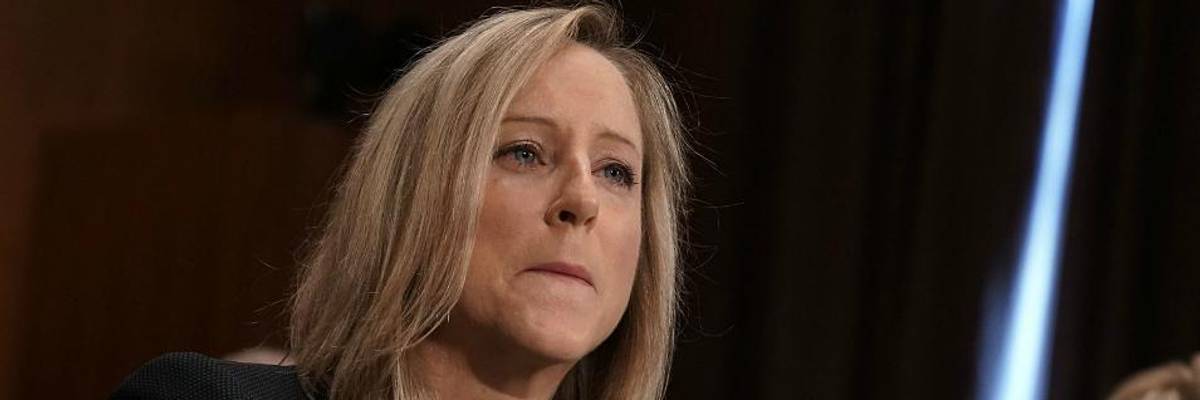
Consumer Financial Protection Bureau director Kathy Kraninger testifies during a confirmation hearing before the Senate Committee on Banking, Housing, and Urban Affairs July 19, 2018 on Capitol Hill in Washington, D.C. (Photo: Alex Wong/Getty Images)
In what progressive lawmakers and advocacy groups decried as the Trump administration's latest "shameful" attack on vulnerable families, the Consumer Financial Protection Bureau (CFPB) unveiled a plan on Wednesday that would gut regulations protecting consumers from predatory payday lenders.
"This decision will put already struggling families in a cycle of debt and leave them in an even worse financial position."
--Vanita Gupta, Leadership Conference on Civil and Human Rights
Vanita Gupta, president and CEO of the Leadership Conference on Civil and Human Rights, denounced the CFPB's plan as "a slap in the face to consumers--especially people of color--who have been victims of predatory business practices and abusive lenders."
"This decision will put already struggling families in a cycle of debt and leave them in an even worse financial position," Gupta added. "This administration has moved the CFPB away from protecting consumers to protecting the very companies abusing them."
Detailed in a statement by Trump-appointed CFPB director Kathy Kraninger, the agency's proposal would dramatically weaken an Obama-era rule that would have required payday lenders to verify that borrowers have the financial ability to repay their loans--an effort to help vulnerable people avoid falling into debt traps.
"Eliminating these protections would be a grave error and would leave the 12 million Americans who use payday loans every year exposed to unaffordable payments at interest rates that average nearly 400 percent."
--Alex Horowitz, Pew Charitable Trusts
In its explanation of the rule change, the CFPB said it wants consumers to have even more access to payday lenders, despite their long record of exploiting the poor.
"Kraninger is siding with the payday loan sharks instead of the American people," Rebecca Borne, senior policy counsel at the Center for Responsible Lending, said in a statement. "We urge director Kraninger to reconsider, as her current plan will keep families trapped in predatory, unaffordable debt."
The original rule was initially set to take effect in January, but the Trump administration has delayed implementation until August.
In a tweet responding to the agency's proposed rollback, former CFPB chief Richard Cordray called the plan "a bad move that will hurt the hardest-hit consumers" and predicted that it "will be subject to a stiff legal challenge."
"Eliminating these protections would be a grave error and would leave the 12 million Americans who use payday loans every year exposed to unaffordable payments at interest rates that average nearly 400 percent," concluded Alex Horowitz, senior research officer with Pew Charitable Trusts' consumer finance project. "This proposal is not a tweak to the existing rule; instead, it's a complete dismantling of the consumer protections finalized in 2017."
Dear Common Dreams reader, It’s been nearly 30 years since I co-founded Common Dreams with my late wife, Lina Newhouser. We had the radical notion that journalism should serve the public good, not corporate profits. It was clear to us from the outset what it would take to build such a project. No paid advertisements. No corporate sponsors. No millionaire publisher telling us what to think or do. Many people said we wouldn't last a year, but we proved those doubters wrong. Together with a tremendous team of journalists and dedicated staff, we built an independent media outlet free from the constraints of profits and corporate control. Our mission has always been simple: To inform. To inspire. To ignite change for the common good. Building Common Dreams was not easy. Our survival was never guaranteed. When you take on the most powerful forces—Wall Street greed, fossil fuel industry destruction, Big Tech lobbyists, and uber-rich oligarchs who have spent billions upon billions rigging the economy and democracy in their favor—the only bulwark you have is supporters who believe in your work. But here’s the urgent message from me today. It's never been this bad out there. And it's never been this hard to keep us going. At the very moment Common Dreams is most needed, the threats we face are intensifying. We need your support now more than ever. We don't accept corporate advertising and never will. We don't have a paywall because we don't think people should be blocked from critical news based on their ability to pay. Everything we do is funded by the donations of readers like you. When everyone does the little they can afford, we are strong. But if that support retreats or dries up, so do we. Will you donate now to make sure Common Dreams not only survives but thrives? —Craig Brown, Co-founder |
In what progressive lawmakers and advocacy groups decried as the Trump administration's latest "shameful" attack on vulnerable families, the Consumer Financial Protection Bureau (CFPB) unveiled a plan on Wednesday that would gut regulations protecting consumers from predatory payday lenders.
"This decision will put already struggling families in a cycle of debt and leave them in an even worse financial position."
--Vanita Gupta, Leadership Conference on Civil and Human Rights
Vanita Gupta, president and CEO of the Leadership Conference on Civil and Human Rights, denounced the CFPB's plan as "a slap in the face to consumers--especially people of color--who have been victims of predatory business practices and abusive lenders."
"This decision will put already struggling families in a cycle of debt and leave them in an even worse financial position," Gupta added. "This administration has moved the CFPB away from protecting consumers to protecting the very companies abusing them."
Detailed in a statement by Trump-appointed CFPB director Kathy Kraninger, the agency's proposal would dramatically weaken an Obama-era rule that would have required payday lenders to verify that borrowers have the financial ability to repay their loans--an effort to help vulnerable people avoid falling into debt traps.
"Eliminating these protections would be a grave error and would leave the 12 million Americans who use payday loans every year exposed to unaffordable payments at interest rates that average nearly 400 percent."
--Alex Horowitz, Pew Charitable Trusts
In its explanation of the rule change, the CFPB said it wants consumers to have even more access to payday lenders, despite their long record of exploiting the poor.
"Kraninger is siding with the payday loan sharks instead of the American people," Rebecca Borne, senior policy counsel at the Center for Responsible Lending, said in a statement. "We urge director Kraninger to reconsider, as her current plan will keep families trapped in predatory, unaffordable debt."
The original rule was initially set to take effect in January, but the Trump administration has delayed implementation until August.
In a tweet responding to the agency's proposed rollback, former CFPB chief Richard Cordray called the plan "a bad move that will hurt the hardest-hit consumers" and predicted that it "will be subject to a stiff legal challenge."
"Eliminating these protections would be a grave error and would leave the 12 million Americans who use payday loans every year exposed to unaffordable payments at interest rates that average nearly 400 percent," concluded Alex Horowitz, senior research officer with Pew Charitable Trusts' consumer finance project. "This proposal is not a tweak to the existing rule; instead, it's a complete dismantling of the consumer protections finalized in 2017."
In what progressive lawmakers and advocacy groups decried as the Trump administration's latest "shameful" attack on vulnerable families, the Consumer Financial Protection Bureau (CFPB) unveiled a plan on Wednesday that would gut regulations protecting consumers from predatory payday lenders.
"This decision will put already struggling families in a cycle of debt and leave them in an even worse financial position."
--Vanita Gupta, Leadership Conference on Civil and Human Rights
Vanita Gupta, president and CEO of the Leadership Conference on Civil and Human Rights, denounced the CFPB's plan as "a slap in the face to consumers--especially people of color--who have been victims of predatory business practices and abusive lenders."
"This decision will put already struggling families in a cycle of debt and leave them in an even worse financial position," Gupta added. "This administration has moved the CFPB away from protecting consumers to protecting the very companies abusing them."
Detailed in a statement by Trump-appointed CFPB director Kathy Kraninger, the agency's proposal would dramatically weaken an Obama-era rule that would have required payday lenders to verify that borrowers have the financial ability to repay their loans--an effort to help vulnerable people avoid falling into debt traps.
"Eliminating these protections would be a grave error and would leave the 12 million Americans who use payday loans every year exposed to unaffordable payments at interest rates that average nearly 400 percent."
--Alex Horowitz, Pew Charitable Trusts
In its explanation of the rule change, the CFPB said it wants consumers to have even more access to payday lenders, despite their long record of exploiting the poor.
"Kraninger is siding with the payday loan sharks instead of the American people," Rebecca Borne, senior policy counsel at the Center for Responsible Lending, said in a statement. "We urge director Kraninger to reconsider, as her current plan will keep families trapped in predatory, unaffordable debt."
The original rule was initially set to take effect in January, but the Trump administration has delayed implementation until August.
In a tweet responding to the agency's proposed rollback, former CFPB chief Richard Cordray called the plan "a bad move that will hurt the hardest-hit consumers" and predicted that it "will be subject to a stiff legal challenge."
"Eliminating these protections would be a grave error and would leave the 12 million Americans who use payday loans every year exposed to unaffordable payments at interest rates that average nearly 400 percent," concluded Alex Horowitz, senior research officer with Pew Charitable Trusts' consumer finance project. "This proposal is not a tweak to the existing rule; instead, it's a complete dismantling of the consumer protections finalized in 2017."