SUBSCRIBE TO OUR FREE NEWSLETTER
Daily news & progressive opinion—funded by the people, not the corporations—delivered straight to your inbox.
5
#000000
#FFFFFF
To donate by check, phone, or other method, see our More Ways to Give page.
Daily news & progressive opinion—funded by the people, not the corporations—delivered straight to your inbox.
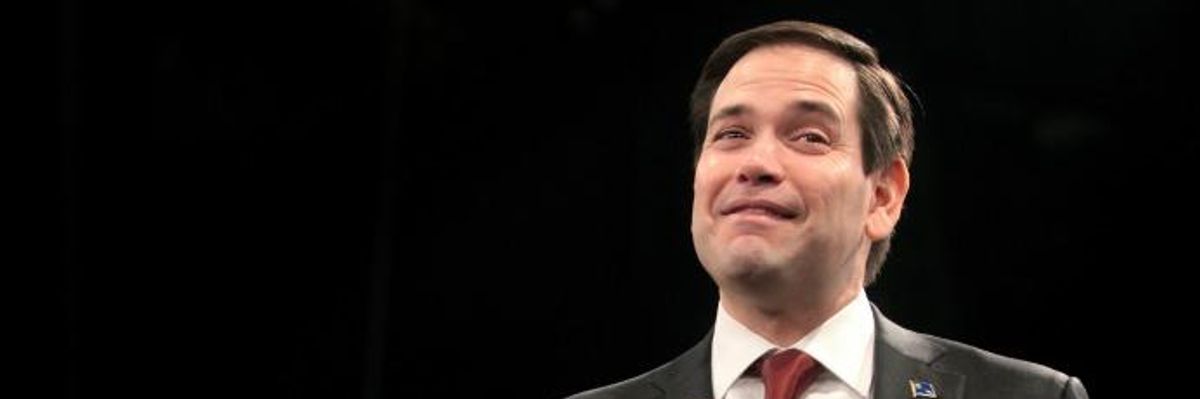
Sen. Marco Rubio (R-Fla.) seen here on February 23, 2016. (Photo: Gage Skidmore/flickr/cc)
The ACLU took to social media on Wednesday to refute Sen. Marco Rubio's (R-Fla.) assertion that the rights group's opposition to his anti-boycott legislation is "baseless," and offer him some guidance on understanding the First Amendment.
The bill, S.1, advanced on Tuesday with the help of 25 Democrats, and includes the Combating BDS Act of 2019, which allows state or local governments to punish entities using boycotts, divestments, or sanctions to protest the Israeli government's policies.
While Rubio and others have continued to support the bill, the ACLU argues the anti-BDS measure "violates the core principle" at the heart of the Constitution's free speech protections. "The government cannot," the group notes, "dictate to its citizens which causes they can and can't support."
Other advocacy groups have spoken out against S.1 as well, including Jewish Voice for Peace. Sen. Bernie Sanders (I-Vt.), meanwhile, is among the lawmakers who've opposed the measure. In a tweet this week, Sanders said, "we must defend every American's constitutional right to peacefully engage in political activity. It is clear to me that S.1 would violate Americans' First Amendment rights."
Dear Common Dreams reader, It’s been nearly 30 years since I co-founded Common Dreams with my late wife, Lina Newhouser. We had the radical notion that journalism should serve the public good, not corporate profits. It was clear to us from the outset what it would take to build such a project. No paid advertisements. No corporate sponsors. No millionaire publisher telling us what to think or do. Many people said we wouldn't last a year, but we proved those doubters wrong. Together with a tremendous team of journalists and dedicated staff, we built an independent media outlet free from the constraints of profits and corporate control. Our mission has always been simple: To inform. To inspire. To ignite change for the common good. Building Common Dreams was not easy. Our survival was never guaranteed. When you take on the most powerful forces—Wall Street greed, fossil fuel industry destruction, Big Tech lobbyists, and uber-rich oligarchs who have spent billions upon billions rigging the economy and democracy in their favor—the only bulwark you have is supporters who believe in your work. But here’s the urgent message from me today. It's never been this bad out there. And it's never been this hard to keep us going. At the very moment Common Dreams is most needed, the threats we face are intensifying. We need your support now more than ever. We don't accept corporate advertising and never will. We don't have a paywall because we don't think people should be blocked from critical news based on their ability to pay. Everything we do is funded by the donations of readers like you. When everyone does the little they can afford, we are strong. But if that support retreats or dries up, so do we. Will you donate now to make sure Common Dreams not only survives but thrives? —Craig Brown, Co-founder |
The ACLU took to social media on Wednesday to refute Sen. Marco Rubio's (R-Fla.) assertion that the rights group's opposition to his anti-boycott legislation is "baseless," and offer him some guidance on understanding the First Amendment.
The bill, S.1, advanced on Tuesday with the help of 25 Democrats, and includes the Combating BDS Act of 2019, which allows state or local governments to punish entities using boycotts, divestments, or sanctions to protest the Israeli government's policies.
While Rubio and others have continued to support the bill, the ACLU argues the anti-BDS measure "violates the core principle" at the heart of the Constitution's free speech protections. "The government cannot," the group notes, "dictate to its citizens which causes they can and can't support."
Other advocacy groups have spoken out against S.1 as well, including Jewish Voice for Peace. Sen. Bernie Sanders (I-Vt.), meanwhile, is among the lawmakers who've opposed the measure. In a tweet this week, Sanders said, "we must defend every American's constitutional right to peacefully engage in political activity. It is clear to me that S.1 would violate Americans' First Amendment rights."
The ACLU took to social media on Wednesday to refute Sen. Marco Rubio's (R-Fla.) assertion that the rights group's opposition to his anti-boycott legislation is "baseless," and offer him some guidance on understanding the First Amendment.
The bill, S.1, advanced on Tuesday with the help of 25 Democrats, and includes the Combating BDS Act of 2019, which allows state or local governments to punish entities using boycotts, divestments, or sanctions to protest the Israeli government's policies.
While Rubio and others have continued to support the bill, the ACLU argues the anti-BDS measure "violates the core principle" at the heart of the Constitution's free speech protections. "The government cannot," the group notes, "dictate to its citizens which causes they can and can't support."
Other advocacy groups have spoken out against S.1 as well, including Jewish Voice for Peace. Sen. Bernie Sanders (I-Vt.), meanwhile, is among the lawmakers who've opposed the measure. In a tweet this week, Sanders said, "we must defend every American's constitutional right to peacefully engage in political activity. It is clear to me that S.1 would violate Americans' First Amendment rights."