SUBSCRIBE TO OUR FREE NEWSLETTER
Daily news & progressive opinion—funded by the people, not the corporations—delivered straight to your inbox.
5
#000000
#FFFFFF
To donate by check, phone, or other method, see our More Ways to Give page.
Daily news & progressive opinion—funded by the people, not the corporations—delivered straight to your inbox.
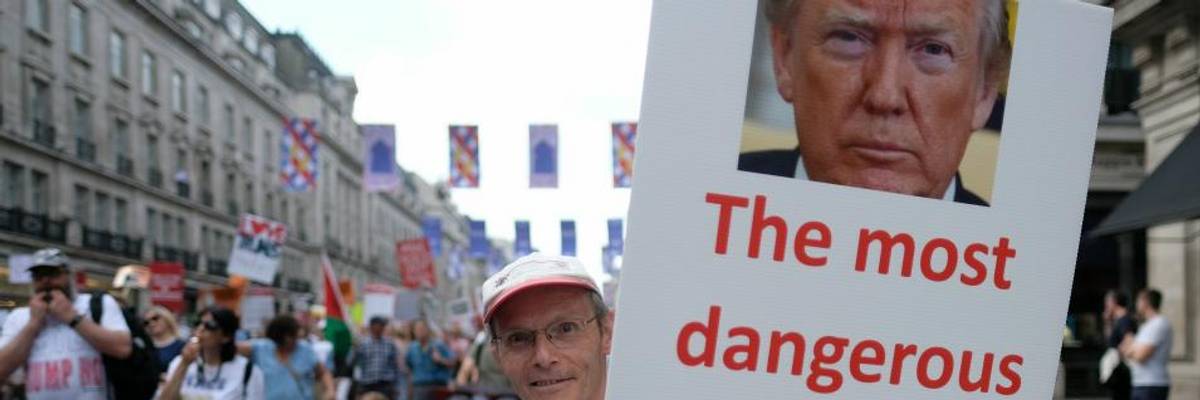
People gathered in the streets of London to protest U.S. President Donald Trump's visit to the United Kingdom in July of 2018. (Photo: Alisdare Hickson/Flickr/cc)
An analysis out Tuesday from Transparency International "reveals the United States as a key country to watch in a global pattern of stagnating anti-corruption efforts and a worldwide crisis of democracy," according to the group, with the U.S. rank on a global index plummeting by four points in just the past year under President Donald Trump.
"A four-point drop in the CPI score is a red flag and comes at a time when the U.S. is experiencing threats to its system of checks and balances, as well as an erosion of ethical norms at the highest levels of power."
--Zoe Reiter, Transparency International
The United States earned a score of 71 out of 100 on the watchdog's 2018 Corruption Perceptions Index (CPI), knocking it out of the top 20 countries for the first time since 2011.
Zoe Reiter, Transparency International's acting representative to the U.S., said in a statement that "a four-point drop in the CPI score is a red flag and comes at a time when the U.S. is experiencing threats to its system of checks and balances, as well as an erosion of ethical norms at the highest levels of power."
"This is a red flag because it's really part of a pattern that we've seen since the 2008 global financial crisis of a loss of trust...in our public institutions," Reiter told Reuters. "People don't see us as having adequate mechanisms in place to fight corruption and ensure the accountability of our elected officials."
Transparency International's latest findings align with a public opinion survey the group conducted two years ago, which revealed that nearly six in ten Americans believed there was an increase in corruption from 2016 to 2017, when Trump entered the White House.
"Concerns around the Trump administration are quite serious, but this has been stewing for several years," Reiter emphasized. "Conflict of interest wasn't a new problem, but it was illuminated in its glory when you have someone who is basically breaking norms."
"With many democratic institutions under threat across the globe--often by leaders with authoritarian or populist tendencies--we need to do more to strengthen checks and balances and protect citizens' rights."
--Patricia Moreira, Transparency International
In other words, she said, "Trump is a symptom not a cause." However, the CPI also showed that the United States is far from alone in its failures to fight corruption. Of the 180 countries and territories analyzed, only 20 have made significant improvements since 2012. The watchdog also designated Brazil as a "country to watch" following the election of Jair Bolsonaro--a racist, sexist, homophobe--as president.
Overall, "the highest scoring region is Western Europe and the European Union, with an average score of 66, while the lowest scoring regions are Sub-Saharan Africa (average score 32) and Eastern Europe and Central Asia (average score 35)," a statement noted. Denmark and New Zealand secured the top spots, with respective scores of 88 and 87.
"With many democratic institutions under threat across the globe--often by leaders with authoritarian or populist tendencies--we need to do more to strengthen checks and balances and protect citizens' rights," concluded Patricia Moreira, Transparency International's managing director.
The report comes as the U.S. House of Representatives is considering the For the People Act (H.R. 1), sweeping anti-corruption legislation that, as Common Dreams has reported, would protect voting rights, promote the public financing of elections, rein in the influence of corporate dark money, and strengthen ethics rules.
The U.S. House Committee on the Judiciary held its first hearing on the bill Tuesday morning. Vanita Gupta, president and CEO of the Leadership Conference on Civil and Human Rights, said in her testimony that H.R. 1 "is a bold, comprehensive reform package that offers solutions to a broken democracy."
Dear Common Dreams reader, It’s been nearly 30 years since I co-founded Common Dreams with my late wife, Lina Newhouser. We had the radical notion that journalism should serve the public good, not corporate profits. It was clear to us from the outset what it would take to build such a project. No paid advertisements. No corporate sponsors. No millionaire publisher telling us what to think or do. Many people said we wouldn't last a year, but we proved those doubters wrong. Together with a tremendous team of journalists and dedicated staff, we built an independent media outlet free from the constraints of profits and corporate control. Our mission has always been simple: To inform. To inspire. To ignite change for the common good. Building Common Dreams was not easy. Our survival was never guaranteed. When you take on the most powerful forces—Wall Street greed, fossil fuel industry destruction, Big Tech lobbyists, and uber-rich oligarchs who have spent billions upon billions rigging the economy and democracy in their favor—the only bulwark you have is supporters who believe in your work. But here’s the urgent message from me today. It's never been this bad out there. And it's never been this hard to keep us going. At the very moment Common Dreams is most needed, the threats we face are intensifying. We need your support now more than ever. We don't accept corporate advertising and never will. We don't have a paywall because we don't think people should be blocked from critical news based on their ability to pay. Everything we do is funded by the donations of readers like you. When everyone does the little they can afford, we are strong. But if that support retreats or dries up, so do we. Will you donate now to make sure Common Dreams not only survives but thrives? —Craig Brown, Co-founder |
An analysis out Tuesday from Transparency International "reveals the United States as a key country to watch in a global pattern of stagnating anti-corruption efforts and a worldwide crisis of democracy," according to the group, with the U.S. rank on a global index plummeting by four points in just the past year under President Donald Trump.
"A four-point drop in the CPI score is a red flag and comes at a time when the U.S. is experiencing threats to its system of checks and balances, as well as an erosion of ethical norms at the highest levels of power."
--Zoe Reiter, Transparency International
The United States earned a score of 71 out of 100 on the watchdog's 2018 Corruption Perceptions Index (CPI), knocking it out of the top 20 countries for the first time since 2011.
Zoe Reiter, Transparency International's acting representative to the U.S., said in a statement that "a four-point drop in the CPI score is a red flag and comes at a time when the U.S. is experiencing threats to its system of checks and balances, as well as an erosion of ethical norms at the highest levels of power."
"This is a red flag because it's really part of a pattern that we've seen since the 2008 global financial crisis of a loss of trust...in our public institutions," Reiter told Reuters. "People don't see us as having adequate mechanisms in place to fight corruption and ensure the accountability of our elected officials."
Transparency International's latest findings align with a public opinion survey the group conducted two years ago, which revealed that nearly six in ten Americans believed there was an increase in corruption from 2016 to 2017, when Trump entered the White House.
"Concerns around the Trump administration are quite serious, but this has been stewing for several years," Reiter emphasized. "Conflict of interest wasn't a new problem, but it was illuminated in its glory when you have someone who is basically breaking norms."
"With many democratic institutions under threat across the globe--often by leaders with authoritarian or populist tendencies--we need to do more to strengthen checks and balances and protect citizens' rights."
--Patricia Moreira, Transparency International
In other words, she said, "Trump is a symptom not a cause." However, the CPI also showed that the United States is far from alone in its failures to fight corruption. Of the 180 countries and territories analyzed, only 20 have made significant improvements since 2012. The watchdog also designated Brazil as a "country to watch" following the election of Jair Bolsonaro--a racist, sexist, homophobe--as president.
Overall, "the highest scoring region is Western Europe and the European Union, with an average score of 66, while the lowest scoring regions are Sub-Saharan Africa (average score 32) and Eastern Europe and Central Asia (average score 35)," a statement noted. Denmark and New Zealand secured the top spots, with respective scores of 88 and 87.
"With many democratic institutions under threat across the globe--often by leaders with authoritarian or populist tendencies--we need to do more to strengthen checks and balances and protect citizens' rights," concluded Patricia Moreira, Transparency International's managing director.
The report comes as the U.S. House of Representatives is considering the For the People Act (H.R. 1), sweeping anti-corruption legislation that, as Common Dreams has reported, would protect voting rights, promote the public financing of elections, rein in the influence of corporate dark money, and strengthen ethics rules.
The U.S. House Committee on the Judiciary held its first hearing on the bill Tuesday morning. Vanita Gupta, president and CEO of the Leadership Conference on Civil and Human Rights, said in her testimony that H.R. 1 "is a bold, comprehensive reform package that offers solutions to a broken democracy."
An analysis out Tuesday from Transparency International "reveals the United States as a key country to watch in a global pattern of stagnating anti-corruption efforts and a worldwide crisis of democracy," according to the group, with the U.S. rank on a global index plummeting by four points in just the past year under President Donald Trump.
"A four-point drop in the CPI score is a red flag and comes at a time when the U.S. is experiencing threats to its system of checks and balances, as well as an erosion of ethical norms at the highest levels of power."
--Zoe Reiter, Transparency International
The United States earned a score of 71 out of 100 on the watchdog's 2018 Corruption Perceptions Index (CPI), knocking it out of the top 20 countries for the first time since 2011.
Zoe Reiter, Transparency International's acting representative to the U.S., said in a statement that "a four-point drop in the CPI score is a red flag and comes at a time when the U.S. is experiencing threats to its system of checks and balances, as well as an erosion of ethical norms at the highest levels of power."
"This is a red flag because it's really part of a pattern that we've seen since the 2008 global financial crisis of a loss of trust...in our public institutions," Reiter told Reuters. "People don't see us as having adequate mechanisms in place to fight corruption and ensure the accountability of our elected officials."
Transparency International's latest findings align with a public opinion survey the group conducted two years ago, which revealed that nearly six in ten Americans believed there was an increase in corruption from 2016 to 2017, when Trump entered the White House.
"Concerns around the Trump administration are quite serious, but this has been stewing for several years," Reiter emphasized. "Conflict of interest wasn't a new problem, but it was illuminated in its glory when you have someone who is basically breaking norms."
"With many democratic institutions under threat across the globe--often by leaders with authoritarian or populist tendencies--we need to do more to strengthen checks and balances and protect citizens' rights."
--Patricia Moreira, Transparency International
In other words, she said, "Trump is a symptom not a cause." However, the CPI also showed that the United States is far from alone in its failures to fight corruption. Of the 180 countries and territories analyzed, only 20 have made significant improvements since 2012. The watchdog also designated Brazil as a "country to watch" following the election of Jair Bolsonaro--a racist, sexist, homophobe--as president.
Overall, "the highest scoring region is Western Europe and the European Union, with an average score of 66, while the lowest scoring regions are Sub-Saharan Africa (average score 32) and Eastern Europe and Central Asia (average score 35)," a statement noted. Denmark and New Zealand secured the top spots, with respective scores of 88 and 87.
"With many democratic institutions under threat across the globe--often by leaders with authoritarian or populist tendencies--we need to do more to strengthen checks and balances and protect citizens' rights," concluded Patricia Moreira, Transparency International's managing director.
The report comes as the U.S. House of Representatives is considering the For the People Act (H.R. 1), sweeping anti-corruption legislation that, as Common Dreams has reported, would protect voting rights, promote the public financing of elections, rein in the influence of corporate dark money, and strengthen ethics rules.
The U.S. House Committee on the Judiciary held its first hearing on the bill Tuesday morning. Vanita Gupta, president and CEO of the Leadership Conference on Civil and Human Rights, said in her testimony that H.R. 1 "is a bold, comprehensive reform package that offers solutions to a broken democracy."