SUBSCRIBE TO OUR FREE NEWSLETTER
Daily news & progressive opinion—funded by the people, not the corporations—delivered straight to your inbox.
5
#000000
#FFFFFF
To donate by check, phone, or other method, see our More Ways to Give page.
Daily news & progressive opinion—funded by the people, not the corporations—delivered straight to your inbox.
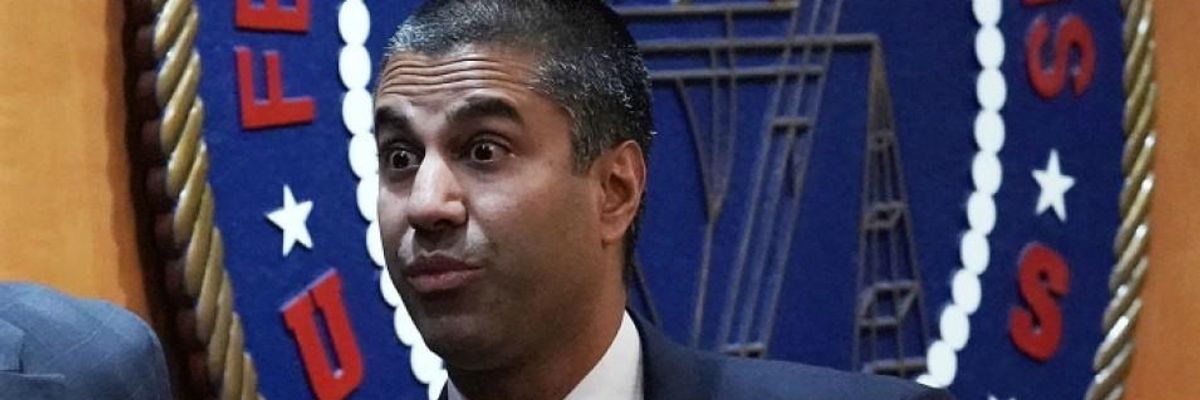
Federal Communications Commission (FCC) Chairman Ajit Pai leaves a meeting Dec. 14, 2017 in Washington, D.C. (Photo: Alex Wong/Getty Images)
The telecom industry and Federal Communications Commission (FCC) Chairman Ajit Pai justified the Republican repeal of net neutrality protections in December of 2017 with promises that a "light-touch framework" would spur investment, giving broadband providers "stronger incentives to build networks, especially in unserved areas, and to upgrade networks."
"The cornerstone of Ajit Pai's net neutrality repeal order has quickly crumbled."
-- Gigi Sohn, former FCC lawyer
However, according to recent reports, in the year after the repeal--which officially took effect last June--cable companies' investments actually fell, just as net neutrality supporters had warned they would.
Those fighting the rollback pointed to the declines in spending as just one piece of evidence that the deregulation push by Pai--a former Verizon lawyer appointed by President Donald Trump--was always designed to benefit industry at the public's expense.
"The repeal of net neutrality is nothing but a massive government handout to some of the most unscrupulous, and least popular, corporations in the United States," Fight for the Future's Evan Greer told Motherboard. "It's not helping workers at these companies. It's not helping people in rural communities. It's not closing the digital divide."
"Sorry, [Ajit Pai]: Your sloppy attempts to tie network investment to your #NetNeutrality repeal just don't hold water. And they never did," tweeted Tim Karr, Free Press's senior director of strategy and communications.
Comcast's overall expenditures increased in 2018, according to an earnings announcement released Wednesday, but "Cable Communications' capital expenditures decreased 3.0 percent to $7.7 billion, reflecting decreased spending on customer premise equipment and support capital, partially offset by higher investment in scalable infrastructure and line extensions."
While Comcast is one of the nation's largest Internet service providers (ISPs), as Ars Technica, noted: "Comcast isn't the only ISP that lowered network investment last year. Charter and Verizon both said in 2018 that they were reducing capital expenditures." And that trend is expected to continue in 2019--at least, for Comcast and Charter--according to MoffettNathanson estimates cited in a Light Reading article this week.
In addition, as Ars Technica reported, "The net neutrality repeal hasn't closed broadband gaps in rural areas, where industry trade groups say they won't expand service unless the government gives them more direct funding," arguing that without such assistance, the return on investment wouldn't be worth it.
As Gigi Sohn, a former FCC lawyer who helped craft the repealed net neutrality rules, concluded in an email to Motherboard, "The cornerstone of Ajit Pai's net neutrality repeal order has quickly crumbled."
Dear Common Dreams reader, It’s been nearly 30 years since I co-founded Common Dreams with my late wife, Lina Newhouser. We had the radical notion that journalism should serve the public good, not corporate profits. It was clear to us from the outset what it would take to build such a project. No paid advertisements. No corporate sponsors. No millionaire publisher telling us what to think or do. Many people said we wouldn't last a year, but we proved those doubters wrong. Together with a tremendous team of journalists and dedicated staff, we built an independent media outlet free from the constraints of profits and corporate control. Our mission has always been simple: To inform. To inspire. To ignite change for the common good. Building Common Dreams was not easy. Our survival was never guaranteed. When you take on the most powerful forces—Wall Street greed, fossil fuel industry destruction, Big Tech lobbyists, and uber-rich oligarchs who have spent billions upon billions rigging the economy and democracy in their favor—the only bulwark you have is supporters who believe in your work. But here’s the urgent message from me today. It's never been this bad out there. And it's never been this hard to keep us going. At the very moment Common Dreams is most needed, the threats we face are intensifying. We need your support now more than ever. We don't accept corporate advertising and never will. We don't have a paywall because we don't think people should be blocked from critical news based on their ability to pay. Everything we do is funded by the donations of readers like you. When everyone does the little they can afford, we are strong. But if that support retreats or dries up, so do we. Will you donate now to make sure Common Dreams not only survives but thrives? —Craig Brown, Co-founder |
The telecom industry and Federal Communications Commission (FCC) Chairman Ajit Pai justified the Republican repeal of net neutrality protections in December of 2017 with promises that a "light-touch framework" would spur investment, giving broadband providers "stronger incentives to build networks, especially in unserved areas, and to upgrade networks."
"The cornerstone of Ajit Pai's net neutrality repeal order has quickly crumbled."
-- Gigi Sohn, former FCC lawyer
However, according to recent reports, in the year after the repeal--which officially took effect last June--cable companies' investments actually fell, just as net neutrality supporters had warned they would.
Those fighting the rollback pointed to the declines in spending as just one piece of evidence that the deregulation push by Pai--a former Verizon lawyer appointed by President Donald Trump--was always designed to benefit industry at the public's expense.
"The repeal of net neutrality is nothing but a massive government handout to some of the most unscrupulous, and least popular, corporations in the United States," Fight for the Future's Evan Greer told Motherboard. "It's not helping workers at these companies. It's not helping people in rural communities. It's not closing the digital divide."
"Sorry, [Ajit Pai]: Your sloppy attempts to tie network investment to your #NetNeutrality repeal just don't hold water. And they never did," tweeted Tim Karr, Free Press's senior director of strategy and communications.
Comcast's overall expenditures increased in 2018, according to an earnings announcement released Wednesday, but "Cable Communications' capital expenditures decreased 3.0 percent to $7.7 billion, reflecting decreased spending on customer premise equipment and support capital, partially offset by higher investment in scalable infrastructure and line extensions."
While Comcast is one of the nation's largest Internet service providers (ISPs), as Ars Technica, noted: "Comcast isn't the only ISP that lowered network investment last year. Charter and Verizon both said in 2018 that they were reducing capital expenditures." And that trend is expected to continue in 2019--at least, for Comcast and Charter--according to MoffettNathanson estimates cited in a Light Reading article this week.
In addition, as Ars Technica reported, "The net neutrality repeal hasn't closed broadband gaps in rural areas, where industry trade groups say they won't expand service unless the government gives them more direct funding," arguing that without such assistance, the return on investment wouldn't be worth it.
As Gigi Sohn, a former FCC lawyer who helped craft the repealed net neutrality rules, concluded in an email to Motherboard, "The cornerstone of Ajit Pai's net neutrality repeal order has quickly crumbled."
The telecom industry and Federal Communications Commission (FCC) Chairman Ajit Pai justified the Republican repeal of net neutrality protections in December of 2017 with promises that a "light-touch framework" would spur investment, giving broadband providers "stronger incentives to build networks, especially in unserved areas, and to upgrade networks."
"The cornerstone of Ajit Pai's net neutrality repeal order has quickly crumbled."
-- Gigi Sohn, former FCC lawyer
However, according to recent reports, in the year after the repeal--which officially took effect last June--cable companies' investments actually fell, just as net neutrality supporters had warned they would.
Those fighting the rollback pointed to the declines in spending as just one piece of evidence that the deregulation push by Pai--a former Verizon lawyer appointed by President Donald Trump--was always designed to benefit industry at the public's expense.
"The repeal of net neutrality is nothing but a massive government handout to some of the most unscrupulous, and least popular, corporations in the United States," Fight for the Future's Evan Greer told Motherboard. "It's not helping workers at these companies. It's not helping people in rural communities. It's not closing the digital divide."
"Sorry, [Ajit Pai]: Your sloppy attempts to tie network investment to your #NetNeutrality repeal just don't hold water. And they never did," tweeted Tim Karr, Free Press's senior director of strategy and communications.
Comcast's overall expenditures increased in 2018, according to an earnings announcement released Wednesday, but "Cable Communications' capital expenditures decreased 3.0 percent to $7.7 billion, reflecting decreased spending on customer premise equipment and support capital, partially offset by higher investment in scalable infrastructure and line extensions."
While Comcast is one of the nation's largest Internet service providers (ISPs), as Ars Technica, noted: "Comcast isn't the only ISP that lowered network investment last year. Charter and Verizon both said in 2018 that they were reducing capital expenditures." And that trend is expected to continue in 2019--at least, for Comcast and Charter--according to MoffettNathanson estimates cited in a Light Reading article this week.
In addition, as Ars Technica reported, "The net neutrality repeal hasn't closed broadband gaps in rural areas, where industry trade groups say they won't expand service unless the government gives them more direct funding," arguing that without such assistance, the return on investment wouldn't be worth it.
As Gigi Sohn, a former FCC lawyer who helped craft the repealed net neutrality rules, concluded in an email to Motherboard, "The cornerstone of Ajit Pai's net neutrality repeal order has quickly crumbled."