SUBSCRIBE TO OUR FREE NEWSLETTER
Daily news & progressive opinion—funded by the people, not the corporations—delivered straight to your inbox.
5
#000000
#FFFFFF
To donate by check, phone, or other method, see our More Ways to Give page.
Daily news & progressive opinion—funded by the people, not the corporations—delivered straight to your inbox.
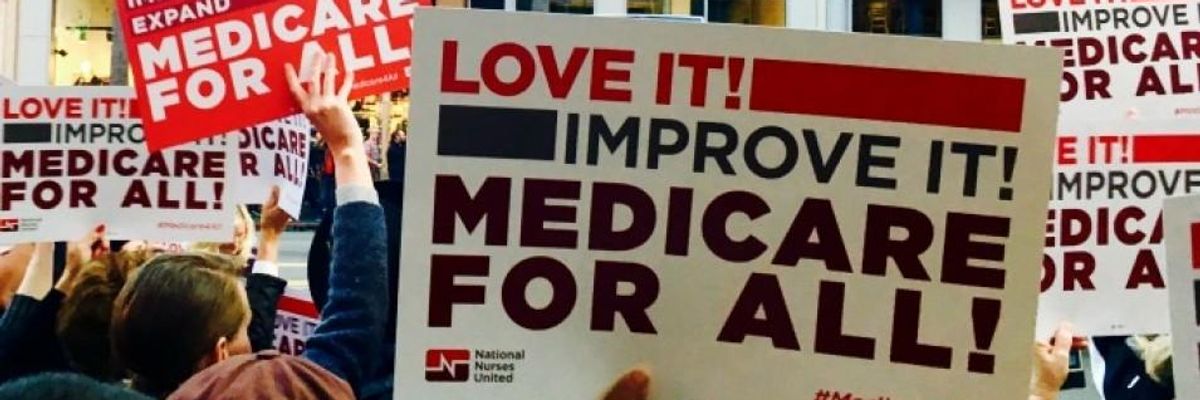
A new poll finds that seven in 10 Americans believe the U.S. healthcare system is in crisis, while a new analysis argues that promoting Medicare for All is far from the polical suicide that corporate Democrats warn candidates against. (Photo: National Nurses United/flickr/cc)
On the same day a new poll showed an overwhelming majority of Americans think the nation's healthcare system is "in state of crisis," a new analysis shows that Democrats should listen to those Americans--and end their reluctance to run on the promise of a bold solution like Medicare for All while propping up the for-profit system.
A new Gallup survey released Monday showed that 70 percent of respondents saw the U.S. healthcare system as having "major problems" or being in a "state of crisis." Eighty-four percent of Democrats expressed these concerns about the system in which many families are forced to pay high premiums and and deductibles, with worse health outcomes than in other high-income countries, while 56 percent of Republicans agreed.
"Democrats shouldn't fear authentic candidates who articulate our values. Those candidates offer the best path forward for the party." --Sean McElwee, Data for ProgressGallup has conducted the poll since 1994, with varying majorities of respondents generally expressing similar levels of concern with the U.S. system--but in recent months more Americans have pointed to Medicare for All as their preferred alternative to the for-profit model.
Meanwhile, the progressive think tank Data for Progress found in a recent analysis of the 2018 midterm election results that Democrats need not fear negativity regarding Medicare for All as they look toward 2020 and other future elections.
Looking at Democratic candidates who won in districts that had been held by Republicans in 2018, Data for Progress found (pdf) that candidates who supported Medicare for All were no more likely to lose their elections than so-called "moderate" Democrats.
"Medicare for All is politically safe ground for Democrats in general elections," said Emma Einhorn, a campaign director for MoveOn, which funded the report. "November's election results show that universal, higher-quality, lower-cost healthcare through Medicare for All is all moral upside--without political downside. Democrats shouldn't let corporate interests scare them away from supporting real change that would save lives."
"There is no evidence that Medicare for All harmed progressive performance in the 2018 midterms. Democrats shouldn't fear authentic candidates who articulate our values. Those candidates offer the best path forward for the party," added Data for Progress co-founder Sean McElwee.
Responding to the Gallup survey, Sen. Bernie Sanders (I-Vt.), whose Medicare for All bill has 15 co-sponsors in the Senate, pointed out Americans' widespread dismay over the for-profit system as the latest proof bolstering his case for the proposal.
A poll by Reuters last summer found that 70 percent of Americans--including 84 percent of Democrats and a majority of Republicans--believe the government should expand the federally-funded and broadly popular Medicare system to all Americans, establishing a universal healthcare system like the ones enjoyed in other wealthy countries.
Despite the rapidly growing appeal of Medicare for All, many powerful Democratic lawmakers continue to refuse to fight for the plan in Congress, with House Majority Whip Steny Hoyer (D-Md.) saying days after the Democrats won control of the House that he prefers to wait for President Donald Trump to propose reforms to the Affordable Care Act.
The corporate media also persists in pushing the false narrative that Medicare for All would be too expensive--despite evidence that the system would save trillions of dollars for American families in its first 10 years--with CNN grilling Rep. Alexandria Ocasio-Cortez (D-N.Y.) about how the country would pay for the program, a concern the network hadn't shared a year earlier when Republicans pushed through their $1.5 trillion tax cut for the wealthy and corporations.
Dear Common Dreams reader, It’s been nearly 30 years since I co-founded Common Dreams with my late wife, Lina Newhouser. We had the radical notion that journalism should serve the public good, not corporate profits. It was clear to us from the outset what it would take to build such a project. No paid advertisements. No corporate sponsors. No millionaire publisher telling us what to think or do. Many people said we wouldn't last a year, but we proved those doubters wrong. Together with a tremendous team of journalists and dedicated staff, we built an independent media outlet free from the constraints of profits and corporate control. Our mission has always been simple: To inform. To inspire. To ignite change for the common good. Building Common Dreams was not easy. Our survival was never guaranteed. When you take on the most powerful forces—Wall Street greed, fossil fuel industry destruction, Big Tech lobbyists, and uber-rich oligarchs who have spent billions upon billions rigging the economy and democracy in their favor—the only bulwark you have is supporters who believe in your work. But here’s the urgent message from me today. It's never been this bad out there. And it's never been this hard to keep us going. At the very moment Common Dreams is most needed, the threats we face are intensifying. We need your support now more than ever. We don't accept corporate advertising and never will. We don't have a paywall because we don't think people should be blocked from critical news based on their ability to pay. Everything we do is funded by the donations of readers like you. When everyone does the little they can afford, we are strong. But if that support retreats or dries up, so do we. Will you donate now to make sure Common Dreams not only survives but thrives? —Craig Brown, Co-founder |
On the same day a new poll showed an overwhelming majority of Americans think the nation's healthcare system is "in state of crisis," a new analysis shows that Democrats should listen to those Americans--and end their reluctance to run on the promise of a bold solution like Medicare for All while propping up the for-profit system.
A new Gallup survey released Monday showed that 70 percent of respondents saw the U.S. healthcare system as having "major problems" or being in a "state of crisis." Eighty-four percent of Democrats expressed these concerns about the system in which many families are forced to pay high premiums and and deductibles, with worse health outcomes than in other high-income countries, while 56 percent of Republicans agreed.
"Democrats shouldn't fear authentic candidates who articulate our values. Those candidates offer the best path forward for the party." --Sean McElwee, Data for ProgressGallup has conducted the poll since 1994, with varying majorities of respondents generally expressing similar levels of concern with the U.S. system--but in recent months more Americans have pointed to Medicare for All as their preferred alternative to the for-profit model.
Meanwhile, the progressive think tank Data for Progress found in a recent analysis of the 2018 midterm election results that Democrats need not fear negativity regarding Medicare for All as they look toward 2020 and other future elections.
Looking at Democratic candidates who won in districts that had been held by Republicans in 2018, Data for Progress found (pdf) that candidates who supported Medicare for All were no more likely to lose their elections than so-called "moderate" Democrats.
"Medicare for All is politically safe ground for Democrats in general elections," said Emma Einhorn, a campaign director for MoveOn, which funded the report. "November's election results show that universal, higher-quality, lower-cost healthcare through Medicare for All is all moral upside--without political downside. Democrats shouldn't let corporate interests scare them away from supporting real change that would save lives."
"There is no evidence that Medicare for All harmed progressive performance in the 2018 midterms. Democrats shouldn't fear authentic candidates who articulate our values. Those candidates offer the best path forward for the party," added Data for Progress co-founder Sean McElwee.
Responding to the Gallup survey, Sen. Bernie Sanders (I-Vt.), whose Medicare for All bill has 15 co-sponsors in the Senate, pointed out Americans' widespread dismay over the for-profit system as the latest proof bolstering his case for the proposal.
A poll by Reuters last summer found that 70 percent of Americans--including 84 percent of Democrats and a majority of Republicans--believe the government should expand the federally-funded and broadly popular Medicare system to all Americans, establishing a universal healthcare system like the ones enjoyed in other wealthy countries.
Despite the rapidly growing appeal of Medicare for All, many powerful Democratic lawmakers continue to refuse to fight for the plan in Congress, with House Majority Whip Steny Hoyer (D-Md.) saying days after the Democrats won control of the House that he prefers to wait for President Donald Trump to propose reforms to the Affordable Care Act.
The corporate media also persists in pushing the false narrative that Medicare for All would be too expensive--despite evidence that the system would save trillions of dollars for American families in its first 10 years--with CNN grilling Rep. Alexandria Ocasio-Cortez (D-N.Y.) about how the country would pay for the program, a concern the network hadn't shared a year earlier when Republicans pushed through their $1.5 trillion tax cut for the wealthy and corporations.
On the same day a new poll showed an overwhelming majority of Americans think the nation's healthcare system is "in state of crisis," a new analysis shows that Democrats should listen to those Americans--and end their reluctance to run on the promise of a bold solution like Medicare for All while propping up the for-profit system.
A new Gallup survey released Monday showed that 70 percent of respondents saw the U.S. healthcare system as having "major problems" or being in a "state of crisis." Eighty-four percent of Democrats expressed these concerns about the system in which many families are forced to pay high premiums and and deductibles, with worse health outcomes than in other high-income countries, while 56 percent of Republicans agreed.
"Democrats shouldn't fear authentic candidates who articulate our values. Those candidates offer the best path forward for the party." --Sean McElwee, Data for ProgressGallup has conducted the poll since 1994, with varying majorities of respondents generally expressing similar levels of concern with the U.S. system--but in recent months more Americans have pointed to Medicare for All as their preferred alternative to the for-profit model.
Meanwhile, the progressive think tank Data for Progress found in a recent analysis of the 2018 midterm election results that Democrats need not fear negativity regarding Medicare for All as they look toward 2020 and other future elections.
Looking at Democratic candidates who won in districts that had been held by Republicans in 2018, Data for Progress found (pdf) that candidates who supported Medicare for All were no more likely to lose their elections than so-called "moderate" Democrats.
"Medicare for All is politically safe ground for Democrats in general elections," said Emma Einhorn, a campaign director for MoveOn, which funded the report. "November's election results show that universal, higher-quality, lower-cost healthcare through Medicare for All is all moral upside--without political downside. Democrats shouldn't let corporate interests scare them away from supporting real change that would save lives."
"There is no evidence that Medicare for All harmed progressive performance in the 2018 midterms. Democrats shouldn't fear authentic candidates who articulate our values. Those candidates offer the best path forward for the party," added Data for Progress co-founder Sean McElwee.
Responding to the Gallup survey, Sen. Bernie Sanders (I-Vt.), whose Medicare for All bill has 15 co-sponsors in the Senate, pointed out Americans' widespread dismay over the for-profit system as the latest proof bolstering his case for the proposal.
A poll by Reuters last summer found that 70 percent of Americans--including 84 percent of Democrats and a majority of Republicans--believe the government should expand the federally-funded and broadly popular Medicare system to all Americans, establishing a universal healthcare system like the ones enjoyed in other wealthy countries.
Despite the rapidly growing appeal of Medicare for All, many powerful Democratic lawmakers continue to refuse to fight for the plan in Congress, with House Majority Whip Steny Hoyer (D-Md.) saying days after the Democrats won control of the House that he prefers to wait for President Donald Trump to propose reforms to the Affordable Care Act.
The corporate media also persists in pushing the false narrative that Medicare for All would be too expensive--despite evidence that the system would save trillions of dollars for American families in its first 10 years--with CNN grilling Rep. Alexandria Ocasio-Cortez (D-N.Y.) about how the country would pay for the program, a concern the network hadn't shared a year earlier when Republicans pushed through their $1.5 trillion tax cut for the wealthy and corporations.