SUBSCRIBE TO OUR FREE NEWSLETTER
Daily news & progressive opinion—funded by the people, not the corporations—delivered straight to your inbox.
5
#000000
#FFFFFF
To donate by check, phone, or other method, see our More Ways to Give page.
Daily news & progressive opinion—funded by the people, not the corporations—delivered straight to your inbox.
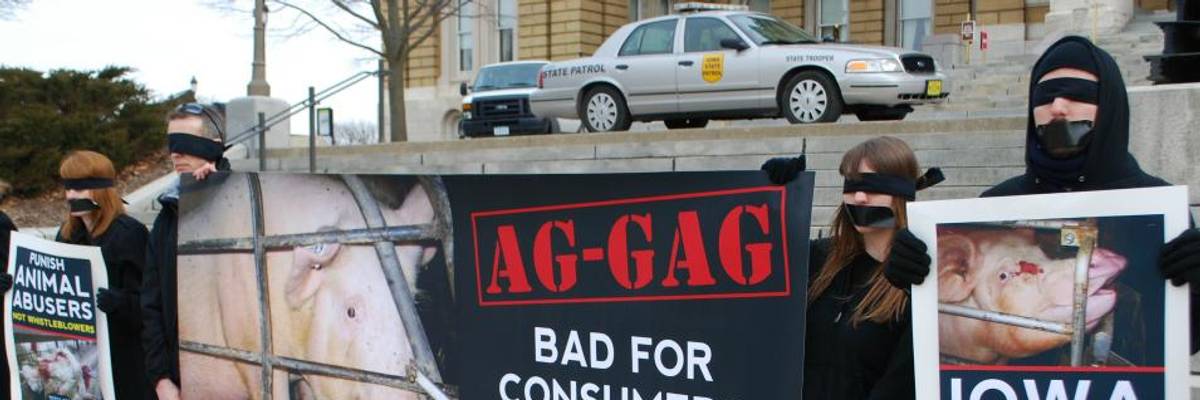
Animal rights activists protested Iowa's ag-gag legislation in March of 2012 shortly before it was signed into law by Republican Gov. Terry Bradstad. (Photo: Mercy For Animals/Flickr/cc)
In "an important victory for free speech" and animal welfare, a federal judge on Wednesday struck down Iowa's so-called "ag-gag" law, determining that it violates the U.S. Constitution's First Amendment.
"It has effectively silenced advocates and ensured that animal cruelty, unsafe food safety practices, environmental hazards, and inhumane working conditions go unreported for years."
--Rita Bettis Austen, ACLU of Iowa
The legal groups that brought the case challenging Iowa's ag-gag law and other animal rights advocates celebrated the win in court, which follows similar victories in Idaho, Utah, and Wyoming.
"Ag-gag laws are a pernicious attempt by animal exploitation industries to hide some of the worst forms of animal abuse in the United States," Animal Legal Defense Fund executive director Stephen Wells said in a statement on Wednesday. "Today's victory makes it clear that the government cannot protect these industries at the expense of our constitutional rights."
Ag-gag legislation, which has been enacted and often struck down in several states with sizable agricultural industries, aims to prevent journalists and activists from going undercover at factory farms and other facilities where animals are held for commercial purposes, such as slaughterhouses and puppy mills, to shed light on abuse.
As ACLU of Iowa legal director Rita Bettis Austen explained, in her state--home to an estimated 10,000 factory farms--"it has effectively silenced advocates and ensured that animal cruelty, unsafe food safety practices, environmental hazards, and inhumane working conditions go unreported for years."
Senior Judge James Gritzner of the U.S. District Court for the Southern District of Iowa granted summary judgment (pdf) on Wednesday, declaring that the state's lawyers had failed to show that the law's prohibitions on speech "are actually necessary to protect perceived harms to property and biosecurity," as they had argued.
While conceding that protecting both is important, Gritzner further concluded that the "prohibitions are not narrowly tailored to serve either interest." Additionally, his judgement noted that there were other motivations for implementing the law:
[As] admitted by defendants, some lawmakers also wanted to stop "subversive acts" by "groups that go out and gin up campaigns...to give the agricultural industry a bad name." ...Other statements in the record illustrate that [the law] serves the interest of protecting Iowa's agricultural industry from perceived harms flowing from undercover investigations of its facilities.
Journalist, animal rights advocate, and constitutional lawyer Glenn Greenwald declared in a tweet that the decision was "a huge win for free speech and a free press, and a major--and richly deserved--defeat for the pervasively corrupt agricultural industry, that has tried to use their control over governments to criminalize the exposure of their heinous practices."
Dear Common Dreams reader, It’s been nearly 30 years since I co-founded Common Dreams with my late wife, Lina Newhouser. We had the radical notion that journalism should serve the public good, not corporate profits. It was clear to us from the outset what it would take to build such a project. No paid advertisements. No corporate sponsors. No millionaire publisher telling us what to think or do. Many people said we wouldn't last a year, but we proved those doubters wrong. Together with a tremendous team of journalists and dedicated staff, we built an independent media outlet free from the constraints of profits and corporate control. Our mission has always been simple: To inform. To inspire. To ignite change for the common good. Building Common Dreams was not easy. Our survival was never guaranteed. When you take on the most powerful forces—Wall Street greed, fossil fuel industry destruction, Big Tech lobbyists, and uber-rich oligarchs who have spent billions upon billions rigging the economy and democracy in their favor—the only bulwark you have is supporters who believe in your work. But here’s the urgent message from me today. It's never been this bad out there. And it's never been this hard to keep us going. At the very moment Common Dreams is most needed, the threats we face are intensifying. We need your support now more than ever. We don't accept corporate advertising and never will. We don't have a paywall because we don't think people should be blocked from critical news based on their ability to pay. Everything we do is funded by the donations of readers like you. When everyone does the little they can afford, we are strong. But if that support retreats or dries up, so do we. Will you donate now to make sure Common Dreams not only survives but thrives? —Craig Brown, Co-founder |
In "an important victory for free speech" and animal welfare, a federal judge on Wednesday struck down Iowa's so-called "ag-gag" law, determining that it violates the U.S. Constitution's First Amendment.
"It has effectively silenced advocates and ensured that animal cruelty, unsafe food safety practices, environmental hazards, and inhumane working conditions go unreported for years."
--Rita Bettis Austen, ACLU of Iowa
The legal groups that brought the case challenging Iowa's ag-gag law and other animal rights advocates celebrated the win in court, which follows similar victories in Idaho, Utah, and Wyoming.
"Ag-gag laws are a pernicious attempt by animal exploitation industries to hide some of the worst forms of animal abuse in the United States," Animal Legal Defense Fund executive director Stephen Wells said in a statement on Wednesday. "Today's victory makes it clear that the government cannot protect these industries at the expense of our constitutional rights."
Ag-gag legislation, which has been enacted and often struck down in several states with sizable agricultural industries, aims to prevent journalists and activists from going undercover at factory farms and other facilities where animals are held for commercial purposes, such as slaughterhouses and puppy mills, to shed light on abuse.
As ACLU of Iowa legal director Rita Bettis Austen explained, in her state--home to an estimated 10,000 factory farms--"it has effectively silenced advocates and ensured that animal cruelty, unsafe food safety practices, environmental hazards, and inhumane working conditions go unreported for years."
Senior Judge James Gritzner of the U.S. District Court for the Southern District of Iowa granted summary judgment (pdf) on Wednesday, declaring that the state's lawyers had failed to show that the law's prohibitions on speech "are actually necessary to protect perceived harms to property and biosecurity," as they had argued.
While conceding that protecting both is important, Gritzner further concluded that the "prohibitions are not narrowly tailored to serve either interest." Additionally, his judgement noted that there were other motivations for implementing the law:
[As] admitted by defendants, some lawmakers also wanted to stop "subversive acts" by "groups that go out and gin up campaigns...to give the agricultural industry a bad name." ...Other statements in the record illustrate that [the law] serves the interest of protecting Iowa's agricultural industry from perceived harms flowing from undercover investigations of its facilities.
Journalist, animal rights advocate, and constitutional lawyer Glenn Greenwald declared in a tweet that the decision was "a huge win for free speech and a free press, and a major--and richly deserved--defeat for the pervasively corrupt agricultural industry, that has tried to use their control over governments to criminalize the exposure of their heinous practices."
In "an important victory for free speech" and animal welfare, a federal judge on Wednesday struck down Iowa's so-called "ag-gag" law, determining that it violates the U.S. Constitution's First Amendment.
"It has effectively silenced advocates and ensured that animal cruelty, unsafe food safety practices, environmental hazards, and inhumane working conditions go unreported for years."
--Rita Bettis Austen, ACLU of Iowa
The legal groups that brought the case challenging Iowa's ag-gag law and other animal rights advocates celebrated the win in court, which follows similar victories in Idaho, Utah, and Wyoming.
"Ag-gag laws are a pernicious attempt by animal exploitation industries to hide some of the worst forms of animal abuse in the United States," Animal Legal Defense Fund executive director Stephen Wells said in a statement on Wednesday. "Today's victory makes it clear that the government cannot protect these industries at the expense of our constitutional rights."
Ag-gag legislation, which has been enacted and often struck down in several states with sizable agricultural industries, aims to prevent journalists and activists from going undercover at factory farms and other facilities where animals are held for commercial purposes, such as slaughterhouses and puppy mills, to shed light on abuse.
As ACLU of Iowa legal director Rita Bettis Austen explained, in her state--home to an estimated 10,000 factory farms--"it has effectively silenced advocates and ensured that animal cruelty, unsafe food safety practices, environmental hazards, and inhumane working conditions go unreported for years."
Senior Judge James Gritzner of the U.S. District Court for the Southern District of Iowa granted summary judgment (pdf) on Wednesday, declaring that the state's lawyers had failed to show that the law's prohibitions on speech "are actually necessary to protect perceived harms to property and biosecurity," as they had argued.
While conceding that protecting both is important, Gritzner further concluded that the "prohibitions are not narrowly tailored to serve either interest." Additionally, his judgement noted that there were other motivations for implementing the law:
[As] admitted by defendants, some lawmakers also wanted to stop "subversive acts" by "groups that go out and gin up campaigns...to give the agricultural industry a bad name." ...Other statements in the record illustrate that [the law] serves the interest of protecting Iowa's agricultural industry from perceived harms flowing from undercover investigations of its facilities.
Journalist, animal rights advocate, and constitutional lawyer Glenn Greenwald declared in a tweet that the decision was "a huge win for free speech and a free press, and a major--and richly deserved--defeat for the pervasively corrupt agricultural industry, that has tried to use their control over governments to criminalize the exposure of their heinous practices."