SUBSCRIBE TO OUR FREE NEWSLETTER
Daily news & progressive opinion—funded by the people, not the corporations—delivered straight to your inbox.
5
#000000
#FFFFFF
To donate by check, phone, or other method, see our More Ways to Give page.
Daily news & progressive opinion—funded by the people, not the corporations—delivered straight to your inbox.
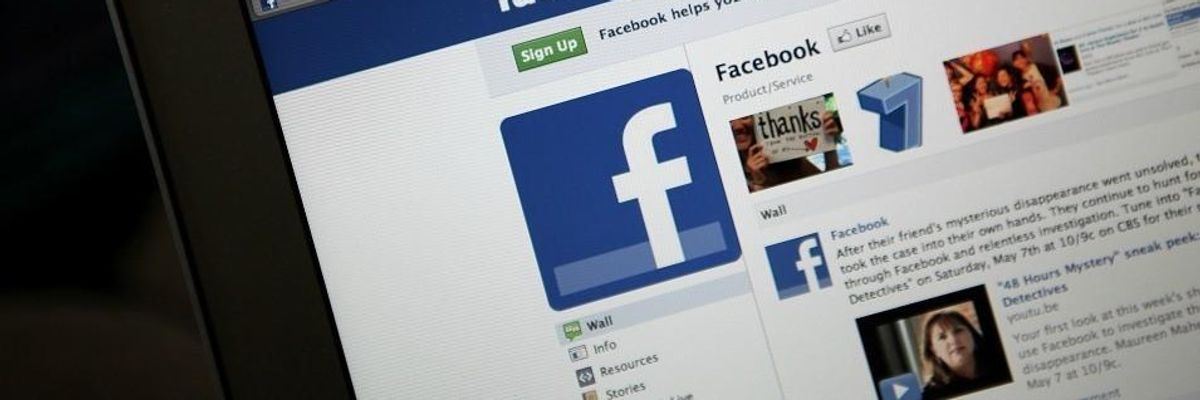
The New York Times on Thursday published a report on Facebook's censorship policies. (Photo: Justin Sullivan/Getty Images)
After the New York Times on Thursday published an expose of Facebook's global censorship rulebook, journalist Rania Khalek called out the social media giant for taking down a video in which she explains how, "on top of being occupied, colonized territory, Palestine is Israel's personal laboratory for testing, refining, and showcasing methods and weapons of domination and control."
Tweeting out the Times report--and noting that while, according to the newspaper, "moderators were told to hunt down and remove rumors wrongly accusing an Israeli soldier of killing a Palestinian medic," Israeli soldiers did fatally shoot an unarmed 21-year-old female paramedic earlier this year--she announced Friday morning that Facebook had "just removed" her video.
After she and other prominent reporters issued public complaints, Khalek announced a couple hours later that Facebook had restored the video. "Still this is a good reminder that at the moment these social media giants have the ability to disappear content as they please," she said in a tweet. "It's creepy and alarming and should be loudly opposed."
Among those who highlighted Facebook's censorship of Khalek's video on Friday were Ben Norton of The Real News Network--who called it an "excellent, informative video report"--and The Intercept's Glenn Greenwald, who pointed out that the platform has been silencing Palestinian and pro-Palestinian voices for more than a year.
"In Mark Zuckerberg, Sundar Pichai, Sheryl Sandberg, and Eric Schmidt we trust to censor and regulate the internet with the most benevolent of motives, devoted as they've been their entire lives to safeguarding the voiceless and protecting the marginalized," Greenwald sarcastically added, referring to Facebook's CEO, Google's CEO, Facebook's COO, and the executive chairman of Alphabet, Google's parent company.
"Facebook, to address hate and misinformation epidemics of its own creation, is intervening into political and social matters the world over. Like an unseen branch of government, it is governing without our consent."
--Max Fisher, New York Times
The short and successful fight to restore Khalek's video, however, is just one of countless instances of Facebook taking down content without providing an explanation to the user or the public. Max Fisher's report for the Times offers a glimpse into its secretive but widely criticized censorship practices.
A review of 1,400 pages provided to the newspaper by a concerned employee--and verified as authentic by Facebook, which supposedly has made some updates--"revealed numerous gaps, biases, and outright errors," Fisher wrote. "The closely held rules are extensive, and they make the company a far more powerful arbiter of global speech than has been publicly recognized or acknowledged by the company itself."
While Facebook claimed the rulebook is for training, moderators--who "describe feeling in over their heads" as they try to make decisions in as little as eight-to-10 seconds--told Fisher they reference it regularly. And though Facebook staff reportedly craft moderation rules in meetings every other week, "the company outsources much of the actual post-by-post moderation to companies that enlist largely unskilled workers, many hired out of call centers."
The lengthy and arguably confusing guidance that Facebook gives to moderators has produced mixed and, at times, alarming results. As Fisher noted, "They have allowed extremist language to flourish in some countries while censoring mainstream speech in others." He explained:
Moderators were once told, for example, to remove fundraising appeals for volcano victims in Indonesia because a co-sponsor of the drive was on Facebook's internal list of banned groups. In Myanmar, a paperwork error allowed a prominent extremist group, accused of fomenting genocide, to stay on the platform for months. In India, moderators were mistakenly told to take down comments critical of religion.
The key takeaway from his report, Fisher said on Twitter, is two-fold: Facebook "is intervening into political and social matters the world over," acting "like an unseen branch of government," and "is doing this all on the cheap, shipping disorganized PowerPoint slides to outsourcing companies it can barely control. And it is making many, many mistakes along the way."
Dear Common Dreams reader, It’s been nearly 30 years since I co-founded Common Dreams with my late wife, Lina Newhouser. We had the radical notion that journalism should serve the public good, not corporate profits. It was clear to us from the outset what it would take to build such a project. No paid advertisements. No corporate sponsors. No millionaire publisher telling us what to think or do. Many people said we wouldn't last a year, but we proved those doubters wrong. Together with a tremendous team of journalists and dedicated staff, we built an independent media outlet free from the constraints of profits and corporate control. Our mission has always been simple: To inform. To inspire. To ignite change for the common good. Building Common Dreams was not easy. Our survival was never guaranteed. When you take on the most powerful forces—Wall Street greed, fossil fuel industry destruction, Big Tech lobbyists, and uber-rich oligarchs who have spent billions upon billions rigging the economy and democracy in their favor—the only bulwark you have is supporters who believe in your work. But here’s the urgent message from me today. It's never been this bad out there. And it's never been this hard to keep us going. At the very moment Common Dreams is most needed, the threats we face are intensifying. We need your support now more than ever. We don't accept corporate advertising and never will. We don't have a paywall because we don't think people should be blocked from critical news based on their ability to pay. Everything we do is funded by the donations of readers like you. When everyone does the little they can afford, we are strong. But if that support retreats or dries up, so do we. Will you donate now to make sure Common Dreams not only survives but thrives? —Craig Brown, Co-founder |
After the New York Times on Thursday published an expose of Facebook's global censorship rulebook, journalist Rania Khalek called out the social media giant for taking down a video in which she explains how, "on top of being occupied, colonized territory, Palestine is Israel's personal laboratory for testing, refining, and showcasing methods and weapons of domination and control."
Tweeting out the Times report--and noting that while, according to the newspaper, "moderators were told to hunt down and remove rumors wrongly accusing an Israeli soldier of killing a Palestinian medic," Israeli soldiers did fatally shoot an unarmed 21-year-old female paramedic earlier this year--she announced Friday morning that Facebook had "just removed" her video.
After she and other prominent reporters issued public complaints, Khalek announced a couple hours later that Facebook had restored the video. "Still this is a good reminder that at the moment these social media giants have the ability to disappear content as they please," she said in a tweet. "It's creepy and alarming and should be loudly opposed."
Among those who highlighted Facebook's censorship of Khalek's video on Friday were Ben Norton of The Real News Network--who called it an "excellent, informative video report"--and The Intercept's Glenn Greenwald, who pointed out that the platform has been silencing Palestinian and pro-Palestinian voices for more than a year.
"In Mark Zuckerberg, Sundar Pichai, Sheryl Sandberg, and Eric Schmidt we trust to censor and regulate the internet with the most benevolent of motives, devoted as they've been their entire lives to safeguarding the voiceless and protecting the marginalized," Greenwald sarcastically added, referring to Facebook's CEO, Google's CEO, Facebook's COO, and the executive chairman of Alphabet, Google's parent company.
"Facebook, to address hate and misinformation epidemics of its own creation, is intervening into political and social matters the world over. Like an unseen branch of government, it is governing without our consent."
--Max Fisher, New York Times
The short and successful fight to restore Khalek's video, however, is just one of countless instances of Facebook taking down content without providing an explanation to the user or the public. Max Fisher's report for the Times offers a glimpse into its secretive but widely criticized censorship practices.
A review of 1,400 pages provided to the newspaper by a concerned employee--and verified as authentic by Facebook, which supposedly has made some updates--"revealed numerous gaps, biases, and outright errors," Fisher wrote. "The closely held rules are extensive, and they make the company a far more powerful arbiter of global speech than has been publicly recognized or acknowledged by the company itself."
While Facebook claimed the rulebook is for training, moderators--who "describe feeling in over their heads" as they try to make decisions in as little as eight-to-10 seconds--told Fisher they reference it regularly. And though Facebook staff reportedly craft moderation rules in meetings every other week, "the company outsources much of the actual post-by-post moderation to companies that enlist largely unskilled workers, many hired out of call centers."
The lengthy and arguably confusing guidance that Facebook gives to moderators has produced mixed and, at times, alarming results. As Fisher noted, "They have allowed extremist language to flourish in some countries while censoring mainstream speech in others." He explained:
Moderators were once told, for example, to remove fundraising appeals for volcano victims in Indonesia because a co-sponsor of the drive was on Facebook's internal list of banned groups. In Myanmar, a paperwork error allowed a prominent extremist group, accused of fomenting genocide, to stay on the platform for months. In India, moderators were mistakenly told to take down comments critical of religion.
The key takeaway from his report, Fisher said on Twitter, is two-fold: Facebook "is intervening into political and social matters the world over," acting "like an unseen branch of government," and "is doing this all on the cheap, shipping disorganized PowerPoint slides to outsourcing companies it can barely control. And it is making many, many mistakes along the way."
After the New York Times on Thursday published an expose of Facebook's global censorship rulebook, journalist Rania Khalek called out the social media giant for taking down a video in which she explains how, "on top of being occupied, colonized territory, Palestine is Israel's personal laboratory for testing, refining, and showcasing methods and weapons of domination and control."
Tweeting out the Times report--and noting that while, according to the newspaper, "moderators were told to hunt down and remove rumors wrongly accusing an Israeli soldier of killing a Palestinian medic," Israeli soldiers did fatally shoot an unarmed 21-year-old female paramedic earlier this year--she announced Friday morning that Facebook had "just removed" her video.
After she and other prominent reporters issued public complaints, Khalek announced a couple hours later that Facebook had restored the video. "Still this is a good reminder that at the moment these social media giants have the ability to disappear content as they please," she said in a tweet. "It's creepy and alarming and should be loudly opposed."
Among those who highlighted Facebook's censorship of Khalek's video on Friday were Ben Norton of The Real News Network--who called it an "excellent, informative video report"--and The Intercept's Glenn Greenwald, who pointed out that the platform has been silencing Palestinian and pro-Palestinian voices for more than a year.
"In Mark Zuckerberg, Sundar Pichai, Sheryl Sandberg, and Eric Schmidt we trust to censor and regulate the internet with the most benevolent of motives, devoted as they've been their entire lives to safeguarding the voiceless and protecting the marginalized," Greenwald sarcastically added, referring to Facebook's CEO, Google's CEO, Facebook's COO, and the executive chairman of Alphabet, Google's parent company.
"Facebook, to address hate and misinformation epidemics of its own creation, is intervening into political and social matters the world over. Like an unseen branch of government, it is governing without our consent."
--Max Fisher, New York Times
The short and successful fight to restore Khalek's video, however, is just one of countless instances of Facebook taking down content without providing an explanation to the user or the public. Max Fisher's report for the Times offers a glimpse into its secretive but widely criticized censorship practices.
A review of 1,400 pages provided to the newspaper by a concerned employee--and verified as authentic by Facebook, which supposedly has made some updates--"revealed numerous gaps, biases, and outright errors," Fisher wrote. "The closely held rules are extensive, and they make the company a far more powerful arbiter of global speech than has been publicly recognized or acknowledged by the company itself."
While Facebook claimed the rulebook is for training, moderators--who "describe feeling in over their heads" as they try to make decisions in as little as eight-to-10 seconds--told Fisher they reference it regularly. And though Facebook staff reportedly craft moderation rules in meetings every other week, "the company outsources much of the actual post-by-post moderation to companies that enlist largely unskilled workers, many hired out of call centers."
The lengthy and arguably confusing guidance that Facebook gives to moderators has produced mixed and, at times, alarming results. As Fisher noted, "They have allowed extremist language to flourish in some countries while censoring mainstream speech in others." He explained:
Moderators were once told, for example, to remove fundraising appeals for volcano victims in Indonesia because a co-sponsor of the drive was on Facebook's internal list of banned groups. In Myanmar, a paperwork error allowed a prominent extremist group, accused of fomenting genocide, to stay on the platform for months. In India, moderators were mistakenly told to take down comments critical of religion.
The key takeaway from his report, Fisher said on Twitter, is two-fold: Facebook "is intervening into political and social matters the world over," acting "like an unseen branch of government," and "is doing this all on the cheap, shipping disorganized PowerPoint slides to outsourcing companies it can barely control. And it is making many, many mistakes along the way."