SUBSCRIBE TO OUR FREE NEWSLETTER
Daily news & progressive opinion—funded by the people, not the corporations—delivered straight to your inbox.
5
#000000
#FFFFFF
To donate by check, phone, or other method, see our More Ways to Give page.
Daily news & progressive opinion—funded by the people, not the corporations—delivered straight to your inbox.
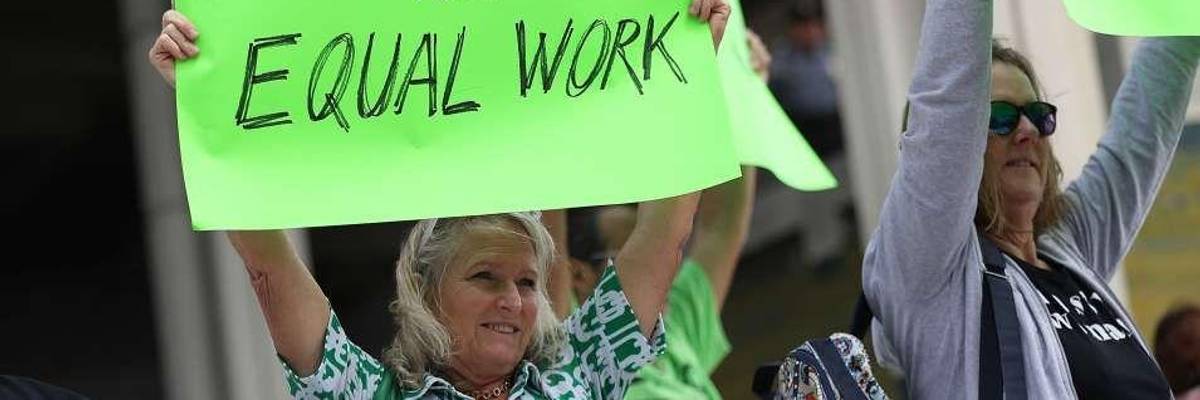
The World Economic Forum reported Wednesday that the global gender pay gap will take 200 years to close at the current rate of progress. (Photo: Joe Raedle/Getty Images)
At the current rate of progress--or lack thereof--the global gender pay gap would take more than 200 years to close, according to a new report by the World Economic Forum (WEF).
The 2018 Global Gender Gap Report examined women's earning potential and political involvement in comparison to that--given the current rate--women will continue to earn less than their male counterparts until at least the year 2220.
"The overall picture is that gender equality has stalled," Saadia Zahidi, head of social and economic agendas for the WEF, told the Guardian.
Gender pay gap: Women are on track to earn the same as men - in 202 years https://t.co/PdQe68Eu1t
-- Asher Wolf (@Asher_Wolf) December 18, 2018
Around the world, women make an average of 63 percent of what men make, and the report found no countries where women earn more than their male counterparts.
In terms of pay equity, Laos was the highest-ranking country, with women taking home 91 percent of men's earnings. Barbados, The Bahamas, and Benin were not far behind; women in those countries earn at least 85 percent of men's salaries.
Earlier this year, a study out of Princeton University found that gender pay gaps around the world are essentially the result of a "child penalty" faced by women who have children.
"Policy plays a role here too--countries have the ability to shape what child rearing looks like with how they structure parental leave policies, for example," wrote Sarah Kliff at Vox.com when the Princeton report came out. "It's a decision that each country makes about whether to enact policies that bring more equity to its labor forces, or ones that place the disproportionate share of child care on women."
The WEF's study also examined political power, health and survival, and access to education to measure women's status in each country, and found that Iceland had the highest overall gender equity. The country ranked number one in terms of political involvement of women--and was one of just 17 countries that have female heads of state--but was not included in the top 10 countries with the smallest wage gaps, ranking at number 17.
Nicaragua and Norway followed Iceland in the political power rankings.
"On the other end of the spectrum, almost one-quarter of the countries assessed have closed less than 10 percent of their gender gap" in politics, the WEF reported. "The four worst-performing countries--Kuwait, Lebanon, Oman, and Yemen--have yet to bridge over 97 percent of their gap."
"The world still has a long way to go" in terms of political and economic empowerment of women, the report added. Just 34 percent of management and senior official positions are held by women around the world, while an average of "just 18 percent of ministers and 24 percent of parliamentarians globally are women."
The United States ranked 19th on the index of economic participation and opportunity and 98th in terms of women's political involvement.
The inequality like the kind seen in the U.S. political system and in workplaces and governments around the world has real consequences for the well-being of the world's communities, the report found.
"The equal contribution of women and men in this process of deep economic and societal transformation is critical," Klaus Schwab, executive chairman of the WEF, told the Guardian. "More than ever, societies cannot afford to lose out on the skills, ideas, and perspectives of half of humanity."
Dear Common Dreams reader, It’s been nearly 30 years since I co-founded Common Dreams with my late wife, Lina Newhouser. We had the radical notion that journalism should serve the public good, not corporate profits. It was clear to us from the outset what it would take to build such a project. No paid advertisements. No corporate sponsors. No millionaire publisher telling us what to think or do. Many people said we wouldn't last a year, but we proved those doubters wrong. Together with a tremendous team of journalists and dedicated staff, we built an independent media outlet free from the constraints of profits and corporate control. Our mission has always been simple: To inform. To inspire. To ignite change for the common good. Building Common Dreams was not easy. Our survival was never guaranteed. When you take on the most powerful forces—Wall Street greed, fossil fuel industry destruction, Big Tech lobbyists, and uber-rich oligarchs who have spent billions upon billions rigging the economy and democracy in their favor—the only bulwark you have is supporters who believe in your work. But here’s the urgent message from me today. It's never been this bad out there. And it's never been this hard to keep us going. At the very moment Common Dreams is most needed, the threats we face are intensifying. We need your support now more than ever. We don't accept corporate advertising and never will. We don't have a paywall because we don't think people should be blocked from critical news based on their ability to pay. Everything we do is funded by the donations of readers like you. When everyone does the little they can afford, we are strong. But if that support retreats or dries up, so do we. Will you donate now to make sure Common Dreams not only survives but thrives? —Craig Brown, Co-founder |
At the current rate of progress--or lack thereof--the global gender pay gap would take more than 200 years to close, according to a new report by the World Economic Forum (WEF).
The 2018 Global Gender Gap Report examined women's earning potential and political involvement in comparison to that--given the current rate--women will continue to earn less than their male counterparts until at least the year 2220.
"The overall picture is that gender equality has stalled," Saadia Zahidi, head of social and economic agendas for the WEF, told the Guardian.
Gender pay gap: Women are on track to earn the same as men - in 202 years https://t.co/PdQe68Eu1t
-- Asher Wolf (@Asher_Wolf) December 18, 2018
Around the world, women make an average of 63 percent of what men make, and the report found no countries where women earn more than their male counterparts.
In terms of pay equity, Laos was the highest-ranking country, with women taking home 91 percent of men's earnings. Barbados, The Bahamas, and Benin were not far behind; women in those countries earn at least 85 percent of men's salaries.
Earlier this year, a study out of Princeton University found that gender pay gaps around the world are essentially the result of a "child penalty" faced by women who have children.
"Policy plays a role here too--countries have the ability to shape what child rearing looks like with how they structure parental leave policies, for example," wrote Sarah Kliff at Vox.com when the Princeton report came out. "It's a decision that each country makes about whether to enact policies that bring more equity to its labor forces, or ones that place the disproportionate share of child care on women."
The WEF's study also examined political power, health and survival, and access to education to measure women's status in each country, and found that Iceland had the highest overall gender equity. The country ranked number one in terms of political involvement of women--and was one of just 17 countries that have female heads of state--but was not included in the top 10 countries with the smallest wage gaps, ranking at number 17.
Nicaragua and Norway followed Iceland in the political power rankings.
"On the other end of the spectrum, almost one-quarter of the countries assessed have closed less than 10 percent of their gender gap" in politics, the WEF reported. "The four worst-performing countries--Kuwait, Lebanon, Oman, and Yemen--have yet to bridge over 97 percent of their gap."
"The world still has a long way to go" in terms of political and economic empowerment of women, the report added. Just 34 percent of management and senior official positions are held by women around the world, while an average of "just 18 percent of ministers and 24 percent of parliamentarians globally are women."
The United States ranked 19th on the index of economic participation and opportunity and 98th in terms of women's political involvement.
The inequality like the kind seen in the U.S. political system and in workplaces and governments around the world has real consequences for the well-being of the world's communities, the report found.
"The equal contribution of women and men in this process of deep economic and societal transformation is critical," Klaus Schwab, executive chairman of the WEF, told the Guardian. "More than ever, societies cannot afford to lose out on the skills, ideas, and perspectives of half of humanity."
At the current rate of progress--or lack thereof--the global gender pay gap would take more than 200 years to close, according to a new report by the World Economic Forum (WEF).
The 2018 Global Gender Gap Report examined women's earning potential and political involvement in comparison to that--given the current rate--women will continue to earn less than their male counterparts until at least the year 2220.
"The overall picture is that gender equality has stalled," Saadia Zahidi, head of social and economic agendas for the WEF, told the Guardian.
Gender pay gap: Women are on track to earn the same as men - in 202 years https://t.co/PdQe68Eu1t
-- Asher Wolf (@Asher_Wolf) December 18, 2018
Around the world, women make an average of 63 percent of what men make, and the report found no countries where women earn more than their male counterparts.
In terms of pay equity, Laos was the highest-ranking country, with women taking home 91 percent of men's earnings. Barbados, The Bahamas, and Benin were not far behind; women in those countries earn at least 85 percent of men's salaries.
Earlier this year, a study out of Princeton University found that gender pay gaps around the world are essentially the result of a "child penalty" faced by women who have children.
"Policy plays a role here too--countries have the ability to shape what child rearing looks like with how they structure parental leave policies, for example," wrote Sarah Kliff at Vox.com when the Princeton report came out. "It's a decision that each country makes about whether to enact policies that bring more equity to its labor forces, or ones that place the disproportionate share of child care on women."
The WEF's study also examined political power, health and survival, and access to education to measure women's status in each country, and found that Iceland had the highest overall gender equity. The country ranked number one in terms of political involvement of women--and was one of just 17 countries that have female heads of state--but was not included in the top 10 countries with the smallest wage gaps, ranking at number 17.
Nicaragua and Norway followed Iceland in the political power rankings.
"On the other end of the spectrum, almost one-quarter of the countries assessed have closed less than 10 percent of their gender gap" in politics, the WEF reported. "The four worst-performing countries--Kuwait, Lebanon, Oman, and Yemen--have yet to bridge over 97 percent of their gap."
"The world still has a long way to go" in terms of political and economic empowerment of women, the report added. Just 34 percent of management and senior official positions are held by women around the world, while an average of "just 18 percent of ministers and 24 percent of parliamentarians globally are women."
The United States ranked 19th on the index of economic participation and opportunity and 98th in terms of women's political involvement.
The inequality like the kind seen in the U.S. political system and in workplaces and governments around the world has real consequences for the well-being of the world's communities, the report found.
"The equal contribution of women and men in this process of deep economic and societal transformation is critical," Klaus Schwab, executive chairman of the WEF, told the Guardian. "More than ever, societies cannot afford to lose out on the skills, ideas, and perspectives of half of humanity."