SUBSCRIBE TO OUR FREE NEWSLETTER
Daily news & progressive opinion—funded by the people, not the corporations—delivered straight to your inbox.
5
#000000
#FFFFFF
To donate by check, phone, or other method, see our More Ways to Give page.
Daily news & progressive opinion—funded by the people, not the corporations—delivered straight to your inbox.
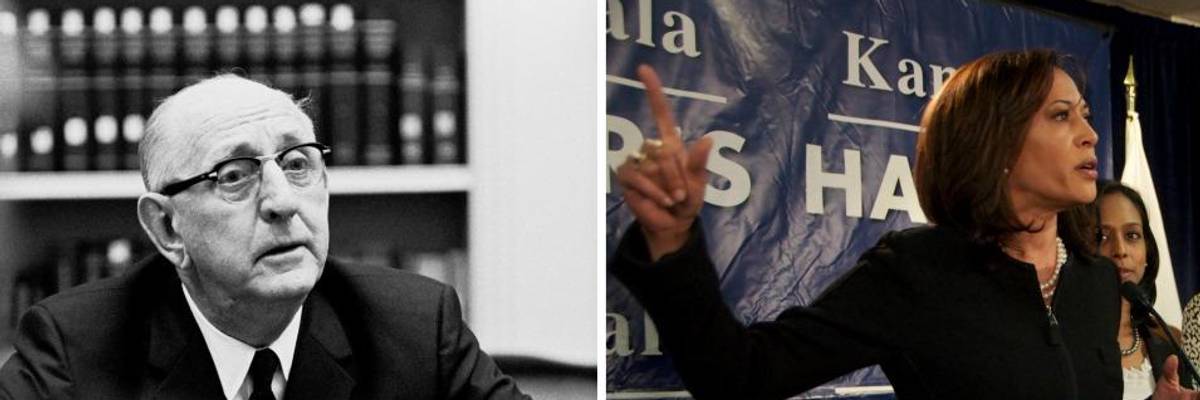
Sen. Richard B. Russell (D-Ga.) filibustered anti-lynching bills in the 1960s. On Wednesday, Sen. Kamala Harris (D-Calif.) led the charge to finally pass legislation making lynching a federal crime. (Photo: LBJ Library/Steve Rhodes/Flickr/cc)
More than a century after legislation to recognize lynching as a crime was first introduced in Congress, a bill was unanimously passed in the Senate on Wednesday making the brutal method of public execution--which was common throughout the late 19th century and persisted through the civil rights era--as a "federal civil-rights crime."
Sens. Kamala Harris (D-Calif.), Cory Booker (D-N.J.), and Tim Scott (R-S.C.) introduced the latest bill to make lynching punishable as a hate crime. The legislation passed unanimously.
"This is an historic piece of legislation that would criminalize lynching, attempts to lynch, and conspiracy to lynch for the first time in American history," said Harris on the Senate floor ahead of the vote. "Lynching is part of the dark and despicable aspect of our country's history that followed slavery and many other outrages in our country...They were needless and horrendous acts of violence and they were motivated by racism. And we must acknowledge that fact lest we repeat it."
Sen. Cindy Hyde-Smith (R-Miss.), who came under fire last month when she joked about attending a "public hanging" while facing black Democratic candidate Mike Espy in a run-off election--in the state with the most recorded lynchings in U.S. history--was presiding over the Senate during the debate.
According to the NAACP, 4,743 people were lynched between 1882 and 1968, and nearly three-quarters of the victims were black. White victims were generally targeted for their anti-racist and anti-lynching beliefs.
Over the past two decades, two murders of black men by white supremacists--those of James Byrd and Brandon McClelland--were classified as lynchings by some.
Despite the persistence of these public extrajudicial killings, lawmakers failed to pass legislation codifying the practice as a crime--although proposals were brought up in Congress about 200 times since the first attempt at the turn of the 20th century, according to Harris.
As Waleed Shahid of Justice Democrats wrote on Twitter, refusal to stand firmly against lynching by the Democratic Party for several decades, in the interest of uniting with conservatives, was to blame for much of the inaction.
In the 1960s, Sen. Richard Russell (D-Ga.)--after whom one of the Senate office buildings on Capitol Hill is named--successfully blocked numerous pieces of legislation making lynching a crime.
"For over a century members of Congress have attempted to pass some version of a bill that would recognize lynching for what it is, a bias, motivated act of terror. ... We do know the passage of this bill, even though it cannot reverse irrevocable harm that lynching was used as a terror of suppression, the passage of this bill is a recognition of that dark past," Booker said.
Rep.-elect Ilhan Omar (D-Minn.) was among the progressive lawmakers who applauded the vote--and expressed dismay that the subject of lynching's illegality still needed to be brought up in the Senate in 2018.
"Making lynching a hate crime should be an obvious choice," she wrote. "There is no more clear symbol of the terror of racism and hate."
Dear Common Dreams reader, It’s been nearly 30 years since I co-founded Common Dreams with my late wife, Lina Newhouser. We had the radical notion that journalism should serve the public good, not corporate profits. It was clear to us from the outset what it would take to build such a project. No paid advertisements. No corporate sponsors. No millionaire publisher telling us what to think or do. Many people said we wouldn't last a year, but we proved those doubters wrong. Together with a tremendous team of journalists and dedicated staff, we built an independent media outlet free from the constraints of profits and corporate control. Our mission has always been simple: To inform. To inspire. To ignite change for the common good. Building Common Dreams was not easy. Our survival was never guaranteed. When you take on the most powerful forces—Wall Street greed, fossil fuel industry destruction, Big Tech lobbyists, and uber-rich oligarchs who have spent billions upon billions rigging the economy and democracy in their favor—the only bulwark you have is supporters who believe in your work. But here’s the urgent message from me today. It's never been this bad out there. And it's never been this hard to keep us going. At the very moment Common Dreams is most needed, the threats we face are intensifying. We need your support now more than ever. We don't accept corporate advertising and never will. We don't have a paywall because we don't think people should be blocked from critical news based on their ability to pay. Everything we do is funded by the donations of readers like you. When everyone does the little they can afford, we are strong. But if that support retreats or dries up, so do we. Will you donate now to make sure Common Dreams not only survives but thrives? —Craig Brown, Co-founder |
More than a century after legislation to recognize lynching as a crime was first introduced in Congress, a bill was unanimously passed in the Senate on Wednesday making the brutal method of public execution--which was common throughout the late 19th century and persisted through the civil rights era--as a "federal civil-rights crime."
Sens. Kamala Harris (D-Calif.), Cory Booker (D-N.J.), and Tim Scott (R-S.C.) introduced the latest bill to make lynching punishable as a hate crime. The legislation passed unanimously.
"This is an historic piece of legislation that would criminalize lynching, attempts to lynch, and conspiracy to lynch for the first time in American history," said Harris on the Senate floor ahead of the vote. "Lynching is part of the dark and despicable aspect of our country's history that followed slavery and many other outrages in our country...They were needless and horrendous acts of violence and they were motivated by racism. And we must acknowledge that fact lest we repeat it."
Sen. Cindy Hyde-Smith (R-Miss.), who came under fire last month when she joked about attending a "public hanging" while facing black Democratic candidate Mike Espy in a run-off election--in the state with the most recorded lynchings in U.S. history--was presiding over the Senate during the debate.
According to the NAACP, 4,743 people were lynched between 1882 and 1968, and nearly three-quarters of the victims were black. White victims were generally targeted for their anti-racist and anti-lynching beliefs.
Over the past two decades, two murders of black men by white supremacists--those of James Byrd and Brandon McClelland--were classified as lynchings by some.
Despite the persistence of these public extrajudicial killings, lawmakers failed to pass legislation codifying the practice as a crime--although proposals were brought up in Congress about 200 times since the first attempt at the turn of the 20th century, according to Harris.
As Waleed Shahid of Justice Democrats wrote on Twitter, refusal to stand firmly against lynching by the Democratic Party for several decades, in the interest of uniting with conservatives, was to blame for much of the inaction.
In the 1960s, Sen. Richard Russell (D-Ga.)--after whom one of the Senate office buildings on Capitol Hill is named--successfully blocked numerous pieces of legislation making lynching a crime.
"For over a century members of Congress have attempted to pass some version of a bill that would recognize lynching for what it is, a bias, motivated act of terror. ... We do know the passage of this bill, even though it cannot reverse irrevocable harm that lynching was used as a terror of suppression, the passage of this bill is a recognition of that dark past," Booker said.
Rep.-elect Ilhan Omar (D-Minn.) was among the progressive lawmakers who applauded the vote--and expressed dismay that the subject of lynching's illegality still needed to be brought up in the Senate in 2018.
"Making lynching a hate crime should be an obvious choice," she wrote. "There is no more clear symbol of the terror of racism and hate."
More than a century after legislation to recognize lynching as a crime was first introduced in Congress, a bill was unanimously passed in the Senate on Wednesday making the brutal method of public execution--which was common throughout the late 19th century and persisted through the civil rights era--as a "federal civil-rights crime."
Sens. Kamala Harris (D-Calif.), Cory Booker (D-N.J.), and Tim Scott (R-S.C.) introduced the latest bill to make lynching punishable as a hate crime. The legislation passed unanimously.
"This is an historic piece of legislation that would criminalize lynching, attempts to lynch, and conspiracy to lynch for the first time in American history," said Harris on the Senate floor ahead of the vote. "Lynching is part of the dark and despicable aspect of our country's history that followed slavery and many other outrages in our country...They were needless and horrendous acts of violence and they were motivated by racism. And we must acknowledge that fact lest we repeat it."
Sen. Cindy Hyde-Smith (R-Miss.), who came under fire last month when she joked about attending a "public hanging" while facing black Democratic candidate Mike Espy in a run-off election--in the state with the most recorded lynchings in U.S. history--was presiding over the Senate during the debate.
According to the NAACP, 4,743 people were lynched between 1882 and 1968, and nearly three-quarters of the victims were black. White victims were generally targeted for their anti-racist and anti-lynching beliefs.
Over the past two decades, two murders of black men by white supremacists--those of James Byrd and Brandon McClelland--were classified as lynchings by some.
Despite the persistence of these public extrajudicial killings, lawmakers failed to pass legislation codifying the practice as a crime--although proposals were brought up in Congress about 200 times since the first attempt at the turn of the 20th century, according to Harris.
As Waleed Shahid of Justice Democrats wrote on Twitter, refusal to stand firmly against lynching by the Democratic Party for several decades, in the interest of uniting with conservatives, was to blame for much of the inaction.
In the 1960s, Sen. Richard Russell (D-Ga.)--after whom one of the Senate office buildings on Capitol Hill is named--successfully blocked numerous pieces of legislation making lynching a crime.
"For over a century members of Congress have attempted to pass some version of a bill that would recognize lynching for what it is, a bias, motivated act of terror. ... We do know the passage of this bill, even though it cannot reverse irrevocable harm that lynching was used as a terror of suppression, the passage of this bill is a recognition of that dark past," Booker said.
Rep.-elect Ilhan Omar (D-Minn.) was among the progressive lawmakers who applauded the vote--and expressed dismay that the subject of lynching's illegality still needed to be brought up in the Senate in 2018.
"Making lynching a hate crime should be an obvious choice," she wrote. "There is no more clear symbol of the terror of racism and hate."