SUBSCRIBE TO OUR FREE NEWSLETTER
Daily news & progressive opinion—funded by the people, not the corporations—delivered straight to your inbox.
5
#000000
#FFFFFF
To donate by check, phone, or other method, see our More Ways to Give page.
Daily news & progressive opinion—funded by the people, not the corporations—delivered straight to your inbox.
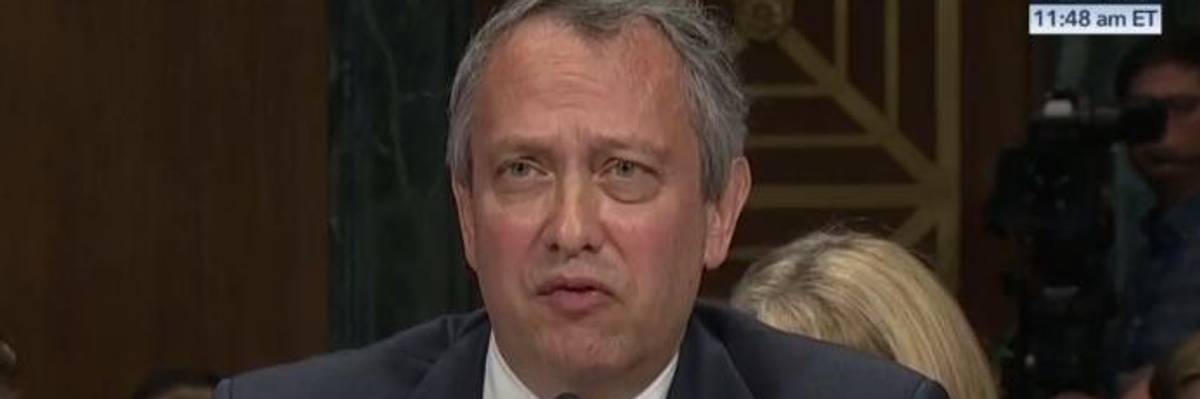
Republican attorney Thomas Farr speaking on Sept. 20,2017 before the Senate Judiciary Committee. (Screengrab: C-Span)
Civil rights advocates on Wednesday are urging constituents to tell their senators to oppose the nomination of Thomas Farr, President Donald Trump's pick for a federal judgeship in North Carolina.
If confirmed, Farr would fill a more than decade-long vacancy at the U.S. District Court of the Eastern District of North Carolina--a lifetime position that rights groups and Democratic lawmakers say would allow him to further a campaign of suppressing the votes of communities of color and attacking worker rights.
As McClatchy reported last week:
Farr, who was first nominated by Trump in 2017 and again in 2018, passed out of the Republican-led judiciary committee on a party-line in January. But [Senate majority Leader Mitch] McConnell did not schedule a full vote until this week--with precious few legislative days remaining in the calendar. If he is not confirmed before the end of the year, Trump would have to renominate him to a new Senate. [...]
The Eastern District of North Carolina includes 44 counties that stretch from Raleigh to the coast. Blacks make up more than 25 percent of the district, but no black judge has served on the court. President Obama nominated two black women to serve on the court, but neither got a vote in committee.
McConnell's advancement of the nomination drew outrage from a number of advocacy groups including The Leadership Conference on Civil and Human Rights. Vanita Gupta, president and CEO of the organization, denounced "Farr's unrelenting pursuit of restricting voting rights and defending employment discrimination." She added, "At a moment when our courts are under attack, it is more important than ever that those who serve on the bench are fair and independent."
Rev. William Barber wrote last year that "African-Americans seeking to have their rights protected under federal law have much to fear if Farr takes the bench," while legal expert Andrew Cohen previously expressed concern over his background, writing that Farr "has yet to fully answer for a professional career rooted in white supremacy and voter suppression."
The NAACP Legal Defense and Educational Fund highlighted that career in a Twitter thread Tuesday:
The NAACP, meanwhile, is pointing people towards a petition aimed at senators to urge their opposition to the nomination. It states, in part: "Farr has also demonstrated an opposition to workers' rights. He has championed weakening or eliminating legal protections for employment discrimination; he repeatedly defended companies that discriminated against employees and customers. He has also fought vigorously against workers' efforts to freely unionize, having defended companies trying to deny recognition of unions and committing unfair labor practices."
Declaring his nomination "a threat to our democracy," Hilary Shelton, director of the NAACP's Washington bureau, said on a press call Thursday: "Our nation just held critical mid-term elections in which we saw record participation by African Americans but also witnessed rampant voter suppression. For the Senate to first bring up the judicial nominee known as the 'vote-suppressor-in-chief' adds insult to injury."
"It makes crystal clear who stands for voting rights and who stands for voting wrongs," she continued. "The courts are supposed to be where we can find and seek justice. But Farr's lifetime crusade is to disenfranchise African Americans and deprive them of their rights. He belongs nowhere near a bench of justice."
The Hill reported this week that moving judicial nominations is one of McConnell's key priorities, though that effort could be thwarted by a member of his own party--outgoing Sen. Jeff Flake (Ariz.), who said last week he would not vote to confirm Trump's judicial nominees until the Senate votes on legislation to protect Special Counsel Robert Mueller's probe.
"And in a Senate where Republicans hold just a two-vote margin over Democrats," NPR noted, "if Flake can persuade just one other GOP senator to join him, he could halt the confirmation of 32 judicial nominees now awaiting a vote on the floor."
This country and this world are at a monumental crossroads. US voters have an opportunity to beat back the forces of fascism and confront the billionaires who are rigging the economy, our media system, and our democracy, making it increasingly impossible for ordinary people to get by. We’re not just talking about the election. We’re talking about what must be done once these fascist elements are vanquished from power. We need a bolder set of solutions than what either major party has so far been willing to offer and a working-class movement ready to fight like hell for it. Trump didn't emerge from nowhere. The conditions that fueled MAGA authoritarianism were created by decades of radical neoliberal economic policies and a corrupt political system dominated by corporate interests. They slashed taxes on the super-rich, promising that the benefits would trickle down. They said giveaways to the corporate titans would make life more affordable for the rest of us. It was all bullshit. And when a bitter, betrayed populace searches for someone to blame, right-wing demagogues have little trouble finding scapegoats. People know when they're being lied to, but you won't hear any of this from the corporate media. Only independent journalism—powered and funded by people who believe in building a better world—can deliver truly trustworthy daily news. If you share our vision, please contribute whatever you can to sustain our work. |
Civil rights advocates on Wednesday are urging constituents to tell their senators to oppose the nomination of Thomas Farr, President Donald Trump's pick for a federal judgeship in North Carolina.
If confirmed, Farr would fill a more than decade-long vacancy at the U.S. District Court of the Eastern District of North Carolina--a lifetime position that rights groups and Democratic lawmakers say would allow him to further a campaign of suppressing the votes of communities of color and attacking worker rights.
As McClatchy reported last week:
Farr, who was first nominated by Trump in 2017 and again in 2018, passed out of the Republican-led judiciary committee on a party-line in January. But [Senate majority Leader Mitch] McConnell did not schedule a full vote until this week--with precious few legislative days remaining in the calendar. If he is not confirmed before the end of the year, Trump would have to renominate him to a new Senate. [...]
The Eastern District of North Carolina includes 44 counties that stretch from Raleigh to the coast. Blacks make up more than 25 percent of the district, but no black judge has served on the court. President Obama nominated two black women to serve on the court, but neither got a vote in committee.
McConnell's advancement of the nomination drew outrage from a number of advocacy groups including The Leadership Conference on Civil and Human Rights. Vanita Gupta, president and CEO of the organization, denounced "Farr's unrelenting pursuit of restricting voting rights and defending employment discrimination." She added, "At a moment when our courts are under attack, it is more important than ever that those who serve on the bench are fair and independent."
Rev. William Barber wrote last year that "African-Americans seeking to have their rights protected under federal law have much to fear if Farr takes the bench," while legal expert Andrew Cohen previously expressed concern over his background, writing that Farr "has yet to fully answer for a professional career rooted in white supremacy and voter suppression."
The NAACP Legal Defense and Educational Fund highlighted that career in a Twitter thread Tuesday:
The NAACP, meanwhile, is pointing people towards a petition aimed at senators to urge their opposition to the nomination. It states, in part: "Farr has also demonstrated an opposition to workers' rights. He has championed weakening or eliminating legal protections for employment discrimination; he repeatedly defended companies that discriminated against employees and customers. He has also fought vigorously against workers' efforts to freely unionize, having defended companies trying to deny recognition of unions and committing unfair labor practices."
Declaring his nomination "a threat to our democracy," Hilary Shelton, director of the NAACP's Washington bureau, said on a press call Thursday: "Our nation just held critical mid-term elections in which we saw record participation by African Americans but also witnessed rampant voter suppression. For the Senate to first bring up the judicial nominee known as the 'vote-suppressor-in-chief' adds insult to injury."
"It makes crystal clear who stands for voting rights and who stands for voting wrongs," she continued. "The courts are supposed to be where we can find and seek justice. But Farr's lifetime crusade is to disenfranchise African Americans and deprive them of their rights. He belongs nowhere near a bench of justice."
The Hill reported this week that moving judicial nominations is one of McConnell's key priorities, though that effort could be thwarted by a member of his own party--outgoing Sen. Jeff Flake (Ariz.), who said last week he would not vote to confirm Trump's judicial nominees until the Senate votes on legislation to protect Special Counsel Robert Mueller's probe.
"And in a Senate where Republicans hold just a two-vote margin over Democrats," NPR noted, "if Flake can persuade just one other GOP senator to join him, he could halt the confirmation of 32 judicial nominees now awaiting a vote on the floor."