SUBSCRIBE TO OUR FREE NEWSLETTER
Daily news & progressive opinion—funded by the people, not the corporations—delivered straight to your inbox.
5
#000000
#FFFFFF
To donate by check, phone, or other method, see our More Ways to Give page.
Daily news & progressive opinion—funded by the people, not the corporations—delivered straight to your inbox.
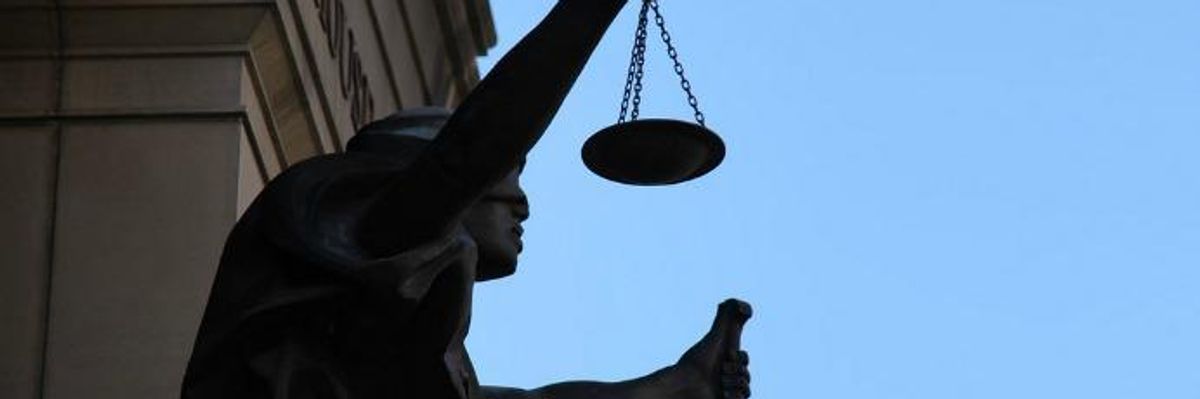
A statue of Blind Justice on front of the Albert V. Bryan United States Courthouse in Alexandria, Virginia. (Photo: Tim Evanson/flickr/cc)
In its first year in power the Trump administration has done to the federal judiciary what it has done more broadly to American political discourse. It has moved the courts far to the right, beyond prior boundaries, by relentlessly nominating conservative ideologues, with and without appropriate experience, to life-tenured jobs on the bench. Thanks to the Republican-controlled Senate, which has rushed to confirm most of these picks, we now have a growing cadre of Federalist Society-infused jurists who will be meting out their particular brand of injustice for generations to come.
Justice Neil Gorsuch, now ensconced on the Supreme Court, is the most notable example of the political theory known as the "Overton Window." It posits that there is a relatively narrow range of ideas politicians can consider and still win re-election. However window can be moved right or left by the persistent introduction and discussion of once-unthinkable ideas. President Trump has moved the window with his racist, ignorant, nativistic, and misogynistic rhetoric. His administration has moved the window with prejudiced, self-defeating, delusional policies. And the White House's judicial picks have changed the nature of our conversation about what it means to be an Article III judge.
Gorsuch, who on some issues makes the late Antonin Scalia seem like William Brennan, seems reasonable and mainstream only in contrast to fellow Trump nominees such as Don Willett, confirmed last month to the 5th U.S. Circuit Court of Appeals, John K. Bush, confirmed in July to the 6th U.S. Circuit Court of Appeals, and Thomas Farr, a nominee to the federal trial bench in North Carolina. Willett, beloved by journalists for his Twitter wit, during his tenure on the Texas Supreme Court little more than a mouthpiece for his political benefactors, conservative megadonor Foster Freiss (who is contemplating a 2018 U.S. Senate run from Wyoming), and evangelist James Dobson, founder of Focus on the Family. He campaigned for the state bench, and then for re-election, as a conservative jurist who would champion pro-life, gun-rights, homeschooling causes.
There were, given Willett's long public record of partisan jurisprudence, plenty of legitimate questions he could have been asked when he appeared before the Senate Judiciary Committee in November. But the panel seemed sufficiently relieved to see that Willett wasn't foaming at the mouth that they never even asked him about his obvious conflicts of interest (or anything else of substance). Would he recuse himself from cases in which Dobson or Freiss had an interest? Did his jurisprudence leave room for atheists and others who do not share his religious views? Now we will get answers to those questions only when actual controversies erupt; last month, Willett was confirmed to the bench on a party-line vote.
Bush, for his part, was confirmed easily despite a consistent record of anti-gay bias. When asked during his nomination process about some of his other views, like his comparison of slavery to abortion or his refusal to acknowledge the effect of global warming, Bush refused to answer candidly, saying only that his personal views were irrelevant to the job for which he was being considered. No matter, he won unanimous support from Senate Republicans, and he was confirmed 51-47.
Thomas Farr, meanwhile, not yet confirmed, has yet to fully answer for a professional career rooted in white supremacy and voter suppression. Twice, in 2006 and 2007, during the second Bush administration, Farr was nominated to the federal bench. Twice he failed to have his nomination even voted upon by the Senate Judiciary Committee. Now Farr, who once was counsel to the arch-conservative Sen. Jesse Helms,once again is up for a seat in a district that has been vacant for 11 years. But the same baggage that hobbled Farr a decade ago hobbles him today. In 1990 he was counsel to Helms when the North Carolina senator faced a tough re-election fight against a black Democratic nominee. Accounts vary, but there's no doubt Farr was present at a meeting at which the campaign discussed its notorious "ballot security program" which resulted in 100,000 postcards being mailed to black voters erroneously warning they could face jail time if they provided incorrect information at the polls. Senate Republicans tried to rush Farr's confirmation ,but Senate Democrats, so far anyway, have succeeded in blocking the move.
Yet, Willett, Bush, and Farr, seem like paragons of high jurisprudence in contrast to Trump nominees Brett Talley, Jeff Mateer, and Matthew Peterson, three hapless, failed candidates who had no business even being considered for the federal bench. Peterson, famously, was unable to answer even basic legal questions during his confirmation hearing from Sen. John Kennedy, a freshman Republican from Louisiana, who in has sometimes undermined the administration's nomination strategy. Mateer was nominated even after he called same-sex marriage "debauchery" and transgender children part of "Satan's plan." Talley was patently unqualified even before it was learned he had failed to disclose that his wife just happens to be chief of staff to White House Counsel Donald McGahn. Moreover Peterson's spouse is also a witness in Robert Mueller's obstruction of justice investigation.
But we shouldn't focus on the nominations that have been stymied. They only tell the smaller part of the story of the administration's judicial picks one year into its rule. They represent only sporadic victories in a broad war that is being fought and won weekly by Senate Republicans, the White House, and conservative groups. They highlight only the worst excesses of Trump's judgment. The bigger story is the far larger number of men (and they have almost always been white men) whose nominations have been endorsed by the Senate and who now are sitting in robes exercising life and death power over the rest of us.
As a whole, Willett, Bush, and Farr moved the Overton window to the right to make Gorsuch seem like a moderate on the Supreme Court. Talley, Mateer, and Peterson moved the Overton window even further to the right to make Willett, Bush, and Farr seem like mainstream judicial nominees. They aren't. These men, and the many more inapt Trump nominees to come this year, constitute a clear and present danger to American law. They already have changed our perceptions of what constitutes an acceptable judicial nominee. And it's unclear whether those perceptions will ever go back to the way they were.
Dear Common Dreams reader, It’s been nearly 30 years since I co-founded Common Dreams with my late wife, Lina Newhouser. We had the radical notion that journalism should serve the public good, not corporate profits. It was clear to us from the outset what it would take to build such a project. No paid advertisements. No corporate sponsors. No millionaire publisher telling us what to think or do. Many people said we wouldn't last a year, but we proved those doubters wrong. Together with a tremendous team of journalists and dedicated staff, we built an independent media outlet free from the constraints of profits and corporate control. Our mission has always been simple: To inform. To inspire. To ignite change for the common good. Building Common Dreams was not easy. Our survival was never guaranteed. When you take on the most powerful forces—Wall Street greed, fossil fuel industry destruction, Big Tech lobbyists, and uber-rich oligarchs who have spent billions upon billions rigging the economy and democracy in their favor—the only bulwark you have is supporters who believe in your work. But here’s the urgent message from me today. It's never been this bad out there. And it's never been this hard to keep us going. At the very moment Common Dreams is most needed, the threats we face are intensifying. We need your support now more than ever. We don't accept corporate advertising and never will. We don't have a paywall because we don't think people should be blocked from critical news based on their ability to pay. Everything we do is funded by the donations of readers like you. When everyone does the little they can afford, we are strong. But if that support retreats or dries up, so do we. Will you donate now to make sure Common Dreams not only survives but thrives? —Craig Brown, Co-founder |
In its first year in power the Trump administration has done to the federal judiciary what it has done more broadly to American political discourse. It has moved the courts far to the right, beyond prior boundaries, by relentlessly nominating conservative ideologues, with and without appropriate experience, to life-tenured jobs on the bench. Thanks to the Republican-controlled Senate, which has rushed to confirm most of these picks, we now have a growing cadre of Federalist Society-infused jurists who will be meting out their particular brand of injustice for generations to come.
Justice Neil Gorsuch, now ensconced on the Supreme Court, is the most notable example of the political theory known as the "Overton Window." It posits that there is a relatively narrow range of ideas politicians can consider and still win re-election. However window can be moved right or left by the persistent introduction and discussion of once-unthinkable ideas. President Trump has moved the window with his racist, ignorant, nativistic, and misogynistic rhetoric. His administration has moved the window with prejudiced, self-defeating, delusional policies. And the White House's judicial picks have changed the nature of our conversation about what it means to be an Article III judge.
Gorsuch, who on some issues makes the late Antonin Scalia seem like William Brennan, seems reasonable and mainstream only in contrast to fellow Trump nominees such as Don Willett, confirmed last month to the 5th U.S. Circuit Court of Appeals, John K. Bush, confirmed in July to the 6th U.S. Circuit Court of Appeals, and Thomas Farr, a nominee to the federal trial bench in North Carolina. Willett, beloved by journalists for his Twitter wit, during his tenure on the Texas Supreme Court little more than a mouthpiece for his political benefactors, conservative megadonor Foster Freiss (who is contemplating a 2018 U.S. Senate run from Wyoming), and evangelist James Dobson, founder of Focus on the Family. He campaigned for the state bench, and then for re-election, as a conservative jurist who would champion pro-life, gun-rights, homeschooling causes.
There were, given Willett's long public record of partisan jurisprudence, plenty of legitimate questions he could have been asked when he appeared before the Senate Judiciary Committee in November. But the panel seemed sufficiently relieved to see that Willett wasn't foaming at the mouth that they never even asked him about his obvious conflicts of interest (or anything else of substance). Would he recuse himself from cases in which Dobson or Freiss had an interest? Did his jurisprudence leave room for atheists and others who do not share his religious views? Now we will get answers to those questions only when actual controversies erupt; last month, Willett was confirmed to the bench on a party-line vote.
Bush, for his part, was confirmed easily despite a consistent record of anti-gay bias. When asked during his nomination process about some of his other views, like his comparison of slavery to abortion or his refusal to acknowledge the effect of global warming, Bush refused to answer candidly, saying only that his personal views were irrelevant to the job for which he was being considered. No matter, he won unanimous support from Senate Republicans, and he was confirmed 51-47.
Thomas Farr, meanwhile, not yet confirmed, has yet to fully answer for a professional career rooted in white supremacy and voter suppression. Twice, in 2006 and 2007, during the second Bush administration, Farr was nominated to the federal bench. Twice he failed to have his nomination even voted upon by the Senate Judiciary Committee. Now Farr, who once was counsel to the arch-conservative Sen. Jesse Helms,once again is up for a seat in a district that has been vacant for 11 years. But the same baggage that hobbled Farr a decade ago hobbles him today. In 1990 he was counsel to Helms when the North Carolina senator faced a tough re-election fight against a black Democratic nominee. Accounts vary, but there's no doubt Farr was present at a meeting at which the campaign discussed its notorious "ballot security program" which resulted in 100,000 postcards being mailed to black voters erroneously warning they could face jail time if they provided incorrect information at the polls. Senate Republicans tried to rush Farr's confirmation ,but Senate Democrats, so far anyway, have succeeded in blocking the move.
Yet, Willett, Bush, and Farr, seem like paragons of high jurisprudence in contrast to Trump nominees Brett Talley, Jeff Mateer, and Matthew Peterson, three hapless, failed candidates who had no business even being considered for the federal bench. Peterson, famously, was unable to answer even basic legal questions during his confirmation hearing from Sen. John Kennedy, a freshman Republican from Louisiana, who in has sometimes undermined the administration's nomination strategy. Mateer was nominated even after he called same-sex marriage "debauchery" and transgender children part of "Satan's plan." Talley was patently unqualified even before it was learned he had failed to disclose that his wife just happens to be chief of staff to White House Counsel Donald McGahn. Moreover Peterson's spouse is also a witness in Robert Mueller's obstruction of justice investigation.
But we shouldn't focus on the nominations that have been stymied. They only tell the smaller part of the story of the administration's judicial picks one year into its rule. They represent only sporadic victories in a broad war that is being fought and won weekly by Senate Republicans, the White House, and conservative groups. They highlight only the worst excesses of Trump's judgment. The bigger story is the far larger number of men (and they have almost always been white men) whose nominations have been endorsed by the Senate and who now are sitting in robes exercising life and death power over the rest of us.
As a whole, Willett, Bush, and Farr moved the Overton window to the right to make Gorsuch seem like a moderate on the Supreme Court. Talley, Mateer, and Peterson moved the Overton window even further to the right to make Willett, Bush, and Farr seem like mainstream judicial nominees. They aren't. These men, and the many more inapt Trump nominees to come this year, constitute a clear and present danger to American law. They already have changed our perceptions of what constitutes an acceptable judicial nominee. And it's unclear whether those perceptions will ever go back to the way they were.
In its first year in power the Trump administration has done to the federal judiciary what it has done more broadly to American political discourse. It has moved the courts far to the right, beyond prior boundaries, by relentlessly nominating conservative ideologues, with and without appropriate experience, to life-tenured jobs on the bench. Thanks to the Republican-controlled Senate, which has rushed to confirm most of these picks, we now have a growing cadre of Federalist Society-infused jurists who will be meting out their particular brand of injustice for generations to come.
Justice Neil Gorsuch, now ensconced on the Supreme Court, is the most notable example of the political theory known as the "Overton Window." It posits that there is a relatively narrow range of ideas politicians can consider and still win re-election. However window can be moved right or left by the persistent introduction and discussion of once-unthinkable ideas. President Trump has moved the window with his racist, ignorant, nativistic, and misogynistic rhetoric. His administration has moved the window with prejudiced, self-defeating, delusional policies. And the White House's judicial picks have changed the nature of our conversation about what it means to be an Article III judge.
Gorsuch, who on some issues makes the late Antonin Scalia seem like William Brennan, seems reasonable and mainstream only in contrast to fellow Trump nominees such as Don Willett, confirmed last month to the 5th U.S. Circuit Court of Appeals, John K. Bush, confirmed in July to the 6th U.S. Circuit Court of Appeals, and Thomas Farr, a nominee to the federal trial bench in North Carolina. Willett, beloved by journalists for his Twitter wit, during his tenure on the Texas Supreme Court little more than a mouthpiece for his political benefactors, conservative megadonor Foster Freiss (who is contemplating a 2018 U.S. Senate run from Wyoming), and evangelist James Dobson, founder of Focus on the Family. He campaigned for the state bench, and then for re-election, as a conservative jurist who would champion pro-life, gun-rights, homeschooling causes.
There were, given Willett's long public record of partisan jurisprudence, plenty of legitimate questions he could have been asked when he appeared before the Senate Judiciary Committee in November. But the panel seemed sufficiently relieved to see that Willett wasn't foaming at the mouth that they never even asked him about his obvious conflicts of interest (or anything else of substance). Would he recuse himself from cases in which Dobson or Freiss had an interest? Did his jurisprudence leave room for atheists and others who do not share his religious views? Now we will get answers to those questions only when actual controversies erupt; last month, Willett was confirmed to the bench on a party-line vote.
Bush, for his part, was confirmed easily despite a consistent record of anti-gay bias. When asked during his nomination process about some of his other views, like his comparison of slavery to abortion or his refusal to acknowledge the effect of global warming, Bush refused to answer candidly, saying only that his personal views were irrelevant to the job for which he was being considered. No matter, he won unanimous support from Senate Republicans, and he was confirmed 51-47.
Thomas Farr, meanwhile, not yet confirmed, has yet to fully answer for a professional career rooted in white supremacy and voter suppression. Twice, in 2006 and 2007, during the second Bush administration, Farr was nominated to the federal bench. Twice he failed to have his nomination even voted upon by the Senate Judiciary Committee. Now Farr, who once was counsel to the arch-conservative Sen. Jesse Helms,once again is up for a seat in a district that has been vacant for 11 years. But the same baggage that hobbled Farr a decade ago hobbles him today. In 1990 he was counsel to Helms when the North Carolina senator faced a tough re-election fight against a black Democratic nominee. Accounts vary, but there's no doubt Farr was present at a meeting at which the campaign discussed its notorious "ballot security program" which resulted in 100,000 postcards being mailed to black voters erroneously warning they could face jail time if they provided incorrect information at the polls. Senate Republicans tried to rush Farr's confirmation ,but Senate Democrats, so far anyway, have succeeded in blocking the move.
Yet, Willett, Bush, and Farr, seem like paragons of high jurisprudence in contrast to Trump nominees Brett Talley, Jeff Mateer, and Matthew Peterson, three hapless, failed candidates who had no business even being considered for the federal bench. Peterson, famously, was unable to answer even basic legal questions during his confirmation hearing from Sen. John Kennedy, a freshman Republican from Louisiana, who in has sometimes undermined the administration's nomination strategy. Mateer was nominated even after he called same-sex marriage "debauchery" and transgender children part of "Satan's plan." Talley was patently unqualified even before it was learned he had failed to disclose that his wife just happens to be chief of staff to White House Counsel Donald McGahn. Moreover Peterson's spouse is also a witness in Robert Mueller's obstruction of justice investigation.
But we shouldn't focus on the nominations that have been stymied. They only tell the smaller part of the story of the administration's judicial picks one year into its rule. They represent only sporadic victories in a broad war that is being fought and won weekly by Senate Republicans, the White House, and conservative groups. They highlight only the worst excesses of Trump's judgment. The bigger story is the far larger number of men (and they have almost always been white men) whose nominations have been endorsed by the Senate and who now are sitting in robes exercising life and death power over the rest of us.
As a whole, Willett, Bush, and Farr moved the Overton window to the right to make Gorsuch seem like a moderate on the Supreme Court. Talley, Mateer, and Peterson moved the Overton window even further to the right to make Willett, Bush, and Farr seem like mainstream judicial nominees. They aren't. These men, and the many more inapt Trump nominees to come this year, constitute a clear and present danger to American law. They already have changed our perceptions of what constitutes an acceptable judicial nominee. And it's unclear whether those perceptions will ever go back to the way they were.