SUBSCRIBE TO OUR FREE NEWSLETTER
Daily news & progressive opinion—funded by the people, not the corporations—delivered straight to your inbox.
5
#000000
#FFFFFF
To donate by check, phone, or other method, see our More Ways to Give page.
A new analysis of G20 countries found that despite warnings from international scientists of a looming climate catastrophe absent dramatic action within the next decade or so, governments in most of world's top economies are providing sizeable subsidies to the fossil fuel industry while planet-warming emissions continue to rise.
"There is a huge fight by the fossil fuel industry against cheap renewable. The old economy is well organized and they have put huge lobbying pressure on governments to spend tax money to subsidize the old world."
--Jan Burck, report co-author
Released Wednesday, just ahead of the G20 Summit in Argentina and COP24 in Poland, Climate Transparency's Brown to Green Report 2018 (pdf) concludes that among these countries, "more ambitious climate action is needed to keepglobal warming well below 2degC and to pursue efforts to limit the increase to 1.5degC" above pre-industrial levels within this century, the main goals of the Paris climate accord.
While the report points to some positive developments since the international community came together for the Paris agreement in 2015--with the thought that a "solutions-oriented approach" will motivate the adoption of more planet-friendly practices--it also features some alarming takeaways.
Simply put, as co-author Jan Burck told the Guardian, "The G20 is not moving fast enough." In part, that is because "there is a huge fight by the fossil fuel industry against cheap renewables," he explained. "The old economy is well organized and they have put huge lobbying pressure on governments to spend tax money to subsidize the old world."
Such lobbying efforts have paid off. Across the G20, from 2007 to 2016, subsidies for coal, oil, and gas rose from $75 billion to $147 billion--which, as the report notes, "only includes tax exemptions and budgetary support towards production and consumption of fossil fuels, and does not consider other types of subsidies, such as state-owned enterprise investments and public financing."
As fossil fuel subsidies have increased in these nations, so have greenhouse gas emissions. According to the report, "In 15 of the G20 countries, energy-related CO2 emissions increases again in 2017, and 82 percent of the G20 energy supply is still from fossil fuels."
The actions of the G20 have a global impact, particularly when it comes to the climate crisis. Excluding emissions from forestry, these nations account for 79 percent of the world's greenhouse gas emissions, and about 81 percent of energy-related emissions. Based on G20 countries' nationally determined contributions (NDCs), current emissions levels and climate action plans have the world on track to increase the global temperature by about 3.2degC, higher than the upper limit of the Paris goals.
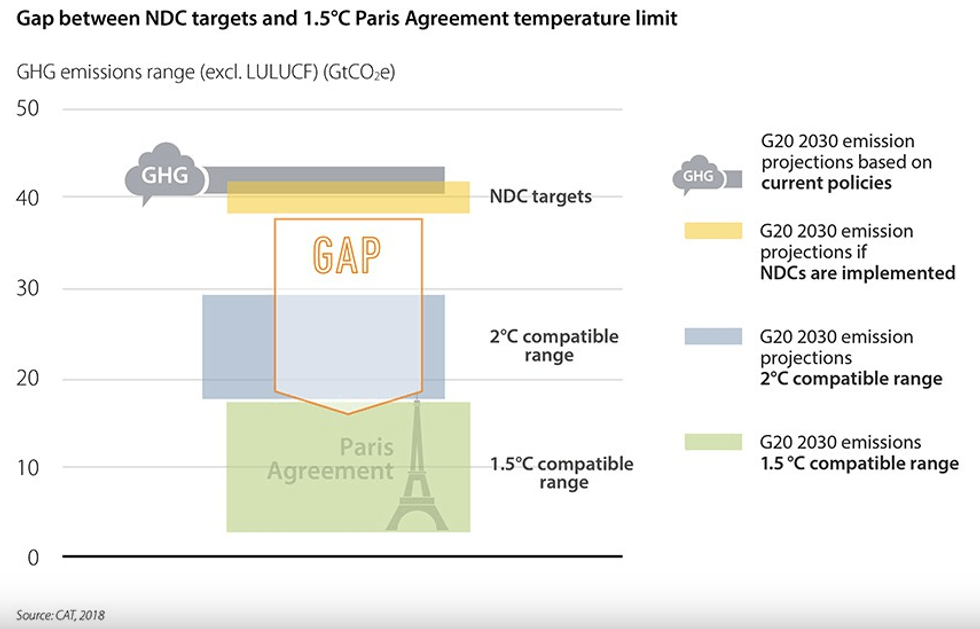
Acknowledging the latest findings from the U.N.'s Intergovernmental Panel on Climate Change (IPCC) that even "the difference in impacts between warming of 1.5degC and 2degC would be substantial, damaging communities, economies and ecosystems across the world," the report declares that "collectively, the G20 needs to roughly halve emissions in 2030 to meet the Paris goals, but adequate long-term strategies to do so are still lacking."
While the report warns about the inadequate NDCs among most nations examined--particularly those of Russia, Saudi Arabia, and Turkey--perhaps the least ambitious approach to climate policy is that of the Trump administration. Last year, a few months after President Donald Trump vowed to withdraw from the Paris agreement, war-torn Syria signed on to it, leaving the United States as the only nation on Earth opposed to the international accord.
In addition to the new report, Climate Transparency produced profiles for each G20 country. As the U.S. profile (pdf) notes, under the current administration, "no national plan to tackle climate change exists." Thus, citing the withdrawal from the Paris accord and the dismantling of the Obama-era Clean Power Plan as particularly egregious moves, "experts rate both its national and international climate policy performance as very low."
A new analysis of G20 countries found that despite warnings from international scientists of a looming climate catastrophe absent dramatic action within the next decade or so, governments in most of world's top economies are providing sizeable subsidies to the fossil fuel industry while planet-warming emissions continue to rise.
"There is a huge fight by the fossil fuel industry against cheap renewable. The old economy is well organized and they have put huge lobbying pressure on governments to spend tax money to subsidize the old world."
--Jan Burck, report co-author
Released Wednesday, just ahead of the G20 Summit in Argentina and COP24 in Poland, Climate Transparency's Brown to Green Report 2018 (pdf) concludes that among these countries, "more ambitious climate action is needed to keepglobal warming well below 2degC and to pursue efforts to limit the increase to 1.5degC" above pre-industrial levels within this century, the main goals of the Paris climate accord.
While the report points to some positive developments since the international community came together for the Paris agreement in 2015--with the thought that a "solutions-oriented approach" will motivate the adoption of more planet-friendly practices--it also features some alarming takeaways.
Simply put, as co-author Jan Burck told the Guardian, "The G20 is not moving fast enough." In part, that is because "there is a huge fight by the fossil fuel industry against cheap renewables," he explained. "The old economy is well organized and they have put huge lobbying pressure on governments to spend tax money to subsidize the old world."
Such lobbying efforts have paid off. Across the G20, from 2007 to 2016, subsidies for coal, oil, and gas rose from $75 billion to $147 billion--which, as the report notes, "only includes tax exemptions and budgetary support towards production and consumption of fossil fuels, and does not consider other types of subsidies, such as state-owned enterprise investments and public financing."
As fossil fuel subsidies have increased in these nations, so have greenhouse gas emissions. According to the report, "In 15 of the G20 countries, energy-related CO2 emissions increases again in 2017, and 82 percent of the G20 energy supply is still from fossil fuels."
The actions of the G20 have a global impact, particularly when it comes to the climate crisis. Excluding emissions from forestry, these nations account for 79 percent of the world's greenhouse gas emissions, and about 81 percent of energy-related emissions. Based on G20 countries' nationally determined contributions (NDCs), current emissions levels and climate action plans have the world on track to increase the global temperature by about 3.2degC, higher than the upper limit of the Paris goals.
Acknowledging the latest findings from the U.N.'s Intergovernmental Panel on Climate Change (IPCC) that even "the difference in impacts between warming of 1.5degC and 2degC would be substantial, damaging communities, economies and ecosystems across the world," the report declares that "collectively, the G20 needs to roughly halve emissions in 2030 to meet the Paris goals, but adequate long-term strategies to do so are still lacking."
While the report warns about the inadequate NDCs among most nations examined--particularly those of Russia, Saudi Arabia, and Turkey--perhaps the least ambitious approach to climate policy is that of the Trump administration. Last year, a few months after President Donald Trump vowed to withdraw from the Paris agreement, war-torn Syria signed on to it, leaving the United States as the only nation on Earth opposed to the international accord.
In addition to the new report, Climate Transparency produced profiles for each G20 country. As the U.S. profile (pdf) notes, under the current administration, "no national plan to tackle climate change exists." Thus, citing the withdrawal from the Paris accord and the dismantling of the Obama-era Clean Power Plan as particularly egregious moves, "experts rate both its national and international climate policy performance as very low."
A new analysis of G20 countries found that despite warnings from international scientists of a looming climate catastrophe absent dramatic action within the next decade or so, governments in most of world's top economies are providing sizeable subsidies to the fossil fuel industry while planet-warming emissions continue to rise.
"There is a huge fight by the fossil fuel industry against cheap renewable. The old economy is well organized and they have put huge lobbying pressure on governments to spend tax money to subsidize the old world."
--Jan Burck, report co-author
Released Wednesday, just ahead of the G20 Summit in Argentina and COP24 in Poland, Climate Transparency's Brown to Green Report 2018 (pdf) concludes that among these countries, "more ambitious climate action is needed to keepglobal warming well below 2degC and to pursue efforts to limit the increase to 1.5degC" above pre-industrial levels within this century, the main goals of the Paris climate accord.
While the report points to some positive developments since the international community came together for the Paris agreement in 2015--with the thought that a "solutions-oriented approach" will motivate the adoption of more planet-friendly practices--it also features some alarming takeaways.
Simply put, as co-author Jan Burck told the Guardian, "The G20 is not moving fast enough." In part, that is because "there is a huge fight by the fossil fuel industry against cheap renewables," he explained. "The old economy is well organized and they have put huge lobbying pressure on governments to spend tax money to subsidize the old world."
Such lobbying efforts have paid off. Across the G20, from 2007 to 2016, subsidies for coal, oil, and gas rose from $75 billion to $147 billion--which, as the report notes, "only includes tax exemptions and budgetary support towards production and consumption of fossil fuels, and does not consider other types of subsidies, such as state-owned enterprise investments and public financing."
As fossil fuel subsidies have increased in these nations, so have greenhouse gas emissions. According to the report, "In 15 of the G20 countries, energy-related CO2 emissions increases again in 2017, and 82 percent of the G20 energy supply is still from fossil fuels."
The actions of the G20 have a global impact, particularly when it comes to the climate crisis. Excluding emissions from forestry, these nations account for 79 percent of the world's greenhouse gas emissions, and about 81 percent of energy-related emissions. Based on G20 countries' nationally determined contributions (NDCs), current emissions levels and climate action plans have the world on track to increase the global temperature by about 3.2degC, higher than the upper limit of the Paris goals.
Acknowledging the latest findings from the U.N.'s Intergovernmental Panel on Climate Change (IPCC) that even "the difference in impacts between warming of 1.5degC and 2degC would be substantial, damaging communities, economies and ecosystems across the world," the report declares that "collectively, the G20 needs to roughly halve emissions in 2030 to meet the Paris goals, but adequate long-term strategies to do so are still lacking."
While the report warns about the inadequate NDCs among most nations examined--particularly those of Russia, Saudi Arabia, and Turkey--perhaps the least ambitious approach to climate policy is that of the Trump administration. Last year, a few months after President Donald Trump vowed to withdraw from the Paris agreement, war-torn Syria signed on to it, leaving the United States as the only nation on Earth opposed to the international accord.
In addition to the new report, Climate Transparency produced profiles for each G20 country. As the U.S. profile (pdf) notes, under the current administration, "no national plan to tackle climate change exists." Thus, citing the withdrawal from the Paris accord and the dismantling of the Obama-era Clean Power Plan as particularly egregious moves, "experts rate both its national and international climate policy performance as very low."