SUBSCRIBE TO OUR FREE NEWSLETTER
Daily news & progressive opinion—funded by the people, not the corporations—delivered straight to your inbox.
5
#000000
#FFFFFF
To donate by check, phone, or other method, see our More Ways to Give page.
Daily news & progressive opinion—funded by the people, not the corporations—delivered straight to your inbox.
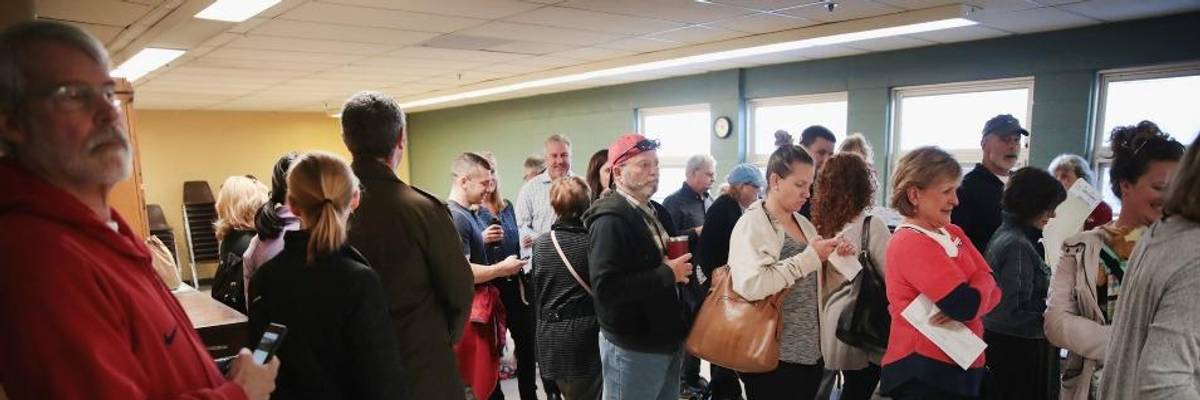
Voters wait in line to vote at a polling place on Nov. 6, 2018 in Kirkwood, Missouri. Voters across the country are casting ballots in a midterm election that couuld change the balance of both the U.S. House and Senate. (Photo by Scott Olson/Getty Images)
A poll released as Americans cast their ballots in the midterm elections on Tuesday shows that more than half of the country believes Election Day should be made a national holiday--a likely partial solution to a number of problems that plague the voting system.
Fifty-four percent of respondents to the survey, taken by Hill.TV and HarrisX, say workers should be given the day off on Election Day, allowing them far more time to vote, saving them from having to leave their polling places without voting due to long lines and issues with voting machines, and potentially changing the United States' generally low election turnout for the better.
On social media, a number of politicians and political observers voiced support for the idea.
At least 12 states were reporting broken or faulty voting machines on Tuesday, including New York, Georgia, and Arizona. As a result, voters in some states were given provisional ballots--which are not always counted--while others were forced to leave polling places without voting.
Reports on social media showed that voters in New York, Florida, Indiana, and Pennsylvania were among those who had to leave due to voting machine issues.
Extremely long waits were also reported in Georgia, where the Republican candidate for governor, Brian Kemp, is also the Secretary of State and is responsible for overseeing the state's elections. At 5:00pm on Tuesday, five Georgia voters filed an emergency lawsuit seeking to stop him from exercising any further power over the state's elections.
"Allowing one of the candidates to not just preside over their own election but misuse their office to give them an unfair advantage is just anti-democratic and unlawful," said Bryan L. Sells, an attorney representing the voters, in a statement.
In Snellville, Georgia, the state had evidently not provided a polling location with power cords for the voting machines, leaving voters with no way to cast their ballots after the machines' batteries ran out.
Both reports drew ire from critics who in recent weeks have decried a number of voter suppression efforts by Kemp's office--including the attempted closure of polling places in majority-black areas and an attempt to disenfranchise 53,000 mostly-black voters for clerical errors on voting forms.
Voters in Georgia also reported that they had been turned away at the polls despite presenting photo IDs that are ostensibly accepted forms of identification for voters in the state.
Reports of difficulties casting votes are common on Election Day in the U.S.--and stand as incontrovertible evidence, critics say, that the country's democratic system is broken.
The reports also intensified demands that the U.S. should demonstrate the same respect for the democratic process that countries including Mexico and France do--by ensuring that voters can make their voices heard without having to worry about getting to work.
Dear Common Dreams reader, It’s been nearly 30 years since I co-founded Common Dreams with my late wife, Lina Newhouser. We had the radical notion that journalism should serve the public good, not corporate profits. It was clear to us from the outset what it would take to build such a project. No paid advertisements. No corporate sponsors. No millionaire publisher telling us what to think or do. Many people said we wouldn't last a year, but we proved those doubters wrong. Together with a tremendous team of journalists and dedicated staff, we built an independent media outlet free from the constraints of profits and corporate control. Our mission has always been simple: To inform. To inspire. To ignite change for the common good. Building Common Dreams was not easy. Our survival was never guaranteed. When you take on the most powerful forces—Wall Street greed, fossil fuel industry destruction, Big Tech lobbyists, and uber-rich oligarchs who have spent billions upon billions rigging the economy and democracy in their favor—the only bulwark you have is supporters who believe in your work. But here’s the urgent message from me today. It's never been this bad out there. And it's never been this hard to keep us going. At the very moment Common Dreams is most needed, the threats we face are intensifying. We need your support now more than ever. We don't accept corporate advertising and never will. We don't have a paywall because we don't think people should be blocked from critical news based on their ability to pay. Everything we do is funded by the donations of readers like you. When everyone does the little they can afford, we are strong. But if that support retreats or dries up, so do we. Will you donate now to make sure Common Dreams not only survives but thrives? —Craig Brown, Co-founder |
A poll released as Americans cast their ballots in the midterm elections on Tuesday shows that more than half of the country believes Election Day should be made a national holiday--a likely partial solution to a number of problems that plague the voting system.
Fifty-four percent of respondents to the survey, taken by Hill.TV and HarrisX, say workers should be given the day off on Election Day, allowing them far more time to vote, saving them from having to leave their polling places without voting due to long lines and issues with voting machines, and potentially changing the United States' generally low election turnout for the better.
On social media, a number of politicians and political observers voiced support for the idea.
At least 12 states were reporting broken or faulty voting machines on Tuesday, including New York, Georgia, and Arizona. As a result, voters in some states were given provisional ballots--which are not always counted--while others were forced to leave polling places without voting.
Reports on social media showed that voters in New York, Florida, Indiana, and Pennsylvania were among those who had to leave due to voting machine issues.
Extremely long waits were also reported in Georgia, where the Republican candidate for governor, Brian Kemp, is also the Secretary of State and is responsible for overseeing the state's elections. At 5:00pm on Tuesday, five Georgia voters filed an emergency lawsuit seeking to stop him from exercising any further power over the state's elections.
"Allowing one of the candidates to not just preside over their own election but misuse their office to give them an unfair advantage is just anti-democratic and unlawful," said Bryan L. Sells, an attorney representing the voters, in a statement.
In Snellville, Georgia, the state had evidently not provided a polling location with power cords for the voting machines, leaving voters with no way to cast their ballots after the machines' batteries ran out.
Both reports drew ire from critics who in recent weeks have decried a number of voter suppression efforts by Kemp's office--including the attempted closure of polling places in majority-black areas and an attempt to disenfranchise 53,000 mostly-black voters for clerical errors on voting forms.
Voters in Georgia also reported that they had been turned away at the polls despite presenting photo IDs that are ostensibly accepted forms of identification for voters in the state.
Reports of difficulties casting votes are common on Election Day in the U.S.--and stand as incontrovertible evidence, critics say, that the country's democratic system is broken.
The reports also intensified demands that the U.S. should demonstrate the same respect for the democratic process that countries including Mexico and France do--by ensuring that voters can make their voices heard without having to worry about getting to work.
A poll released as Americans cast their ballots in the midterm elections on Tuesday shows that more than half of the country believes Election Day should be made a national holiday--a likely partial solution to a number of problems that plague the voting system.
Fifty-four percent of respondents to the survey, taken by Hill.TV and HarrisX, say workers should be given the day off on Election Day, allowing them far more time to vote, saving them from having to leave their polling places without voting due to long lines and issues with voting machines, and potentially changing the United States' generally low election turnout for the better.
On social media, a number of politicians and political observers voiced support for the idea.
At least 12 states were reporting broken or faulty voting machines on Tuesday, including New York, Georgia, and Arizona. As a result, voters in some states were given provisional ballots--which are not always counted--while others were forced to leave polling places without voting.
Reports on social media showed that voters in New York, Florida, Indiana, and Pennsylvania were among those who had to leave due to voting machine issues.
Extremely long waits were also reported in Georgia, where the Republican candidate for governor, Brian Kemp, is also the Secretary of State and is responsible for overseeing the state's elections. At 5:00pm on Tuesday, five Georgia voters filed an emergency lawsuit seeking to stop him from exercising any further power over the state's elections.
"Allowing one of the candidates to not just preside over their own election but misuse their office to give them an unfair advantage is just anti-democratic and unlawful," said Bryan L. Sells, an attorney representing the voters, in a statement.
In Snellville, Georgia, the state had evidently not provided a polling location with power cords for the voting machines, leaving voters with no way to cast their ballots after the machines' batteries ran out.
Both reports drew ire from critics who in recent weeks have decried a number of voter suppression efforts by Kemp's office--including the attempted closure of polling places in majority-black areas and an attempt to disenfranchise 53,000 mostly-black voters for clerical errors on voting forms.
Voters in Georgia also reported that they had been turned away at the polls despite presenting photo IDs that are ostensibly accepted forms of identification for voters in the state.
Reports of difficulties casting votes are common on Election Day in the U.S.--and stand as incontrovertible evidence, critics say, that the country's democratic system is broken.
The reports also intensified demands that the U.S. should demonstrate the same respect for the democratic process that countries including Mexico and France do--by ensuring that voters can make their voices heard without having to worry about getting to work.