SUBSCRIBE TO OUR FREE NEWSLETTER
Daily news & progressive opinion—funded by the people, not the corporations—delivered straight to your inbox.
5
#000000
#FFFFFF
To donate by check, phone, or other method, see our More Ways to Give page.
Daily news & progressive opinion—funded by the people, not the corporations—delivered straight to your inbox.
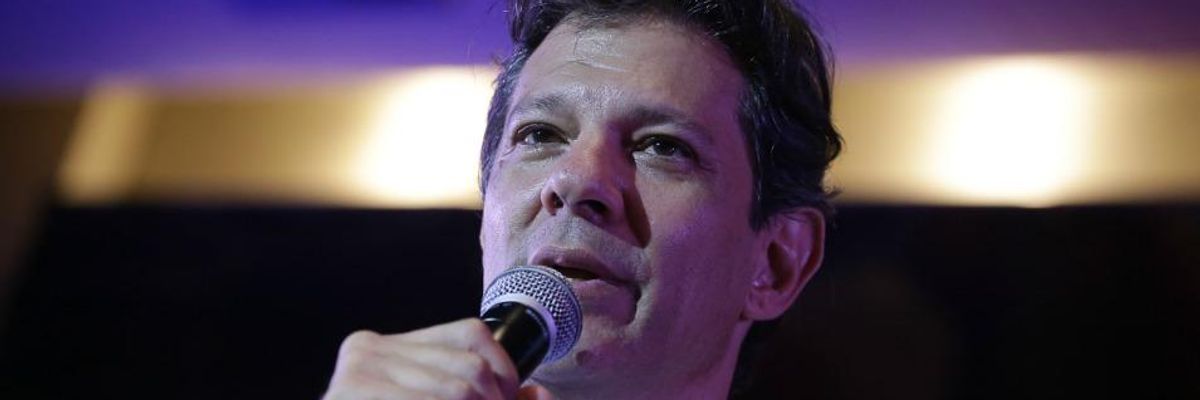
Fernando Haddad, Brazil's left-wing presidential candidate, has been illegally targeted by entrepreneurs who support his opponent, Jair Bolsonaro, in the country's election campaign. (Photo: PT--Partido dos Trabalhadores/Flickr/cc)
Brazilian left-wing presidential candidate Fernando Haddad is demanding an investigation into an illegal campaign funded by right-wing marketing firms in support of his opponent, Jair Bolsonaro, which is making use of the messaging service WhatsApp to send anti-Haddad propaganda to millions of voters ahead of the country's election.
Brazil's largest newspaper, Folha, reported Thursday that pro-Bolsonaro entrepreneurs have spent $3.2 million purchasing bundles of local phone numbers in order to send hundreds of millions of messages to WhatsApp users featuring fake news stories about Haddad.
"My adversary is seeking to benefit from electoral crimes," Haddad tweeted after the report came out. "What we are facing here is an attempt at electoral fraud."
"While the west obsesses on the spread of disinformation via Facebook and Twitter posts, Brazil is showing that WhatsApp--which is huge in Brazil but lots of other places--can be way more powerful." --Glenn GreenwaldHaddad's Worker's Party (PT) also spoke out, calling on WhatsApp to combat the business-backed campaign.
"What is at stake here is the survival of the democratic process," said the party.
The campaign "constitutes undeclared campaign donations by companies," reported Folha, which is "outlawed by electoral legislation."
The hugely popular messaging app, which is owned by Facebook, is used by about 40 percent of Brazilians and is where about 60 percent of the country's voters get their news, according to BuzzFeed. Its messages are encrypted, making it difficult for the company to monitor what's being said among users.
As journalist and Brazil resident Glenn Greenwald wrote on Twitter, the entrepreneurs behind the campaign have been able to pose as WhatsApp users' friends when they send fake news through the app, allowing stories--like one about Haddad distributing "erotic baby bottles" to schools in an effort to combat homophobia--to reach millions of users.
A Brazilian fact-checking group, Project Eleicoes Sem Fake, found in a study of 347 public WhatsApp chat groups that almost all of the political images shared in the groups from August to October were false or misleading.
"From a sample of more than 100,000 political images that circulated in those 347 groups, we selected the 50 most widely shared," the researchers wrote in an op-ed in the New York Times this week. "Eight of those 50 photos and images were considered completely false; 16 were real pictures but used out of their original context or related to distorted data; four were unsubstantiated claims, not based on a trustworthy public source. This means that 56 percent of the most-shared images were misleading. Only eight percent of the 50 most widely shared images were considered fully truthful."
The group called on Whatsapp to restrict the number of people a single user can broadcast a message to, as well as the number of times a message can be forwarded, in an effort to mitigate the power of the fake news campaign.
The news of the business-led election-meddling follows reports that in August, Eduardo Bolsonaro, the son of the pro-torture, openly misogynist candidate, met with former Trump administration strategist Steve Bannon, who offered "internet tips, analysis, interpreting data, that type of stuff"--raising concerns that Bannon has brought his quest to help right-wing autocrats take control of the world's democracies to Brazil.
In the picture below, Bolsonaro's son getting 'some advice' from an American friend about the role of fake news in elections, a couple of weeks ago pic.twitter.com/BgLEyKEdqn
-- sergio bretas (@serbretas) October 18, 2018
Haddad's campaign has attempted to counter the pro-Bolsonaro fake news campaign by drawing attention to his opponent's relationship with Bannon, whose appointment to President Donald Trump's White House was applauded by white supremacists.
"Steve Bannon is accused of sabotaging democratic regimes around the world. He uses fake news to spread fear and violence to win elections," the narrator in a new ad by Haddad tells viewers. "Bannon is a specialist in spreading terror around the world. Bolsonaro has spent the last 30 years doing this in Brazil."
Dear Common Dreams reader, It’s been nearly 30 years since I co-founded Common Dreams with my late wife, Lina Newhouser. We had the radical notion that journalism should serve the public good, not corporate profits. It was clear to us from the outset what it would take to build such a project. No paid advertisements. No corporate sponsors. No millionaire publisher telling us what to think or do. Many people said we wouldn't last a year, but we proved those doubters wrong. Together with a tremendous team of journalists and dedicated staff, we built an independent media outlet free from the constraints of profits and corporate control. Our mission has always been simple: To inform. To inspire. To ignite change for the common good. Building Common Dreams was not easy. Our survival was never guaranteed. When you take on the most powerful forces—Wall Street greed, fossil fuel industry destruction, Big Tech lobbyists, and uber-rich oligarchs who have spent billions upon billions rigging the economy and democracy in their favor—the only bulwark you have is supporters who believe in your work. But here’s the urgent message from me today. It's never been this bad out there. And it's never been this hard to keep us going. At the very moment Common Dreams is most needed, the threats we face are intensifying. We need your support now more than ever. We don't accept corporate advertising and never will. We don't have a paywall because we don't think people should be blocked from critical news based on their ability to pay. Everything we do is funded by the donations of readers like you. When everyone does the little they can afford, we are strong. But if that support retreats or dries up, so do we. Will you donate now to make sure Common Dreams not only survives but thrives? —Craig Brown, Co-founder |
Brazilian left-wing presidential candidate Fernando Haddad is demanding an investigation into an illegal campaign funded by right-wing marketing firms in support of his opponent, Jair Bolsonaro, which is making use of the messaging service WhatsApp to send anti-Haddad propaganda to millions of voters ahead of the country's election.
Brazil's largest newspaper, Folha, reported Thursday that pro-Bolsonaro entrepreneurs have spent $3.2 million purchasing bundles of local phone numbers in order to send hundreds of millions of messages to WhatsApp users featuring fake news stories about Haddad.
"My adversary is seeking to benefit from electoral crimes," Haddad tweeted after the report came out. "What we are facing here is an attempt at electoral fraud."
"While the west obsesses on the spread of disinformation via Facebook and Twitter posts, Brazil is showing that WhatsApp--which is huge in Brazil but lots of other places--can be way more powerful." --Glenn GreenwaldHaddad's Worker's Party (PT) also spoke out, calling on WhatsApp to combat the business-backed campaign.
"What is at stake here is the survival of the democratic process," said the party.
The campaign "constitutes undeclared campaign donations by companies," reported Folha, which is "outlawed by electoral legislation."
The hugely popular messaging app, which is owned by Facebook, is used by about 40 percent of Brazilians and is where about 60 percent of the country's voters get their news, according to BuzzFeed. Its messages are encrypted, making it difficult for the company to monitor what's being said among users.
As journalist and Brazil resident Glenn Greenwald wrote on Twitter, the entrepreneurs behind the campaign have been able to pose as WhatsApp users' friends when they send fake news through the app, allowing stories--like one about Haddad distributing "erotic baby bottles" to schools in an effort to combat homophobia--to reach millions of users.
A Brazilian fact-checking group, Project Eleicoes Sem Fake, found in a study of 347 public WhatsApp chat groups that almost all of the political images shared in the groups from August to October were false or misleading.
"From a sample of more than 100,000 political images that circulated in those 347 groups, we selected the 50 most widely shared," the researchers wrote in an op-ed in the New York Times this week. "Eight of those 50 photos and images were considered completely false; 16 were real pictures but used out of their original context or related to distorted data; four were unsubstantiated claims, not based on a trustworthy public source. This means that 56 percent of the most-shared images were misleading. Only eight percent of the 50 most widely shared images were considered fully truthful."
The group called on Whatsapp to restrict the number of people a single user can broadcast a message to, as well as the number of times a message can be forwarded, in an effort to mitigate the power of the fake news campaign.
The news of the business-led election-meddling follows reports that in August, Eduardo Bolsonaro, the son of the pro-torture, openly misogynist candidate, met with former Trump administration strategist Steve Bannon, who offered "internet tips, analysis, interpreting data, that type of stuff"--raising concerns that Bannon has brought his quest to help right-wing autocrats take control of the world's democracies to Brazil.
In the picture below, Bolsonaro's son getting 'some advice' from an American friend about the role of fake news in elections, a couple of weeks ago pic.twitter.com/BgLEyKEdqn
-- sergio bretas (@serbretas) October 18, 2018
Haddad's campaign has attempted to counter the pro-Bolsonaro fake news campaign by drawing attention to his opponent's relationship with Bannon, whose appointment to President Donald Trump's White House was applauded by white supremacists.
"Steve Bannon is accused of sabotaging democratic regimes around the world. He uses fake news to spread fear and violence to win elections," the narrator in a new ad by Haddad tells viewers. "Bannon is a specialist in spreading terror around the world. Bolsonaro has spent the last 30 years doing this in Brazil."
Brazilian left-wing presidential candidate Fernando Haddad is demanding an investigation into an illegal campaign funded by right-wing marketing firms in support of his opponent, Jair Bolsonaro, which is making use of the messaging service WhatsApp to send anti-Haddad propaganda to millions of voters ahead of the country's election.
Brazil's largest newspaper, Folha, reported Thursday that pro-Bolsonaro entrepreneurs have spent $3.2 million purchasing bundles of local phone numbers in order to send hundreds of millions of messages to WhatsApp users featuring fake news stories about Haddad.
"My adversary is seeking to benefit from electoral crimes," Haddad tweeted after the report came out. "What we are facing here is an attempt at electoral fraud."
"While the west obsesses on the spread of disinformation via Facebook and Twitter posts, Brazil is showing that WhatsApp--which is huge in Brazil but lots of other places--can be way more powerful." --Glenn GreenwaldHaddad's Worker's Party (PT) also spoke out, calling on WhatsApp to combat the business-backed campaign.
"What is at stake here is the survival of the democratic process," said the party.
The campaign "constitutes undeclared campaign donations by companies," reported Folha, which is "outlawed by electoral legislation."
The hugely popular messaging app, which is owned by Facebook, is used by about 40 percent of Brazilians and is where about 60 percent of the country's voters get their news, according to BuzzFeed. Its messages are encrypted, making it difficult for the company to monitor what's being said among users.
As journalist and Brazil resident Glenn Greenwald wrote on Twitter, the entrepreneurs behind the campaign have been able to pose as WhatsApp users' friends when they send fake news through the app, allowing stories--like one about Haddad distributing "erotic baby bottles" to schools in an effort to combat homophobia--to reach millions of users.
A Brazilian fact-checking group, Project Eleicoes Sem Fake, found in a study of 347 public WhatsApp chat groups that almost all of the political images shared in the groups from August to October were false or misleading.
"From a sample of more than 100,000 political images that circulated in those 347 groups, we selected the 50 most widely shared," the researchers wrote in an op-ed in the New York Times this week. "Eight of those 50 photos and images were considered completely false; 16 were real pictures but used out of their original context or related to distorted data; four were unsubstantiated claims, not based on a trustworthy public source. This means that 56 percent of the most-shared images were misleading. Only eight percent of the 50 most widely shared images were considered fully truthful."
The group called on Whatsapp to restrict the number of people a single user can broadcast a message to, as well as the number of times a message can be forwarded, in an effort to mitigate the power of the fake news campaign.
The news of the business-led election-meddling follows reports that in August, Eduardo Bolsonaro, the son of the pro-torture, openly misogynist candidate, met with former Trump administration strategist Steve Bannon, who offered "internet tips, analysis, interpreting data, that type of stuff"--raising concerns that Bannon has brought his quest to help right-wing autocrats take control of the world's democracies to Brazil.
In the picture below, Bolsonaro's son getting 'some advice' from an American friend about the role of fake news in elections, a couple of weeks ago pic.twitter.com/BgLEyKEdqn
-- sergio bretas (@serbretas) October 18, 2018
Haddad's campaign has attempted to counter the pro-Bolsonaro fake news campaign by drawing attention to his opponent's relationship with Bannon, whose appointment to President Donald Trump's White House was applauded by white supremacists.
"Steve Bannon is accused of sabotaging democratic regimes around the world. He uses fake news to spread fear and violence to win elections," the narrator in a new ad by Haddad tells viewers. "Bannon is a specialist in spreading terror around the world. Bolsonaro has spent the last 30 years doing this in Brazil."