SUBSCRIBE TO OUR FREE NEWSLETTER
Daily news & progressive opinion—funded by the people, not the corporations—delivered straight to your inbox.
5
#000000
#FFFFFF
To donate by check, phone, or other method, see our More Ways to Give page.
Daily news & progressive opinion—funded by the people, not the corporations—delivered straight to your inbox.
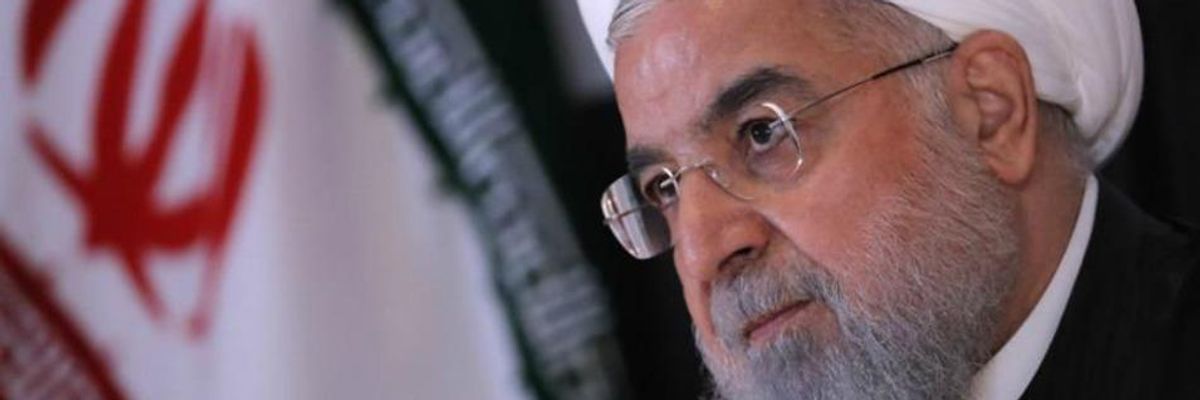
Iranian President Hassan Rouhani has called the U.S. withdrawal from 2015 nuclear deal, "a mistake." (Photo: Brendan Mcdermid/Reuters)
Ahead of the United States' newest round of sanctions targeting his country, Iranian President Hassan Rouhani on Sunday accused the Trump administration of "psychological and economic warfare" and of working toward regime change in Iran.
Speaking at Tehran University, Rouhani expressed outrage amid rising tensions following President Donald Trump's breach of the 2015 nuclear deal between Iran, the U.S., and five other countries as well as the European Union.
"In the past 40 years, there has not been a more spiteful team than the current U.S. government team toward Iran, Iranians and the Islamic Republic," Rouhani said.
After announcing the United States' withdrawal from the Joint Comprehensive Plan of Action (JCPOA) in May--against the advice of several world leaders and the wishes of 63 percent of the American public--Trump reimposed sanctions on Iran, banning the country's purchasing of U.S. banknotes and precious metals as well as airplane and auto parts.
The effects of the sanctions have already been felt by Iranians, with the prices of cars, electronics, and medications doubling.
Earlier this month, the International Court of Justice (ICJ) of the United Nations ordered the U.S. to ensure its sanctions do not endanger Iranians by affecting the delivery of humanitarian aid.
"On humanitarian grounds, the U.S. must remove by means of its choosing any impediment to the free exportation to Iran of goods involving humanitarian concerns," the court said.
The sanctions scheduled to be imposed next month will target the country's oil exports, which account for one-fifth of Iran's economy.
National Security Adviser John Bolton insisted earlier this month that the U.S. is not seeking regime change in Iran--days after he told an audience at an anti-Tehran gathering that there would be "hell to pay" if Iran "crosses" the Trump administration.
"Reducing the legitimacy of the system is their final goal," said Rouhani on Sunday. "When they say 'getting rid of,' regime change in their own words, how does regime change happen? Through reducing legitimacy, otherwise a regime doesn't change."
Dear Common Dreams reader, It’s been nearly 30 years since I co-founded Common Dreams with my late wife, Lina Newhouser. We had the radical notion that journalism should serve the public good, not corporate profits. It was clear to us from the outset what it would take to build such a project. No paid advertisements. No corporate sponsors. No millionaire publisher telling us what to think or do. Many people said we wouldn't last a year, but we proved those doubters wrong. Together with a tremendous team of journalists and dedicated staff, we built an independent media outlet free from the constraints of profits and corporate control. Our mission has always been simple: To inform. To inspire. To ignite change for the common good. Building Common Dreams was not easy. Our survival was never guaranteed. When you take on the most powerful forces—Wall Street greed, fossil fuel industry destruction, Big Tech lobbyists, and uber-rich oligarchs who have spent billions upon billions rigging the economy and democracy in their favor—the only bulwark you have is supporters who believe in your work. But here’s the urgent message from me today. It's never been this bad out there. And it's never been this hard to keep us going. At the very moment Common Dreams is most needed, the threats we face are intensifying. We need your support now more than ever. We don't accept corporate advertising and never will. We don't have a paywall because we don't think people should be blocked from critical news based on their ability to pay. Everything we do is funded by the donations of readers like you. When everyone does the little they can afford, we are strong. But if that support retreats or dries up, so do we. Will you donate now to make sure Common Dreams not only survives but thrives? —Craig Brown, Co-founder |
Ahead of the United States' newest round of sanctions targeting his country, Iranian President Hassan Rouhani on Sunday accused the Trump administration of "psychological and economic warfare" and of working toward regime change in Iran.
Speaking at Tehran University, Rouhani expressed outrage amid rising tensions following President Donald Trump's breach of the 2015 nuclear deal between Iran, the U.S., and five other countries as well as the European Union.
"In the past 40 years, there has not been a more spiteful team than the current U.S. government team toward Iran, Iranians and the Islamic Republic," Rouhani said.
After announcing the United States' withdrawal from the Joint Comprehensive Plan of Action (JCPOA) in May--against the advice of several world leaders and the wishes of 63 percent of the American public--Trump reimposed sanctions on Iran, banning the country's purchasing of U.S. banknotes and precious metals as well as airplane and auto parts.
The effects of the sanctions have already been felt by Iranians, with the prices of cars, electronics, and medications doubling.
Earlier this month, the International Court of Justice (ICJ) of the United Nations ordered the U.S. to ensure its sanctions do not endanger Iranians by affecting the delivery of humanitarian aid.
"On humanitarian grounds, the U.S. must remove by means of its choosing any impediment to the free exportation to Iran of goods involving humanitarian concerns," the court said.
The sanctions scheduled to be imposed next month will target the country's oil exports, which account for one-fifth of Iran's economy.
National Security Adviser John Bolton insisted earlier this month that the U.S. is not seeking regime change in Iran--days after he told an audience at an anti-Tehran gathering that there would be "hell to pay" if Iran "crosses" the Trump administration.
"Reducing the legitimacy of the system is their final goal," said Rouhani on Sunday. "When they say 'getting rid of,' regime change in their own words, how does regime change happen? Through reducing legitimacy, otherwise a regime doesn't change."
Ahead of the United States' newest round of sanctions targeting his country, Iranian President Hassan Rouhani on Sunday accused the Trump administration of "psychological and economic warfare" and of working toward regime change in Iran.
Speaking at Tehran University, Rouhani expressed outrage amid rising tensions following President Donald Trump's breach of the 2015 nuclear deal between Iran, the U.S., and five other countries as well as the European Union.
"In the past 40 years, there has not been a more spiteful team than the current U.S. government team toward Iran, Iranians and the Islamic Republic," Rouhani said.
After announcing the United States' withdrawal from the Joint Comprehensive Plan of Action (JCPOA) in May--against the advice of several world leaders and the wishes of 63 percent of the American public--Trump reimposed sanctions on Iran, banning the country's purchasing of U.S. banknotes and precious metals as well as airplane and auto parts.
The effects of the sanctions have already been felt by Iranians, with the prices of cars, electronics, and medications doubling.
Earlier this month, the International Court of Justice (ICJ) of the United Nations ordered the U.S. to ensure its sanctions do not endanger Iranians by affecting the delivery of humanitarian aid.
"On humanitarian grounds, the U.S. must remove by means of its choosing any impediment to the free exportation to Iran of goods involving humanitarian concerns," the court said.
The sanctions scheduled to be imposed next month will target the country's oil exports, which account for one-fifth of Iran's economy.
National Security Adviser John Bolton insisted earlier this month that the U.S. is not seeking regime change in Iran--days after he told an audience at an anti-Tehran gathering that there would be "hell to pay" if Iran "crosses" the Trump administration.
"Reducing the legitimacy of the system is their final goal," said Rouhani on Sunday. "When they say 'getting rid of,' regime change in their own words, how does regime change happen? Through reducing legitimacy, otherwise a regime doesn't change."