
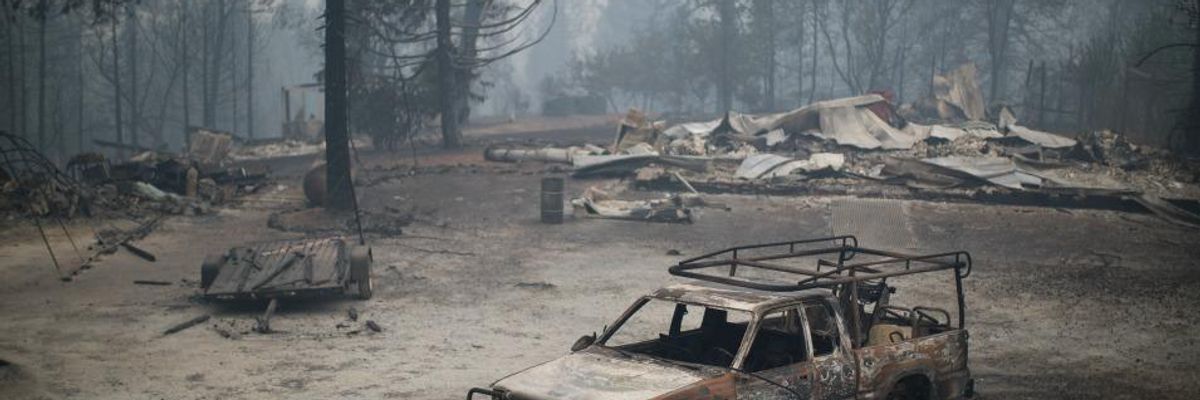
A burned truck and structures are seen at the Butte Fire on September 13, 2015 near San Andreas, California. California governor Jerry Brown has declared a state of emergency in Amador and Calaveras counties where the 100-square-mile wildfire has burned scores of structures so far and is threatening 6,400 in the historic Gold Country of the Sierra Nevada foothills. (Photo: David McNew/Getty Images)
What's Not in the Latest Terrifying IPCC Report? The "Much, Much, Much More Terrifying" New Research on Climate Tipping Points
"This is the scariest thing about the IPCC Report — it’s the watered down, consensus version."
If the latest warnings contained in Monday's report by the Intergovernmental Panel on Climate Change (IPCC)--which included pronouncements that the world has less than twelve years to drastically alter course to avoid the worst impacts of human-caused global warming and that nothing less than keeping all fossil fuels in the ground is the solution to avoid future calamities--have you at all frightened or despondent, experts responding to the report have a potentially unwelcome message for your already over-burdened heart and mind: It's very likely even worse than you're being told.
"The IPCC understates a key risk: that self-reinforcing feedback loops could push the climate system into chaos before we have time to tame our energy system."
--Mario Molina, Nobel Laureate
After the report's publication there were headlines like: "We have 12 years to act on climate change before the world as we know it is lost. How much more urgent can it get?" and "Science pronounces its verdict: World to be doomed at 2degC, less dangerous at 1.5degC" and "A major new climate report slams the door on wishful thinking."
But as Jamie Henn, co-founder and the program director for the international climate group 350.org, stated in a tweet on Tuesday, the "scariest thing about the IPCC Report" is the fact that "it's the watered down, consensus version. The latest science is much, much, much more terrifying."
Henn was actually responding to Penn State University climate scientist Michael Mann who was pushing back against those criticizing the IPCC report as too "alarmist" in its declarations and warnings. "If anything," Professor Mann declared, "it is the opposite. Once again, with their latest report, they have been overly conservative (ie. erring on the side of understating/underestimating the problem.)"
This is very possibly true and there is much scientific data and argument backing this up. As Henn and Mann both indicate, the IPCC report is based on the consensus view of the hundreds of scientists who make up the IPCC - and its been consistently true that some of the most recent (and increasingly worrying) scientific findings have not yet found enough support to make it into these major reports which rely on near-unanimous agreement.
According to Durwood Zaelke, founder of the Institute for Governance and Sustainable Development, speaking to The Guardian in the wake of the latest IPCC report, it "fails to focus on the weakest link in the climate chain: the self-reinforcing feedbacks which, if allowed to continue, will accelerate warming and risk cascading climate tipping points and runaway warming."
"This is not the time to turn away, whether in fear or in active denial of the facts. This is a time to use our fear as fuel."
--Rajiv Sicora, The LeapIn August, as Common Dreams reported, research published by Johan Rockstrom and his colleagues at the Stockholm Resilience Centre in Sweden found that it is precisely these feedback loops and tipping points that should most frighten and concern humanity. While nascent and not conclusive in its findings--two of the reasons you won't find it referenced in the IPCC report--the study warned that humanity may be just 1degC away from creating a series of dynamic feedback loops that could push the world into a climate scenario not seen since the dawn of the Helocene Period, nearly 12,000 years ago.
Quoted in Tuesday's Guardian article about the dangers of ignoring potential tipping points, Nobel prize laureate Mario Molina, who shared the award for chemistry in 1995 for his work on ozone depletion, said: "The IPCC report demonstrates that it is still possible to keep the climate relatively safe, provided we muster an unprecedented level of cooperation, extraordinary speed and heroic scale of action. But even with its description of the increasing impacts that lie ahead, the IPCC understates a key risk: that self-reinforcing feedback loops could push the climate system into chaos before we have time to tame our energy system, and the other sources of climate pollution."
The purpose of recognizing the terrifying predictions is not to instill fear, however, climate campaigners and advocates for bold solutions say.
In a paper authored last year--titled Leading the Public into Emergency Mode: A New Strategy for the Climate Movement--Margaret Klein Salamon writes that while a World War II-style mobilization is necessary to achieve the kind emission cuts and energy transformation that science now mandates, understanding the stakes does not necessarily mean being debilitated by that knowledge. In an op-ed for Common Dreams, she argued "that intense, but not paralyzing, fear combined with maximum hope can actually lead people and groups into a state of peak performance. We can rise to the challenge of our time and dedicate ourselves to become heroic messengers and change-makers."
And as Rajiv Sicora, senior manager of research for The Leap, wrote to his group's supporters in an email on Tuesday: "This is not the time to turn away, whether in fear or in active denial of the facts. This is a time to use our fear as fuel: because the report also makes clear that the worst effects of global warming can still be prevented, and the urgency of transformative change should excite and empower all of us who are fighting for justice anyway."
An Urgent Message From Our Co-Founder
Dear Common Dreams reader, It’s been nearly 30 years since I co-founded Common Dreams with my late wife, Lina Newhouser. We had the radical notion that journalism should serve the public good, not corporate profits. It was clear to us from the outset what it would take to build such a project. No paid advertisements. No corporate sponsors. No millionaire publisher telling us what to think or do. Many people said we wouldn't last a year, but we proved those doubters wrong. Together with a tremendous team of journalists and dedicated staff, we built an independent media outlet free from the constraints of profits and corporate control. Our mission has always been simple: To inform. To inspire. To ignite change for the common good. Building Common Dreams was not easy. Our survival was never guaranteed. When you take on the most powerful forces—Wall Street greed, fossil fuel industry destruction, Big Tech lobbyists, and uber-rich oligarchs who have spent billions upon billions rigging the economy and democracy in their favor—the only bulwark you have is supporters who believe in your work. But here’s the urgent message from me today. It's never been this bad out there. And it's never been this hard to keep us going. At the very moment Common Dreams is most needed, the threats we face are intensifying. We need your support now more than ever. We don't accept corporate advertising and never will. We don't have a paywall because we don't think people should be blocked from critical news based on their ability to pay. Everything we do is funded by the donations of readers like you. When everyone does the little they can afford, we are strong. But if that support retreats or dries up, so do we. Will you donate now to make sure Common Dreams not only survives but thrives? —Craig Brown, Co-founder |
If the latest warnings contained in Monday's report by the Intergovernmental Panel on Climate Change (IPCC)--which included pronouncements that the world has less than twelve years to drastically alter course to avoid the worst impacts of human-caused global warming and that nothing less than keeping all fossil fuels in the ground is the solution to avoid future calamities--have you at all frightened or despondent, experts responding to the report have a potentially unwelcome message for your already over-burdened heart and mind: It's very likely even worse than you're being told.
"The IPCC understates a key risk: that self-reinforcing feedback loops could push the climate system into chaos before we have time to tame our energy system."
--Mario Molina, Nobel Laureate
After the report's publication there were headlines like: "We have 12 years to act on climate change before the world as we know it is lost. How much more urgent can it get?" and "Science pronounces its verdict: World to be doomed at 2degC, less dangerous at 1.5degC" and "A major new climate report slams the door on wishful thinking."
But as Jamie Henn, co-founder and the program director for the international climate group 350.org, stated in a tweet on Tuesday, the "scariest thing about the IPCC Report" is the fact that "it's the watered down, consensus version. The latest science is much, much, much more terrifying."
Henn was actually responding to Penn State University climate scientist Michael Mann who was pushing back against those criticizing the IPCC report as too "alarmist" in its declarations and warnings. "If anything," Professor Mann declared, "it is the opposite. Once again, with their latest report, they have been overly conservative (ie. erring on the side of understating/underestimating the problem.)"
This is very possibly true and there is much scientific data and argument backing this up. As Henn and Mann both indicate, the IPCC report is based on the consensus view of the hundreds of scientists who make up the IPCC - and its been consistently true that some of the most recent (and increasingly worrying) scientific findings have not yet found enough support to make it into these major reports which rely on near-unanimous agreement.
According to Durwood Zaelke, founder of the Institute for Governance and Sustainable Development, speaking to The Guardian in the wake of the latest IPCC report, it "fails to focus on the weakest link in the climate chain: the self-reinforcing feedbacks which, if allowed to continue, will accelerate warming and risk cascading climate tipping points and runaway warming."
"This is not the time to turn away, whether in fear or in active denial of the facts. This is a time to use our fear as fuel."
--Rajiv Sicora, The LeapIn August, as Common Dreams reported, research published by Johan Rockstrom and his colleagues at the Stockholm Resilience Centre in Sweden found that it is precisely these feedback loops and tipping points that should most frighten and concern humanity. While nascent and not conclusive in its findings--two of the reasons you won't find it referenced in the IPCC report--the study warned that humanity may be just 1degC away from creating a series of dynamic feedback loops that could push the world into a climate scenario not seen since the dawn of the Helocene Period, nearly 12,000 years ago.
Quoted in Tuesday's Guardian article about the dangers of ignoring potential tipping points, Nobel prize laureate Mario Molina, who shared the award for chemistry in 1995 for his work on ozone depletion, said: "The IPCC report demonstrates that it is still possible to keep the climate relatively safe, provided we muster an unprecedented level of cooperation, extraordinary speed and heroic scale of action. But even with its description of the increasing impacts that lie ahead, the IPCC understates a key risk: that self-reinforcing feedback loops could push the climate system into chaos before we have time to tame our energy system, and the other sources of climate pollution."
The purpose of recognizing the terrifying predictions is not to instill fear, however, climate campaigners and advocates for bold solutions say.
In a paper authored last year--titled Leading the Public into Emergency Mode: A New Strategy for the Climate Movement--Margaret Klein Salamon writes that while a World War II-style mobilization is necessary to achieve the kind emission cuts and energy transformation that science now mandates, understanding the stakes does not necessarily mean being debilitated by that knowledge. In an op-ed for Common Dreams, she argued "that intense, but not paralyzing, fear combined with maximum hope can actually lead people and groups into a state of peak performance. We can rise to the challenge of our time and dedicate ourselves to become heroic messengers and change-makers."
And as Rajiv Sicora, senior manager of research for The Leap, wrote to his group's supporters in an email on Tuesday: "This is not the time to turn away, whether in fear or in active denial of the facts. This is a time to use our fear as fuel: because the report also makes clear that the worst effects of global warming can still be prevented, and the urgency of transformative change should excite and empower all of us who are fighting for justice anyway."
If the latest warnings contained in Monday's report by the Intergovernmental Panel on Climate Change (IPCC)--which included pronouncements that the world has less than twelve years to drastically alter course to avoid the worst impacts of human-caused global warming and that nothing less than keeping all fossil fuels in the ground is the solution to avoid future calamities--have you at all frightened or despondent, experts responding to the report have a potentially unwelcome message for your already over-burdened heart and mind: It's very likely even worse than you're being told.
"The IPCC understates a key risk: that self-reinforcing feedback loops could push the climate system into chaos before we have time to tame our energy system."
--Mario Molina, Nobel Laureate
After the report's publication there were headlines like: "We have 12 years to act on climate change before the world as we know it is lost. How much more urgent can it get?" and "Science pronounces its verdict: World to be doomed at 2degC, less dangerous at 1.5degC" and "A major new climate report slams the door on wishful thinking."
But as Jamie Henn, co-founder and the program director for the international climate group 350.org, stated in a tweet on Tuesday, the "scariest thing about the IPCC Report" is the fact that "it's the watered down, consensus version. The latest science is much, much, much more terrifying."
Henn was actually responding to Penn State University climate scientist Michael Mann who was pushing back against those criticizing the IPCC report as too "alarmist" in its declarations and warnings. "If anything," Professor Mann declared, "it is the opposite. Once again, with their latest report, they have been overly conservative (ie. erring on the side of understating/underestimating the problem.)"
This is very possibly true and there is much scientific data and argument backing this up. As Henn and Mann both indicate, the IPCC report is based on the consensus view of the hundreds of scientists who make up the IPCC - and its been consistently true that some of the most recent (and increasingly worrying) scientific findings have not yet found enough support to make it into these major reports which rely on near-unanimous agreement.
According to Durwood Zaelke, founder of the Institute for Governance and Sustainable Development, speaking to The Guardian in the wake of the latest IPCC report, it "fails to focus on the weakest link in the climate chain: the self-reinforcing feedbacks which, if allowed to continue, will accelerate warming and risk cascading climate tipping points and runaway warming."
"This is not the time to turn away, whether in fear or in active denial of the facts. This is a time to use our fear as fuel."
--Rajiv Sicora, The LeapIn August, as Common Dreams reported, research published by Johan Rockstrom and his colleagues at the Stockholm Resilience Centre in Sweden found that it is precisely these feedback loops and tipping points that should most frighten and concern humanity. While nascent and not conclusive in its findings--two of the reasons you won't find it referenced in the IPCC report--the study warned that humanity may be just 1degC away from creating a series of dynamic feedback loops that could push the world into a climate scenario not seen since the dawn of the Helocene Period, nearly 12,000 years ago.
Quoted in Tuesday's Guardian article about the dangers of ignoring potential tipping points, Nobel prize laureate Mario Molina, who shared the award for chemistry in 1995 for his work on ozone depletion, said: "The IPCC report demonstrates that it is still possible to keep the climate relatively safe, provided we muster an unprecedented level of cooperation, extraordinary speed and heroic scale of action. But even with its description of the increasing impacts that lie ahead, the IPCC understates a key risk: that self-reinforcing feedback loops could push the climate system into chaos before we have time to tame our energy system, and the other sources of climate pollution."
The purpose of recognizing the terrifying predictions is not to instill fear, however, climate campaigners and advocates for bold solutions say.
In a paper authored last year--titled Leading the Public into Emergency Mode: A New Strategy for the Climate Movement--Margaret Klein Salamon writes that while a World War II-style mobilization is necessary to achieve the kind emission cuts and energy transformation that science now mandates, understanding the stakes does not necessarily mean being debilitated by that knowledge. In an op-ed for Common Dreams, she argued "that intense, but not paralyzing, fear combined with maximum hope can actually lead people and groups into a state of peak performance. We can rise to the challenge of our time and dedicate ourselves to become heroic messengers and change-makers."
And as Rajiv Sicora, senior manager of research for The Leap, wrote to his group's supporters in an email on Tuesday: "This is not the time to turn away, whether in fear or in active denial of the facts. This is a time to use our fear as fuel: because the report also makes clear that the worst effects of global warming can still be prevented, and the urgency of transformative change should excite and empower all of us who are fighting for justice anyway."