SUBSCRIBE TO OUR FREE NEWSLETTER
Daily news & progressive opinion—funded by the people, not the corporations—delivered straight to your inbox.
5
#000000
#FFFFFF
To donate by check, phone, or other method, see our More Ways to Give page.
Daily news & progressive opinion—funded by the people, not the corporations—delivered straight to your inbox.
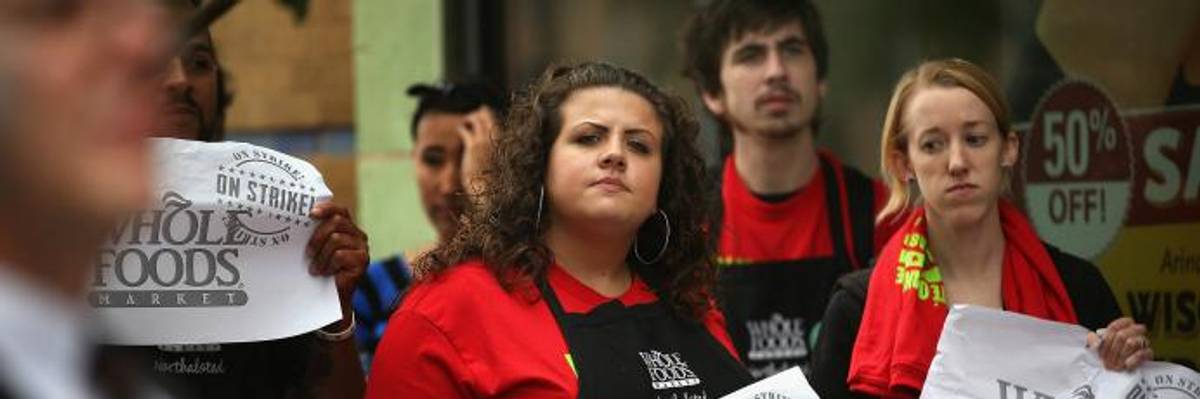
Whole Foods Market employees and union activists protested on July 31, 2013 outside a Whole Foods Market store in Chicago, Illinois. (Photo: Scott Olson/Getty Images)
Whole Foods Market employees are seeking a union to battle anti-worker tactics by Amazon--which acquired the grocery chain last year and is run by the richest man in the world--warning that the company is "self cannibalizing" and "they want us to become robots."
"Store teams used to make more. We had much better pay and were taking more money on our paychecks than we were making from our hourly wage when the company was successful, when it wasn't self cannibalizing, when everybody had the tools to do their job."
--Whole Foods worker"No one trusts Amazon and there are fears in upper management that Amazon will clean house if sales rates aren't hit," a founder of the Whole Worker community told the Guardian in an article published Monday. "They're squeezing all they can out of the workers."
Those interviewed didn't want their names printed, according to the Guardian, because they fear retaliation from managers trained watch for "warning signs" of organizing, such as employees socializing outside of work or using what the company called "union words" like "living wage."
Unnamed employees from stores in multiple states shared how Amazon's acquisition of Whole Foods has impacted them and their work environments:
Even before the Amazon acquisition, Whole Foods had a history of union-busting and implemented policies such as the order-to-shelf system, which critics say aims to make workers "interchangeable." But those who spoke to the Guardian and members of the Whole Worker community argue that some of Amazon's moves have been bad for both employees and business.
"Local and specialty products have been cut and replaced with more conventional mainstream ones, and regional marketing and sign making has been removed," a California worker told the Guardian. "We are losing the shopper and team members who helped make us who we were."
"Corporations keep getting tax incentives, but when you don't raise wages and you need two jobs just to make a living, what's the point? We're not getting anywhere as a society."
--Whole Foods organizerAn Illinois-based employee who helps coordinate the Whole Worker community noted: "We work for the wealthiest man in the world and our stores can't afford to hire. If you actually want to build sales and increase market share, you need to spend the money to get it done."
"Corporations keep getting tax incentives, but when you don't raise wages and you need two jobs just to make a living, what's the point?" the Illinois employee added. "We're not getting anywhere as a society.
While Amazon attempts to quash organizing in Whole Foods stores nationwide--assuring managers in a training video that leaked last week that the law "protects" them when sharing "opinions" such as "unions are lying, cheating rats" to discourage workers from forming a union--efforts continue to improve working and living conditions for Whole Foods and Amazon employees.
Noting that "over the past year, layoffs, and the consolidation of store level positions at Whole Foods Market have upset the livelihood of team members, stirred anxiety, and lowered [morale] within stores," the Whole Worker community emailed employees on Sept. 6 to call for the formation of a union, warning that "there will continue to be layoffs in 2019 and beyond as Amazon aims to aggressively trim our labor force before it expands with new technology and labor models."
With a clear jab at Amazon chief executive Jeff Bezos, Sen. Bernie Sanders (I-Vt.) and Rep. Ro Khanna (D-Calif.) last month introduced the Stop BEZOS Act, which would impose a "corporate welfare tax" on major corporations to pay for the public assistance their employees require due to low wages and inadequate benefits.
Praising Scottish First Minister Nicola Sturgeon's recent decision to pull millions of dollars in grants from Amazon unless it pays workers in the country a living wage, Sanders on Monday called for the U.S. government to pursue the same tactic:
Dear Common Dreams reader, It’s been nearly 30 years since I co-founded Common Dreams with my late wife, Lina Newhouser. We had the radical notion that journalism should serve the public good, not corporate profits. It was clear to us from the outset what it would take to build such a project. No paid advertisements. No corporate sponsors. No millionaire publisher telling us what to think or do. Many people said we wouldn't last a year, but we proved those doubters wrong. Together with a tremendous team of journalists and dedicated staff, we built an independent media outlet free from the constraints of profits and corporate control. Our mission has always been simple: To inform. To inspire. To ignite change for the common good. Building Common Dreams was not easy. Our survival was never guaranteed. When you take on the most powerful forces—Wall Street greed, fossil fuel industry destruction, Big Tech lobbyists, and uber-rich oligarchs who have spent billions upon billions rigging the economy and democracy in their favor—the only bulwark you have is supporters who believe in your work. But here’s the urgent message from me today. It's never been this bad out there. And it's never been this hard to keep us going. At the very moment Common Dreams is most needed, the threats we face are intensifying. We need your support now more than ever. We don't accept corporate advertising and never will. We don't have a paywall because we don't think people should be blocked from critical news based on their ability to pay. Everything we do is funded by the donations of readers like you. When everyone does the little they can afford, we are strong. But if that support retreats or dries up, so do we. Will you donate now to make sure Common Dreams not only survives but thrives? —Craig Brown, Co-founder |
Whole Foods Market employees are seeking a union to battle anti-worker tactics by Amazon--which acquired the grocery chain last year and is run by the richest man in the world--warning that the company is "self cannibalizing" and "they want us to become robots."
"Store teams used to make more. We had much better pay and were taking more money on our paychecks than we were making from our hourly wage when the company was successful, when it wasn't self cannibalizing, when everybody had the tools to do their job."
--Whole Foods worker"No one trusts Amazon and there are fears in upper management that Amazon will clean house if sales rates aren't hit," a founder of the Whole Worker community told the Guardian in an article published Monday. "They're squeezing all they can out of the workers."
Those interviewed didn't want their names printed, according to the Guardian, because they fear retaliation from managers trained watch for "warning signs" of organizing, such as employees socializing outside of work or using what the company called "union words" like "living wage."
Unnamed employees from stores in multiple states shared how Amazon's acquisition of Whole Foods has impacted them and their work environments:
Even before the Amazon acquisition, Whole Foods had a history of union-busting and implemented policies such as the order-to-shelf system, which critics say aims to make workers "interchangeable." But those who spoke to the Guardian and members of the Whole Worker community argue that some of Amazon's moves have been bad for both employees and business.
"Local and specialty products have been cut and replaced with more conventional mainstream ones, and regional marketing and sign making has been removed," a California worker told the Guardian. "We are losing the shopper and team members who helped make us who we were."
"Corporations keep getting tax incentives, but when you don't raise wages and you need two jobs just to make a living, what's the point? We're not getting anywhere as a society."
--Whole Foods organizerAn Illinois-based employee who helps coordinate the Whole Worker community noted: "We work for the wealthiest man in the world and our stores can't afford to hire. If you actually want to build sales and increase market share, you need to spend the money to get it done."
"Corporations keep getting tax incentives, but when you don't raise wages and you need two jobs just to make a living, what's the point?" the Illinois employee added. "We're not getting anywhere as a society.
While Amazon attempts to quash organizing in Whole Foods stores nationwide--assuring managers in a training video that leaked last week that the law "protects" them when sharing "opinions" such as "unions are lying, cheating rats" to discourage workers from forming a union--efforts continue to improve working and living conditions for Whole Foods and Amazon employees.
Noting that "over the past year, layoffs, and the consolidation of store level positions at Whole Foods Market have upset the livelihood of team members, stirred anxiety, and lowered [morale] within stores," the Whole Worker community emailed employees on Sept. 6 to call for the formation of a union, warning that "there will continue to be layoffs in 2019 and beyond as Amazon aims to aggressively trim our labor force before it expands with new technology and labor models."
With a clear jab at Amazon chief executive Jeff Bezos, Sen. Bernie Sanders (I-Vt.) and Rep. Ro Khanna (D-Calif.) last month introduced the Stop BEZOS Act, which would impose a "corporate welfare tax" on major corporations to pay for the public assistance their employees require due to low wages and inadequate benefits.
Praising Scottish First Minister Nicola Sturgeon's recent decision to pull millions of dollars in grants from Amazon unless it pays workers in the country a living wage, Sanders on Monday called for the U.S. government to pursue the same tactic:
Whole Foods Market employees are seeking a union to battle anti-worker tactics by Amazon--which acquired the grocery chain last year and is run by the richest man in the world--warning that the company is "self cannibalizing" and "they want us to become robots."
"Store teams used to make more. We had much better pay and were taking more money on our paychecks than we were making from our hourly wage when the company was successful, when it wasn't self cannibalizing, when everybody had the tools to do their job."
--Whole Foods worker"No one trusts Amazon and there are fears in upper management that Amazon will clean house if sales rates aren't hit," a founder of the Whole Worker community told the Guardian in an article published Monday. "They're squeezing all they can out of the workers."
Those interviewed didn't want their names printed, according to the Guardian, because they fear retaliation from managers trained watch for "warning signs" of organizing, such as employees socializing outside of work or using what the company called "union words" like "living wage."
Unnamed employees from stores in multiple states shared how Amazon's acquisition of Whole Foods has impacted them and their work environments:
Even before the Amazon acquisition, Whole Foods had a history of union-busting and implemented policies such as the order-to-shelf system, which critics say aims to make workers "interchangeable." But those who spoke to the Guardian and members of the Whole Worker community argue that some of Amazon's moves have been bad for both employees and business.
"Local and specialty products have been cut and replaced with more conventional mainstream ones, and regional marketing and sign making has been removed," a California worker told the Guardian. "We are losing the shopper and team members who helped make us who we were."
"Corporations keep getting tax incentives, but when you don't raise wages and you need two jobs just to make a living, what's the point? We're not getting anywhere as a society."
--Whole Foods organizerAn Illinois-based employee who helps coordinate the Whole Worker community noted: "We work for the wealthiest man in the world and our stores can't afford to hire. If you actually want to build sales and increase market share, you need to spend the money to get it done."
"Corporations keep getting tax incentives, but when you don't raise wages and you need two jobs just to make a living, what's the point?" the Illinois employee added. "We're not getting anywhere as a society.
While Amazon attempts to quash organizing in Whole Foods stores nationwide--assuring managers in a training video that leaked last week that the law "protects" them when sharing "opinions" such as "unions are lying, cheating rats" to discourage workers from forming a union--efforts continue to improve working and living conditions for Whole Foods and Amazon employees.
Noting that "over the past year, layoffs, and the consolidation of store level positions at Whole Foods Market have upset the livelihood of team members, stirred anxiety, and lowered [morale] within stores," the Whole Worker community emailed employees on Sept. 6 to call for the formation of a union, warning that "there will continue to be layoffs in 2019 and beyond as Amazon aims to aggressively trim our labor force before it expands with new technology and labor models."
With a clear jab at Amazon chief executive Jeff Bezos, Sen. Bernie Sanders (I-Vt.) and Rep. Ro Khanna (D-Calif.) last month introduced the Stop BEZOS Act, which would impose a "corporate welfare tax" on major corporations to pay for the public assistance their employees require due to low wages and inadequate benefits.
Praising Scottish First Minister Nicola Sturgeon's recent decision to pull millions of dollars in grants from Amazon unless it pays workers in the country a living wage, Sanders on Monday called for the U.S. government to pursue the same tactic: