SUBSCRIBE TO OUR FREE NEWSLETTER
Daily news & progressive opinion—funded by the people, not the corporations—delivered straight to your inbox.
5
#000000
#FFFFFF
To donate by check, phone, or other method, see our More Ways to Give page.
Daily news & progressive opinion—funded by the people, not the corporations—delivered straight to your inbox.
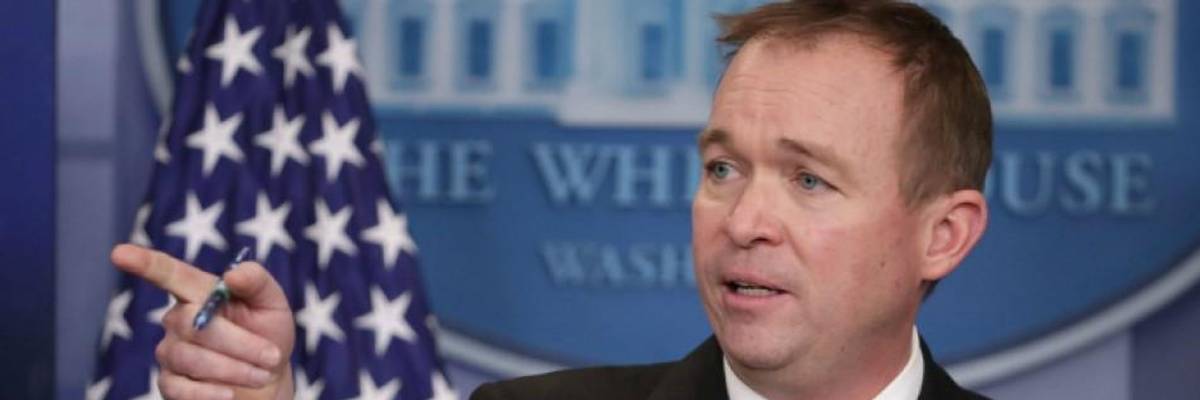
Mick Mulvaney, Acting Director of the Consumer Finanical Protection Bureau, takes questions from reporters during a briefing at the White House on March 16, 2017. (Photo: Chip Somodevilla/Getty Images)
In a "scathing" resignation letter reported by multiple news outlets on Monday, the former student loan ombudsman at the Consumer Financial Protection Bureau (CFPB), Seth Frotman, charged that under the Trump administration, the agency's leadership "has turned its back on young people and their financial futures."
"Unfortunately, under your leadership, the bureau has abandoned the very consumers it is tasked by Congress with protecting. Instead, you have used the bureau to serve the wishes of the most powerful financial companies in America."
--ombudsman's resignation letter
Since taking over as acting director of the CFPB last year, Mick Mulvaney--who also runs the Office of Management and Budget (OMB)--has worked to "quietly sabotage" the agency that federal lawmakers established after the 2007-08 financial crisis to protect consumers from industry abuses.
"Unfortunately, under your leadership, the bureau has abandoned the very consumers it is tasked by Congress with protecting," Frotman's resignation letter declares. "Instead, you have used the bureau to serve the wishes of the most powerful financial companies in America."
His letter asserts that "the bureau's new political leadership has repeatedly undercut and undermined career CFPB staff working to secure relief for consumers," and concludes, "It is clear that current leadership of the bureau has abandoned its duty to fairly and robustly enforce the law."
Among the specific complaints detailed in the letter, Frotman says agency leadership blocked a student loan office report revealing how major U.S. banks were "saddling [students] with legally dubious account fees" as well as "attempts to alert the Department of Education to the far-reaching harm borrowers will face due to the department's unprecedented and illegal attempts to preempt state consumer laws and shield student loan companies from accountability for widespread abuses."
As NPR, which obtained a copy of Frotman's letter, reports:
Last August, the U.S. Department of Education announced it would stop sharing information with the bureau about the department's oversight of federal student loans, calling the CFPB "overreaching and unaccountable" and arguing that the bureau's actions were confusing borrowers and loan servicers alike. Of the move, Frotman writes, "the bureau's current leadership folded to political pressure... and failed borrowers who depend on independent oversight to halt bad practices."
In May, Mulvaney called for a major shake-up in Frotman's division. The Office for Students and Young Consumers would be folded into the bureau's financial education office, signaling a symbolic shift in mission from investigation to information-sharing. While the CFPB told NPR at the time that the move was "a very modest organizational chart change," consumer advocates reacted with alarm.
Christopher Peterson, director of financial services at the non-profit Consumer Federation of America, called the move "an appalling step in a longer march toward the elimination of meaningful American consumer protection law."
Congress established the student loan ombudsman position along with the CFPB as part of the Dodd-Frank Wall Street Reform and Consumer Protection Act in 2010. Since that time, the agency has fielded more than 60,000 student loan complaints and returned $750 million to aggrieved borrowers.
Frotman has been with the agency since its creation, and has served as the ombudsman for the nation's $1.5 trillion student loan market since 2016. He will be stepping down at the end of this week, according to The Associated Press.
Noting that the Trump administration "has shirked its responsibility to protect student borrowers, choosing instead to coddle the for-profit colleges and rogue loan servicers," Randi Weingarten, president of the American Federation of Teachers (AFT), said Monday, "While we commend Seth's decision, we mourn the attacks on the CFPB and demand an end to the politicization of this vital agency."
"AFT members have benefited enormously from Seth's work," Weingarten added. "The CFPB was the place we directed members to who ran into problems getting their servicers to communicate clearly and accurately (or at all), and it regularly helped resolve problems our members encountered."
However, "the bureau's central role in assisting student debtors has been terminated by this administration," she explained, and now "there is literally nowhere to send people who have these problems, other than into the legal system."
President Donald Trump's controversial nominee to replace Mulvaney, Kathy Kraninger--who serves under Mulvaney at OMB--is currently awaiting a confirmation vote in the Senate. If confirmed, Kraninger is expected to continue her predecessor's efforts to gut the agency.
This post has been updated with comment from the American Federation of Teachers (AFT).
Dear Common Dreams reader, It’s been nearly 30 years since I co-founded Common Dreams with my late wife, Lina Newhouser. We had the radical notion that journalism should serve the public good, not corporate profits. It was clear to us from the outset what it would take to build such a project. No paid advertisements. No corporate sponsors. No millionaire publisher telling us what to think or do. Many people said we wouldn't last a year, but we proved those doubters wrong. Together with a tremendous team of journalists and dedicated staff, we built an independent media outlet free from the constraints of profits and corporate control. Our mission has always been simple: To inform. To inspire. To ignite change for the common good. Building Common Dreams was not easy. Our survival was never guaranteed. When you take on the most powerful forces—Wall Street greed, fossil fuel industry destruction, Big Tech lobbyists, and uber-rich oligarchs who have spent billions upon billions rigging the economy and democracy in their favor—the only bulwark you have is supporters who believe in your work. But here’s the urgent message from me today. It's never been this bad out there. And it's never been this hard to keep us going. At the very moment Common Dreams is most needed, the threats we face are intensifying. We need your support now more than ever. We don't accept corporate advertising and never will. We don't have a paywall because we don't think people should be blocked from critical news based on their ability to pay. Everything we do is funded by the donations of readers like you. When everyone does the little they can afford, we are strong. But if that support retreats or dries up, so do we. Will you donate now to make sure Common Dreams not only survives but thrives? —Craig Brown, Co-founder |
In a "scathing" resignation letter reported by multiple news outlets on Monday, the former student loan ombudsman at the Consumer Financial Protection Bureau (CFPB), Seth Frotman, charged that under the Trump administration, the agency's leadership "has turned its back on young people and their financial futures."
"Unfortunately, under your leadership, the bureau has abandoned the very consumers it is tasked by Congress with protecting. Instead, you have used the bureau to serve the wishes of the most powerful financial companies in America."
--ombudsman's resignation letter
Since taking over as acting director of the CFPB last year, Mick Mulvaney--who also runs the Office of Management and Budget (OMB)--has worked to "quietly sabotage" the agency that federal lawmakers established after the 2007-08 financial crisis to protect consumers from industry abuses.
"Unfortunately, under your leadership, the bureau has abandoned the very consumers it is tasked by Congress with protecting," Frotman's resignation letter declares. "Instead, you have used the bureau to serve the wishes of the most powerful financial companies in America."
His letter asserts that "the bureau's new political leadership has repeatedly undercut and undermined career CFPB staff working to secure relief for consumers," and concludes, "It is clear that current leadership of the bureau has abandoned its duty to fairly and robustly enforce the law."
Among the specific complaints detailed in the letter, Frotman says agency leadership blocked a student loan office report revealing how major U.S. banks were "saddling [students] with legally dubious account fees" as well as "attempts to alert the Department of Education to the far-reaching harm borrowers will face due to the department's unprecedented and illegal attempts to preempt state consumer laws and shield student loan companies from accountability for widespread abuses."
As NPR, which obtained a copy of Frotman's letter, reports:
Last August, the U.S. Department of Education announced it would stop sharing information with the bureau about the department's oversight of federal student loans, calling the CFPB "overreaching and unaccountable" and arguing that the bureau's actions were confusing borrowers and loan servicers alike. Of the move, Frotman writes, "the bureau's current leadership folded to political pressure... and failed borrowers who depend on independent oversight to halt bad practices."
In May, Mulvaney called for a major shake-up in Frotman's division. The Office for Students and Young Consumers would be folded into the bureau's financial education office, signaling a symbolic shift in mission from investigation to information-sharing. While the CFPB told NPR at the time that the move was "a very modest organizational chart change," consumer advocates reacted with alarm.
Christopher Peterson, director of financial services at the non-profit Consumer Federation of America, called the move "an appalling step in a longer march toward the elimination of meaningful American consumer protection law."
Congress established the student loan ombudsman position along with the CFPB as part of the Dodd-Frank Wall Street Reform and Consumer Protection Act in 2010. Since that time, the agency has fielded more than 60,000 student loan complaints and returned $750 million to aggrieved borrowers.
Frotman has been with the agency since its creation, and has served as the ombudsman for the nation's $1.5 trillion student loan market since 2016. He will be stepping down at the end of this week, according to The Associated Press.
Noting that the Trump administration "has shirked its responsibility to protect student borrowers, choosing instead to coddle the for-profit colleges and rogue loan servicers," Randi Weingarten, president of the American Federation of Teachers (AFT), said Monday, "While we commend Seth's decision, we mourn the attacks on the CFPB and demand an end to the politicization of this vital agency."
"AFT members have benefited enormously from Seth's work," Weingarten added. "The CFPB was the place we directed members to who ran into problems getting their servicers to communicate clearly and accurately (or at all), and it regularly helped resolve problems our members encountered."
However, "the bureau's central role in assisting student debtors has been terminated by this administration," she explained, and now "there is literally nowhere to send people who have these problems, other than into the legal system."
President Donald Trump's controversial nominee to replace Mulvaney, Kathy Kraninger--who serves under Mulvaney at OMB--is currently awaiting a confirmation vote in the Senate. If confirmed, Kraninger is expected to continue her predecessor's efforts to gut the agency.
This post has been updated with comment from the American Federation of Teachers (AFT).
In a "scathing" resignation letter reported by multiple news outlets on Monday, the former student loan ombudsman at the Consumer Financial Protection Bureau (CFPB), Seth Frotman, charged that under the Trump administration, the agency's leadership "has turned its back on young people and their financial futures."
"Unfortunately, under your leadership, the bureau has abandoned the very consumers it is tasked by Congress with protecting. Instead, you have used the bureau to serve the wishes of the most powerful financial companies in America."
--ombudsman's resignation letter
Since taking over as acting director of the CFPB last year, Mick Mulvaney--who also runs the Office of Management and Budget (OMB)--has worked to "quietly sabotage" the agency that federal lawmakers established after the 2007-08 financial crisis to protect consumers from industry abuses.
"Unfortunately, under your leadership, the bureau has abandoned the very consumers it is tasked by Congress with protecting," Frotman's resignation letter declares. "Instead, you have used the bureau to serve the wishes of the most powerful financial companies in America."
His letter asserts that "the bureau's new political leadership has repeatedly undercut and undermined career CFPB staff working to secure relief for consumers," and concludes, "It is clear that current leadership of the bureau has abandoned its duty to fairly and robustly enforce the law."
Among the specific complaints detailed in the letter, Frotman says agency leadership blocked a student loan office report revealing how major U.S. banks were "saddling [students] with legally dubious account fees" as well as "attempts to alert the Department of Education to the far-reaching harm borrowers will face due to the department's unprecedented and illegal attempts to preempt state consumer laws and shield student loan companies from accountability for widespread abuses."
As NPR, which obtained a copy of Frotman's letter, reports:
Last August, the U.S. Department of Education announced it would stop sharing information with the bureau about the department's oversight of federal student loans, calling the CFPB "overreaching and unaccountable" and arguing that the bureau's actions were confusing borrowers and loan servicers alike. Of the move, Frotman writes, "the bureau's current leadership folded to political pressure... and failed borrowers who depend on independent oversight to halt bad practices."
In May, Mulvaney called for a major shake-up in Frotman's division. The Office for Students and Young Consumers would be folded into the bureau's financial education office, signaling a symbolic shift in mission from investigation to information-sharing. While the CFPB told NPR at the time that the move was "a very modest organizational chart change," consumer advocates reacted with alarm.
Christopher Peterson, director of financial services at the non-profit Consumer Federation of America, called the move "an appalling step in a longer march toward the elimination of meaningful American consumer protection law."
Congress established the student loan ombudsman position along with the CFPB as part of the Dodd-Frank Wall Street Reform and Consumer Protection Act in 2010. Since that time, the agency has fielded more than 60,000 student loan complaints and returned $750 million to aggrieved borrowers.
Frotman has been with the agency since its creation, and has served as the ombudsman for the nation's $1.5 trillion student loan market since 2016. He will be stepping down at the end of this week, according to The Associated Press.
Noting that the Trump administration "has shirked its responsibility to protect student borrowers, choosing instead to coddle the for-profit colleges and rogue loan servicers," Randi Weingarten, president of the American Federation of Teachers (AFT), said Monday, "While we commend Seth's decision, we mourn the attacks on the CFPB and demand an end to the politicization of this vital agency."
"AFT members have benefited enormously from Seth's work," Weingarten added. "The CFPB was the place we directed members to who ran into problems getting their servicers to communicate clearly and accurately (or at all), and it regularly helped resolve problems our members encountered."
However, "the bureau's central role in assisting student debtors has been terminated by this administration," she explained, and now "there is literally nowhere to send people who have these problems, other than into the legal system."
President Donald Trump's controversial nominee to replace Mulvaney, Kathy Kraninger--who serves under Mulvaney at OMB--is currently awaiting a confirmation vote in the Senate. If confirmed, Kraninger is expected to continue her predecessor's efforts to gut the agency.
This post has been updated with comment from the American Federation of Teachers (AFT).