SUBSCRIBE TO OUR FREE NEWSLETTER
Daily news & progressive opinion—funded by the people, not the corporations—delivered straight to your inbox.
5
#000000
#FFFFFF
To donate by check, phone, or other method, see our More Ways to Give page.
Daily news & progressive opinion—funded by the people, not the corporations—delivered straight to your inbox.
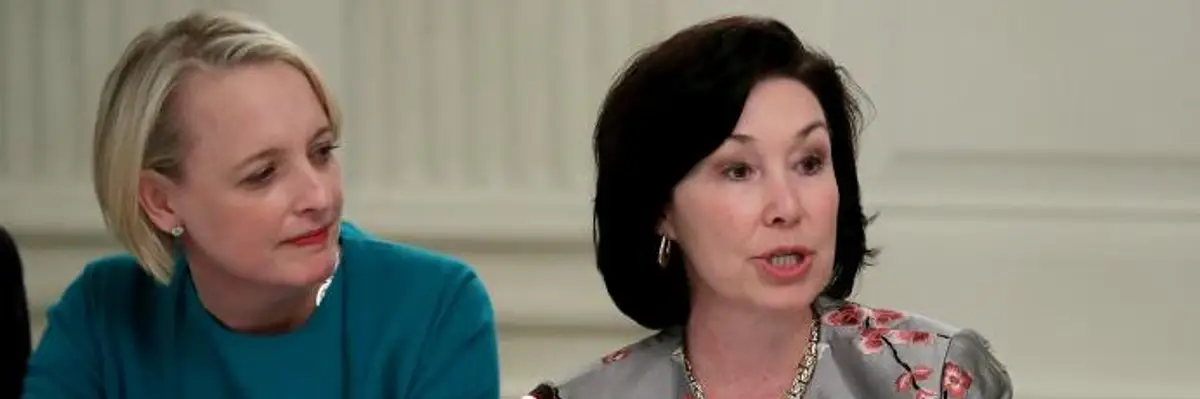
Oracle Co-CEO Safra Catz, right, has reportedly sold $250 million worth of shares in her company since the GOP tax cuts were passed in December. (Photo: Chip Somodevilla/Getty Images)
While workers' wages have steadily declined since congressional Republicans and President Donald Trump pushed through massive tax cuts for corporations and wealthy Americans in December, a new Politico analysis finds that rather than using their savings to raise employee pay or create jobs, companies are generating "eye-popping payouts" for executives with a record-breaking stock buyback "bonanza."
"What does Trump's tax plan accomplish? Make the very, very rich much richer. What a disgrace."
--Sen. Bernie SandersWhen a public company buys back stock, the value of shares spikes, enabling corporate executives "who often receive most of their compensation in stock" to sell their shares at higher rates and rake in more money.
Politico's review of Securities and Exchange Commission (SEC) filings shows that executives "have been profiting handsomely by selling shares" since the tax law took effect, and according to Wall Street experts, "that trend is likely to increase." As Pat McGurn of the advisory firm Institutional Shareholder Services put it, "It is going to be a parade of eye-popping numbers."
The report notes that more than a quarter of S&P 500 companies have disclosed plans to return some tax savings to shareholders and that in the first half of 2018 alone, public companies have announced a record $600 billion in buybacks--which, until 1982, were considered stock market manipulation and thus illegal.
For example, as Politico outlines:
Since the tax cuts were enacted, Oracle Corp. CEO Safra Catz has sold $250 million worth of shares in her company--the largest executive payday this year. Product development head Thomas Kurian sold $85 million. The sales came after the company announced a $12 billion share repurchase.
Mastercard CEO Ajay Banga sold $44.4 million of stock in May, the largest single cash-out by an executive of the company in at least 10 years, months after the company announced a $4 billion buyback of its own stock.
Two days after Eastman Chemical announced it would purchase $2 billion of its own stock, CEO Mark Costa sold 55,000 shares for $5.4 million.
Although some corporations and executives insist that recent buybacks and stock sales have long been planned and aren't related to the GOP's "tax scam," the developments are fulfilling warnings from progressive tax experts that the Republicans' tax overhaul would line the pockets of the 1% at the expense of working families.
The report, though unsurprising, provoked immediate outrage. Sen. Bernie Sanders (I-Vt.) noted the number of Americans that are living in poverty, or without healthcare or retirement savings, and concluded, "What a disgrace."
Progressive congressional candidate Randy "Ironstache" Bryce, who is running to represent outgoing Republican House Speaker Paul Ryan's Wisconsin district, pointed out, "This was the plan all along."
The Politico analysis comes on the heels of findings published last week by Axios that CEO pay is often much higher than the massive numbers that are reported, "due almost entirely to the huge gains they reap from the stock market."
Dear Common Dreams reader, It’s been nearly 30 years since I co-founded Common Dreams with my late wife, Lina Newhouser. We had the radical notion that journalism should serve the public good, not corporate profits. It was clear to us from the outset what it would take to build such a project. No paid advertisements. No corporate sponsors. No millionaire publisher telling us what to think or do. Many people said we wouldn't last a year, but we proved those doubters wrong. Together with a tremendous team of journalists and dedicated staff, we built an independent media outlet free from the constraints of profits and corporate control. Our mission has always been simple: To inform. To inspire. To ignite change for the common good. Building Common Dreams was not easy. Our survival was never guaranteed. When you take on the most powerful forces—Wall Street greed, fossil fuel industry destruction, Big Tech lobbyists, and uber-rich oligarchs who have spent billions upon billions rigging the economy and democracy in their favor—the only bulwark you have is supporters who believe in your work. But here’s the urgent message from me today. It's never been this bad out there. And it's never been this hard to keep us going. At the very moment Common Dreams is most needed, the threats we face are intensifying. We need your support now more than ever. We don't accept corporate advertising and never will. We don't have a paywall because we don't think people should be blocked from critical news based on their ability to pay. Everything we do is funded by the donations of readers like you. When everyone does the little they can afford, we are strong. But if that support retreats or dries up, so do we. Will you donate now to make sure Common Dreams not only survives but thrives? —Craig Brown, Co-founder |
While workers' wages have steadily declined since congressional Republicans and President Donald Trump pushed through massive tax cuts for corporations and wealthy Americans in December, a new Politico analysis finds that rather than using their savings to raise employee pay or create jobs, companies are generating "eye-popping payouts" for executives with a record-breaking stock buyback "bonanza."
"What does Trump's tax plan accomplish? Make the very, very rich much richer. What a disgrace."
--Sen. Bernie SandersWhen a public company buys back stock, the value of shares spikes, enabling corporate executives "who often receive most of their compensation in stock" to sell their shares at higher rates and rake in more money.
Politico's review of Securities and Exchange Commission (SEC) filings shows that executives "have been profiting handsomely by selling shares" since the tax law took effect, and according to Wall Street experts, "that trend is likely to increase." As Pat McGurn of the advisory firm Institutional Shareholder Services put it, "It is going to be a parade of eye-popping numbers."
The report notes that more than a quarter of S&P 500 companies have disclosed plans to return some tax savings to shareholders and that in the first half of 2018 alone, public companies have announced a record $600 billion in buybacks--which, until 1982, were considered stock market manipulation and thus illegal.
For example, as Politico outlines:
Since the tax cuts were enacted, Oracle Corp. CEO Safra Catz has sold $250 million worth of shares in her company--the largest executive payday this year. Product development head Thomas Kurian sold $85 million. The sales came after the company announced a $12 billion share repurchase.
Mastercard CEO Ajay Banga sold $44.4 million of stock in May, the largest single cash-out by an executive of the company in at least 10 years, months after the company announced a $4 billion buyback of its own stock.
Two days after Eastman Chemical announced it would purchase $2 billion of its own stock, CEO Mark Costa sold 55,000 shares for $5.4 million.
Although some corporations and executives insist that recent buybacks and stock sales have long been planned and aren't related to the GOP's "tax scam," the developments are fulfilling warnings from progressive tax experts that the Republicans' tax overhaul would line the pockets of the 1% at the expense of working families.
The report, though unsurprising, provoked immediate outrage. Sen. Bernie Sanders (I-Vt.) noted the number of Americans that are living in poverty, or without healthcare or retirement savings, and concluded, "What a disgrace."
Progressive congressional candidate Randy "Ironstache" Bryce, who is running to represent outgoing Republican House Speaker Paul Ryan's Wisconsin district, pointed out, "This was the plan all along."
The Politico analysis comes on the heels of findings published last week by Axios that CEO pay is often much higher than the massive numbers that are reported, "due almost entirely to the huge gains they reap from the stock market."
While workers' wages have steadily declined since congressional Republicans and President Donald Trump pushed through massive tax cuts for corporations and wealthy Americans in December, a new Politico analysis finds that rather than using their savings to raise employee pay or create jobs, companies are generating "eye-popping payouts" for executives with a record-breaking stock buyback "bonanza."
"What does Trump's tax plan accomplish? Make the very, very rich much richer. What a disgrace."
--Sen. Bernie SandersWhen a public company buys back stock, the value of shares spikes, enabling corporate executives "who often receive most of their compensation in stock" to sell their shares at higher rates and rake in more money.
Politico's review of Securities and Exchange Commission (SEC) filings shows that executives "have been profiting handsomely by selling shares" since the tax law took effect, and according to Wall Street experts, "that trend is likely to increase." As Pat McGurn of the advisory firm Institutional Shareholder Services put it, "It is going to be a parade of eye-popping numbers."
The report notes that more than a quarter of S&P 500 companies have disclosed plans to return some tax savings to shareholders and that in the first half of 2018 alone, public companies have announced a record $600 billion in buybacks--which, until 1982, were considered stock market manipulation and thus illegal.
For example, as Politico outlines:
Since the tax cuts were enacted, Oracle Corp. CEO Safra Catz has sold $250 million worth of shares in her company--the largest executive payday this year. Product development head Thomas Kurian sold $85 million. The sales came after the company announced a $12 billion share repurchase.
Mastercard CEO Ajay Banga sold $44.4 million of stock in May, the largest single cash-out by an executive of the company in at least 10 years, months after the company announced a $4 billion buyback of its own stock.
Two days after Eastman Chemical announced it would purchase $2 billion of its own stock, CEO Mark Costa sold 55,000 shares for $5.4 million.
Although some corporations and executives insist that recent buybacks and stock sales have long been planned and aren't related to the GOP's "tax scam," the developments are fulfilling warnings from progressive tax experts that the Republicans' tax overhaul would line the pockets of the 1% at the expense of working families.
The report, though unsurprising, provoked immediate outrage. Sen. Bernie Sanders (I-Vt.) noted the number of Americans that are living in poverty, or without healthcare or retirement savings, and concluded, "What a disgrace."
Progressive congressional candidate Randy "Ironstache" Bryce, who is running to represent outgoing Republican House Speaker Paul Ryan's Wisconsin district, pointed out, "This was the plan all along."
The Politico analysis comes on the heels of findings published last week by Axios that CEO pay is often much higher than the massive numbers that are reported, "due almost entirely to the huge gains they reap from the stock market."