
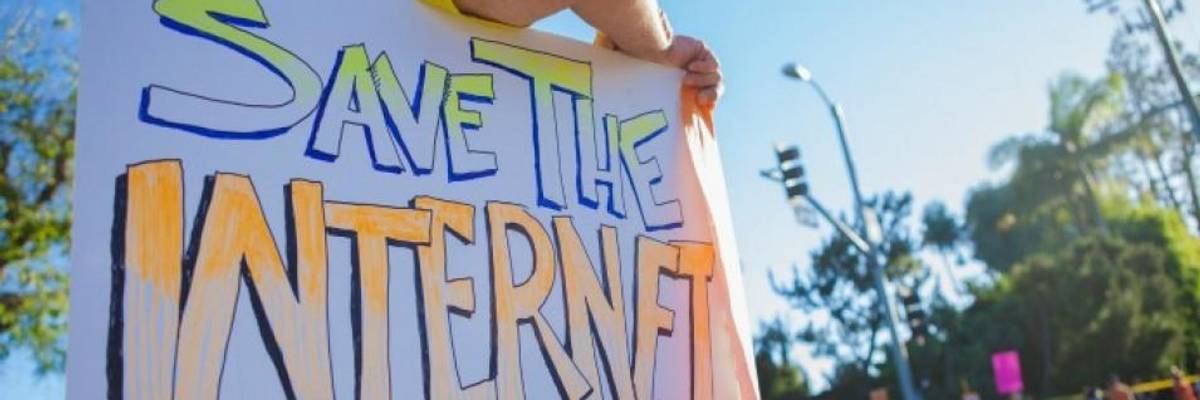
"If the federal government won't protect the internet, California will," said state Sen. Scott Wiener. (Photo: Free Press/ Free Press Action Fund/flickr/cc)
Team Internet Wins as California Bill Regains Key Net Neutrality Protections
Legislation that had been "eviscerated" just weeks ago sees key provisions restored—a development advocacy groups attribute to people power
Open internet advocates are cheering after California lawmakers on Thursday reached a deal on proposed legislation that puts the state on the path to having the strongest net neutrality bill in the nation.
The news, said Evan Greer, deputy director of Fight for the Future, "shows the power of the internet to overcome business as usual and win real victories for the public."
As the San Jose Mercury News sums up,
The effort in California, headed by state Sens. Scott Wiener, D-San Francisco, and Kevin de Leon, D-Los Angeles, seemed doomed after an Assembly committee effectively gutted SB822, Wiener's bill, a couple of weeks ago. De Leon had agreed to pair his bill, SB460, with Wiener's bill, but Assemblyman Miguel Santiago, D-Los Angeles, objected and introduced amendments to weaken SB822.
Wiener in fact declared that it became "a fake net neutrality " bill after being "mutilated" by the industry-friendly provisions of Santiago's amendments.
That development, as Katharine Trendacosta, policy analysts at the Electronic Frontier Foundation writes, sparked "an outcry from Team Internet in California, making clear how important effective, strong net neutrality protections are."
Wiener, de Leon, Santiago, and assemblymember Rob Bonta (D) were able to come together, though, to hammer out a new proposal that consolidates the two bills into one package. As Trendacosta explains, the combination goes a long way to restore the protections the large Internet Service Providers (ISPs), like Verizon and Comcast, had wanted removed:
The ban on blocking, throttling, and paid prioritization remains--paid prioritization has been a particular target of misleading ISP arguments. The ban on certain kinds of zero rating--the kinds that lead consumers to services that ISPs want them to use rather than giving them choices--also remains. And so does the ban on access fees, which means ISPs will not be able to get around these protections by charging fees at the places where data enters their networks.
"This is what real net neutrality looks like," she adds. "And it all happened because people spoke out. You sent emails, called offices, crowdfunded a billboard--all of that was heard. People's voices trumped company money this time."
Wiener, for his part, tweeted that SB822 "will have its strong protections reinstated" and "will be the strongest net neutrality law in the U.S."
"If the federal government won't protect the internet, California will," he said.
"After Donald Trump's FCC obliterated net neutrality," Wiener added in a statement, "we stepped in to protect California residents and businesses and to ensure an open internet. For months, we have worked with a broad coalition to pass strong and enforceable net neutrality protections. As internet service providers and media companies like AT&T and Time Warner consolidate, net neutrality is more important than ever."
The bill still needs approval from the legislature by the end of August, after which it would head to Gov. Jerry Brown's desk.
With that deadline in mind, Fight for the Future is encouraging constituents to call state assembly members to make sure they support the bill. "Let's keep the fight going!" the group says.
Another group applauding the new proposal is the Center for Media Justice, which stressed the importance of net neutrality to confront "the rising authoritarianism of the Trump administration."
"We are in a moment of crisis in this country with a federal administration that has demonstrated its capacity for inhumanity," Steven Renderos, the group's organizing director, said Friday. "Against this backdrop, the ability of marginalized people to dissent is of greater urgency than ever. We cannot fight to end the separation of families and to #AbolishICE if we can't be heard online."
We are at a crossroads
This country and this world are at a monumental crossroads. In a few short weeks, US voters will have an opportunity to beat back the forces of fascism and confront the billionaires who are rigging the economy, our media system, and our democracy, making it increasingly impossible for ordinary people to get by. We’re not just talking about the election. We’re talking about what must be done once these fascist elements are vanquished from power. We need a bolder set of solutions than what either major party has so far been willing to offer and a working-class movement ready to fight like hell for it. Trump didn't emerge from nowhere. The conditions that fueled MAGA authoritarianism were created by decades of radical neoliberal economic policies and a corrupt political system dominated by corporate interests. They slashed taxes on the super-rich, promising that the benefits would trickle down. They said giveaways to the corporate titans would make life more affordable for the rest of us. It was all bullshit. And when a bitter, betrayed populace searches for someone to blame, right-wing demagogues have little trouble finding scapegoats. People know when they're being lied to, but you won't hear any of this from the corporate media. Only independent journalism—powered and funded by people who believe in building a better world—can deliver truly trustworthy daily news. Our Fall Campaign is underway, and we need your help. To power our newsroom through the rest of the year, we need to raise $125,000 by midnight on October 31. So if you share our vision, please contribute whatever you can to sustain our work. |
Open internet advocates are cheering after California lawmakers on Thursday reached a deal on proposed legislation that puts the state on the path to having the strongest net neutrality bill in the nation.
The news, said Evan Greer, deputy director of Fight for the Future, "shows the power of the internet to overcome business as usual and win real victories for the public."
As the San Jose Mercury News sums up,
The effort in California, headed by state Sens. Scott Wiener, D-San Francisco, and Kevin de Leon, D-Los Angeles, seemed doomed after an Assembly committee effectively gutted SB822, Wiener's bill, a couple of weeks ago. De Leon had agreed to pair his bill, SB460, with Wiener's bill, but Assemblyman Miguel Santiago, D-Los Angeles, objected and introduced amendments to weaken SB822.
Wiener in fact declared that it became "a fake net neutrality " bill after being "mutilated" by the industry-friendly provisions of Santiago's amendments.
That development, as Katharine Trendacosta, policy analysts at the Electronic Frontier Foundation writes, sparked "an outcry from Team Internet in California, making clear how important effective, strong net neutrality protections are."
Wiener, de Leon, Santiago, and assemblymember Rob Bonta (D) were able to come together, though, to hammer out a new proposal that consolidates the two bills into one package. As Trendacosta explains, the combination goes a long way to restore the protections the large Internet Service Providers (ISPs), like Verizon and Comcast, had wanted removed:
The ban on blocking, throttling, and paid prioritization remains--paid prioritization has been a particular target of misleading ISP arguments. The ban on certain kinds of zero rating--the kinds that lead consumers to services that ISPs want them to use rather than giving them choices--also remains. And so does the ban on access fees, which means ISPs will not be able to get around these protections by charging fees at the places where data enters their networks.
"This is what real net neutrality looks like," she adds. "And it all happened because people spoke out. You sent emails, called offices, crowdfunded a billboard--all of that was heard. People's voices trumped company money this time."
Wiener, for his part, tweeted that SB822 "will have its strong protections reinstated" and "will be the strongest net neutrality law in the U.S."
"If the federal government won't protect the internet, California will," he said.
"After Donald Trump's FCC obliterated net neutrality," Wiener added in a statement, "we stepped in to protect California residents and businesses and to ensure an open internet. For months, we have worked with a broad coalition to pass strong and enforceable net neutrality protections. As internet service providers and media companies like AT&T and Time Warner consolidate, net neutrality is more important than ever."
The bill still needs approval from the legislature by the end of August, after which it would head to Gov. Jerry Brown's desk.
With that deadline in mind, Fight for the Future is encouraging constituents to call state assembly members to make sure they support the bill. "Let's keep the fight going!" the group says.
Another group applauding the new proposal is the Center for Media Justice, which stressed the importance of net neutrality to confront "the rising authoritarianism of the Trump administration."
"We are in a moment of crisis in this country with a federal administration that has demonstrated its capacity for inhumanity," Steven Renderos, the group's organizing director, said Friday. "Against this backdrop, the ability of marginalized people to dissent is of greater urgency than ever. We cannot fight to end the separation of families and to #AbolishICE if we can't be heard online."
Open internet advocates are cheering after California lawmakers on Thursday reached a deal on proposed legislation that puts the state on the path to having the strongest net neutrality bill in the nation.
The news, said Evan Greer, deputy director of Fight for the Future, "shows the power of the internet to overcome business as usual and win real victories for the public."
As the San Jose Mercury News sums up,
The effort in California, headed by state Sens. Scott Wiener, D-San Francisco, and Kevin de Leon, D-Los Angeles, seemed doomed after an Assembly committee effectively gutted SB822, Wiener's bill, a couple of weeks ago. De Leon had agreed to pair his bill, SB460, with Wiener's bill, but Assemblyman Miguel Santiago, D-Los Angeles, objected and introduced amendments to weaken SB822.
Wiener in fact declared that it became "a fake net neutrality " bill after being "mutilated" by the industry-friendly provisions of Santiago's amendments.
That development, as Katharine Trendacosta, policy analysts at the Electronic Frontier Foundation writes, sparked "an outcry from Team Internet in California, making clear how important effective, strong net neutrality protections are."
Wiener, de Leon, Santiago, and assemblymember Rob Bonta (D) were able to come together, though, to hammer out a new proposal that consolidates the two bills into one package. As Trendacosta explains, the combination goes a long way to restore the protections the large Internet Service Providers (ISPs), like Verizon and Comcast, had wanted removed:
The ban on blocking, throttling, and paid prioritization remains--paid prioritization has been a particular target of misleading ISP arguments. The ban on certain kinds of zero rating--the kinds that lead consumers to services that ISPs want them to use rather than giving them choices--also remains. And so does the ban on access fees, which means ISPs will not be able to get around these protections by charging fees at the places where data enters their networks.
"This is what real net neutrality looks like," she adds. "And it all happened because people spoke out. You sent emails, called offices, crowdfunded a billboard--all of that was heard. People's voices trumped company money this time."
Wiener, for his part, tweeted that SB822 "will have its strong protections reinstated" and "will be the strongest net neutrality law in the U.S."
"If the federal government won't protect the internet, California will," he said.
"After Donald Trump's FCC obliterated net neutrality," Wiener added in a statement, "we stepped in to protect California residents and businesses and to ensure an open internet. For months, we have worked with a broad coalition to pass strong and enforceable net neutrality protections. As internet service providers and media companies like AT&T and Time Warner consolidate, net neutrality is more important than ever."
The bill still needs approval from the legislature by the end of August, after which it would head to Gov. Jerry Brown's desk.
With that deadline in mind, Fight for the Future is encouraging constituents to call state assembly members to make sure they support the bill. "Let's keep the fight going!" the group says.
Another group applauding the new proposal is the Center for Media Justice, which stressed the importance of net neutrality to confront "the rising authoritarianism of the Trump administration."
"We are in a moment of crisis in this country with a federal administration that has demonstrated its capacity for inhumanity," Steven Renderos, the group's organizing director, said Friday. "Against this backdrop, the ability of marginalized people to dissent is of greater urgency than ever. We cannot fight to end the separation of families and to #AbolishICE if we can't be heard online."