SUBSCRIBE TO OUR FREE NEWSLETTER
Daily news & progressive opinion—funded by the people, not the corporations—delivered straight to your inbox.
5
#000000
#FFFFFF
To donate by check, phone, or other method, see our More Ways to Give page.
Daily news & progressive opinion—funded by the people, not the corporations—delivered straight to your inbox.
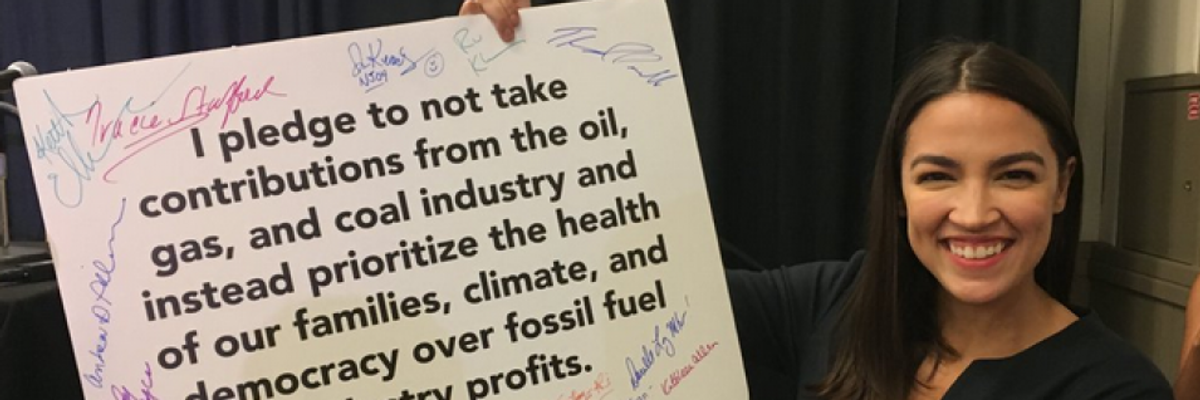
Progressive congressional candidate Alexandria Ocasio-Cortez "strongly supports transitioning the United States to a carbon-free, 100 percent renewable energy system and a fully modernized electrical grid by 2035," according to her campaign platform. (Photo: Ocasio2018 Campaign)
Alexandria Ocasio-Cortez, aka AOC, who recently won her Democratic primary to represent New York's deep blue 14th Congressional District--defeating a longtime representative who was a powerful player in the party--is running on a climate platform that is exciting scientists and constituents alike.
"A plan of the magnitude and pace proposed by Ms. Ocasio-Cortez would be a critically important step in the right direction, albeit long overdue."
--Jennifer Francis, Rutgers University
Ocasio-Cortez "strongly supports transitioning the United States to a carbon-free, 100 percent renewable energy system and a fully modernized electrical grid by 2035," which, according to her platform, she hopes to achieve by "encouraging the electrification of vehicles, sustainable home heating, distributed rooftop solar generation, and the conversion of the power grid to zero-emissions energy sources."
"It's time to shift course and implement a Green New Deal--a transformation that implements structural changes to our political and financial systems in order to alter the trajectory of our environment," the platform declares. "The Green New Deal believes that radically addressing climate change is a potential path towards a more equitable economy with increased employment and widespread financial security for all."
While reports over the past week have heralded the 28-year-old progressive candidate as the Democratic Party's next champion of climate policy, in a New Republic article published Tuesday, journalist Emily Atkins asked experts to weigh in on a plan that, as Ocasio-Cortez described it, would be "similar in scale to the mobilization efforts seen in World War II or the Marshall Plan."
"Climate scientists overwhelmingly agree that aggressive action is needed to stave off the violent storms, rising seas, and debilitating droughts projected to worsen as the climate warms," Atkins wrote. "That means rapidly decarbonizing the U.S. economy--much like Ocasio-Cortez has proposed. But for most of the climate scientists I spoke to, their alignment with Ocasio-Cortez's plan stops there."
"Climate scientists tell me Ocasio-Cortez's plan to fight climate change is 'audacious and bold,' but also half-baked. But half-baked is further along than most Democrats, who haven't even entered the oven."
--Emily Atkins, The New Republic
Simply put, experts told Atkins "the Green New Deal lacks some important details." Penn State climate scientist David Titley, who was previously a leader at NOAA, asked: "How will energy be stored as an economical cost if only using wind and solar? What is the role for nuclear power in such a plan? Who will fund this transition?"
Jennifer Francis of Rutgers University's Institute of Marine and Coastal Sciences explained that a quick transition isn't enough, because "the heat-trapping greenhouse gases already in the atmosphere will remain there for at least a century and cause additional impacts."
Thus, she continued, "the plan to convert to renewable energy sources must be accompanied by efforts and resources to develop technology that can remove carbon dioxide from the atmosphere, along with a carbon fee to discourage further extraction and burning of fossil fuels."
Even so, Francis added, "a plan of the magnitude and pace proposed by Ms. Ocasio-Cortez would be a critically important step in the right direction, albeit long overdue." Michael Mann, director of the Earth System Science Center at Penn State, said, "This is just the sort of audacious and bold thinking we will need if we are going to avert a climate crisis."
As Atkins summarized on Twitter:
Although experts believe Ocasio-Cortez's plan needs some work, as Alexander Kaufman noted for The Huffington Post, "her detailed proposals to deal with climate change could prove among the most influential at a time when the Democrats have failed to rally around any policy that could feasibly reduce greenhouse gas emissions dramatically enough to make a difference."
While some members of Congress have vowed to take action on the climate, the most promising measure--Rep. Tulsi Gabbard's (D-Hawaii) OFF Act--has been stalled in committee for months. With heat waves breaking records worldwide and wildfires tearing through the Western United States, dozens of candidates are campaigning on the promise to do more to address the climate crisis.
"We need more environmental hardliners in Congress," Ocasio-Cortez told In These Times just before her primary victory, pointing out that climate action could even rally Democrats who voted for President Donald Trump in the 2016 election but are frustrated by their experiences with the warming planet.
As she put it:
There is an electorate here that is listening. It's kind of ironic, because the areas of the district that are experiencing the worst of climate volatility right now are actually pockets of Democrats who voted for Trump. In that case, environmentalism and addressing climate change is becoming a bipartisan issue in frontline communities. They may have voted for Trump, but they are screaming at the top of their lungs that their elected officials aren't rebuilding the crumbling seawall.
Read Ocasio-Cortez's full climate platform, "Mobilizing Against Climate Change," on her website.
Dear Common Dreams reader, It’s been nearly 30 years since I co-founded Common Dreams with my late wife, Lina Newhouser. We had the radical notion that journalism should serve the public good, not corporate profits. It was clear to us from the outset what it would take to build such a project. No paid advertisements. No corporate sponsors. No millionaire publisher telling us what to think or do. Many people said we wouldn't last a year, but we proved those doubters wrong. Together with a tremendous team of journalists and dedicated staff, we built an independent media outlet free from the constraints of profits and corporate control. Our mission has always been simple: To inform. To inspire. To ignite change for the common good. Building Common Dreams was not easy. Our survival was never guaranteed. When you take on the most powerful forces—Wall Street greed, fossil fuel industry destruction, Big Tech lobbyists, and uber-rich oligarchs who have spent billions upon billions rigging the economy and democracy in their favor—the only bulwark you have is supporters who believe in your work. But here’s the urgent message from me today. It's never been this bad out there. And it's never been this hard to keep us going. At the very moment Common Dreams is most needed, the threats we face are intensifying. We need your support now more than ever. We don't accept corporate advertising and never will. We don't have a paywall because we don't think people should be blocked from critical news based on their ability to pay. Everything we do is funded by the donations of readers like you. When everyone does the little they can afford, we are strong. But if that support retreats or dries up, so do we. Will you donate now to make sure Common Dreams not only survives but thrives? —Craig Brown, Co-founder |
Alexandria Ocasio-Cortez, aka AOC, who recently won her Democratic primary to represent New York's deep blue 14th Congressional District--defeating a longtime representative who was a powerful player in the party--is running on a climate platform that is exciting scientists and constituents alike.
"A plan of the magnitude and pace proposed by Ms. Ocasio-Cortez would be a critically important step in the right direction, albeit long overdue."
--Jennifer Francis, Rutgers University
Ocasio-Cortez "strongly supports transitioning the United States to a carbon-free, 100 percent renewable energy system and a fully modernized electrical grid by 2035," which, according to her platform, she hopes to achieve by "encouraging the electrification of vehicles, sustainable home heating, distributed rooftop solar generation, and the conversion of the power grid to zero-emissions energy sources."
"It's time to shift course and implement a Green New Deal--a transformation that implements structural changes to our political and financial systems in order to alter the trajectory of our environment," the platform declares. "The Green New Deal believes that radically addressing climate change is a potential path towards a more equitable economy with increased employment and widespread financial security for all."
While reports over the past week have heralded the 28-year-old progressive candidate as the Democratic Party's next champion of climate policy, in a New Republic article published Tuesday, journalist Emily Atkins asked experts to weigh in on a plan that, as Ocasio-Cortez described it, would be "similar in scale to the mobilization efforts seen in World War II or the Marshall Plan."
"Climate scientists overwhelmingly agree that aggressive action is needed to stave off the violent storms, rising seas, and debilitating droughts projected to worsen as the climate warms," Atkins wrote. "That means rapidly decarbonizing the U.S. economy--much like Ocasio-Cortez has proposed. But for most of the climate scientists I spoke to, their alignment with Ocasio-Cortez's plan stops there."
"Climate scientists tell me Ocasio-Cortez's plan to fight climate change is 'audacious and bold,' but also half-baked. But half-baked is further along than most Democrats, who haven't even entered the oven."
--Emily Atkins, The New Republic
Simply put, experts told Atkins "the Green New Deal lacks some important details." Penn State climate scientist David Titley, who was previously a leader at NOAA, asked: "How will energy be stored as an economical cost if only using wind and solar? What is the role for nuclear power in such a plan? Who will fund this transition?"
Jennifer Francis of Rutgers University's Institute of Marine and Coastal Sciences explained that a quick transition isn't enough, because "the heat-trapping greenhouse gases already in the atmosphere will remain there for at least a century and cause additional impacts."
Thus, she continued, "the plan to convert to renewable energy sources must be accompanied by efforts and resources to develop technology that can remove carbon dioxide from the atmosphere, along with a carbon fee to discourage further extraction and burning of fossil fuels."
Even so, Francis added, "a plan of the magnitude and pace proposed by Ms. Ocasio-Cortez would be a critically important step in the right direction, albeit long overdue." Michael Mann, director of the Earth System Science Center at Penn State, said, "This is just the sort of audacious and bold thinking we will need if we are going to avert a climate crisis."
As Atkins summarized on Twitter:
Although experts believe Ocasio-Cortez's plan needs some work, as Alexander Kaufman noted for The Huffington Post, "her detailed proposals to deal with climate change could prove among the most influential at a time when the Democrats have failed to rally around any policy that could feasibly reduce greenhouse gas emissions dramatically enough to make a difference."
While some members of Congress have vowed to take action on the climate, the most promising measure--Rep. Tulsi Gabbard's (D-Hawaii) OFF Act--has been stalled in committee for months. With heat waves breaking records worldwide and wildfires tearing through the Western United States, dozens of candidates are campaigning on the promise to do more to address the climate crisis.
"We need more environmental hardliners in Congress," Ocasio-Cortez told In These Times just before her primary victory, pointing out that climate action could even rally Democrats who voted for President Donald Trump in the 2016 election but are frustrated by their experiences with the warming planet.
As she put it:
There is an electorate here that is listening. It's kind of ironic, because the areas of the district that are experiencing the worst of climate volatility right now are actually pockets of Democrats who voted for Trump. In that case, environmentalism and addressing climate change is becoming a bipartisan issue in frontline communities. They may have voted for Trump, but they are screaming at the top of their lungs that their elected officials aren't rebuilding the crumbling seawall.
Read Ocasio-Cortez's full climate platform, "Mobilizing Against Climate Change," on her website.
Alexandria Ocasio-Cortez, aka AOC, who recently won her Democratic primary to represent New York's deep blue 14th Congressional District--defeating a longtime representative who was a powerful player in the party--is running on a climate platform that is exciting scientists and constituents alike.
"A plan of the magnitude and pace proposed by Ms. Ocasio-Cortez would be a critically important step in the right direction, albeit long overdue."
--Jennifer Francis, Rutgers University
Ocasio-Cortez "strongly supports transitioning the United States to a carbon-free, 100 percent renewable energy system and a fully modernized electrical grid by 2035," which, according to her platform, she hopes to achieve by "encouraging the electrification of vehicles, sustainable home heating, distributed rooftop solar generation, and the conversion of the power grid to zero-emissions energy sources."
"It's time to shift course and implement a Green New Deal--a transformation that implements structural changes to our political and financial systems in order to alter the trajectory of our environment," the platform declares. "The Green New Deal believes that radically addressing climate change is a potential path towards a more equitable economy with increased employment and widespread financial security for all."
While reports over the past week have heralded the 28-year-old progressive candidate as the Democratic Party's next champion of climate policy, in a New Republic article published Tuesday, journalist Emily Atkins asked experts to weigh in on a plan that, as Ocasio-Cortez described it, would be "similar in scale to the mobilization efforts seen in World War II or the Marshall Plan."
"Climate scientists overwhelmingly agree that aggressive action is needed to stave off the violent storms, rising seas, and debilitating droughts projected to worsen as the climate warms," Atkins wrote. "That means rapidly decarbonizing the U.S. economy--much like Ocasio-Cortez has proposed. But for most of the climate scientists I spoke to, their alignment with Ocasio-Cortez's plan stops there."
"Climate scientists tell me Ocasio-Cortez's plan to fight climate change is 'audacious and bold,' but also half-baked. But half-baked is further along than most Democrats, who haven't even entered the oven."
--Emily Atkins, The New Republic
Simply put, experts told Atkins "the Green New Deal lacks some important details." Penn State climate scientist David Titley, who was previously a leader at NOAA, asked: "How will energy be stored as an economical cost if only using wind and solar? What is the role for nuclear power in such a plan? Who will fund this transition?"
Jennifer Francis of Rutgers University's Institute of Marine and Coastal Sciences explained that a quick transition isn't enough, because "the heat-trapping greenhouse gases already in the atmosphere will remain there for at least a century and cause additional impacts."
Thus, she continued, "the plan to convert to renewable energy sources must be accompanied by efforts and resources to develop technology that can remove carbon dioxide from the atmosphere, along with a carbon fee to discourage further extraction and burning of fossil fuels."
Even so, Francis added, "a plan of the magnitude and pace proposed by Ms. Ocasio-Cortez would be a critically important step in the right direction, albeit long overdue." Michael Mann, director of the Earth System Science Center at Penn State, said, "This is just the sort of audacious and bold thinking we will need if we are going to avert a climate crisis."
As Atkins summarized on Twitter:
Although experts believe Ocasio-Cortez's plan needs some work, as Alexander Kaufman noted for The Huffington Post, "her detailed proposals to deal with climate change could prove among the most influential at a time when the Democrats have failed to rally around any policy that could feasibly reduce greenhouse gas emissions dramatically enough to make a difference."
While some members of Congress have vowed to take action on the climate, the most promising measure--Rep. Tulsi Gabbard's (D-Hawaii) OFF Act--has been stalled in committee for months. With heat waves breaking records worldwide and wildfires tearing through the Western United States, dozens of candidates are campaigning on the promise to do more to address the climate crisis.
"We need more environmental hardliners in Congress," Ocasio-Cortez told In These Times just before her primary victory, pointing out that climate action could even rally Democrats who voted for President Donald Trump in the 2016 election but are frustrated by their experiences with the warming planet.
As she put it:
There is an electorate here that is listening. It's kind of ironic, because the areas of the district that are experiencing the worst of climate volatility right now are actually pockets of Democrats who voted for Trump. In that case, environmentalism and addressing climate change is becoming a bipartisan issue in frontline communities. They may have voted for Trump, but they are screaming at the top of their lungs that their elected officials aren't rebuilding the crumbling seawall.
Read Ocasio-Cortez's full climate platform, "Mobilizing Against Climate Change," on her website.