SUBSCRIBE TO OUR FREE NEWSLETTER
Daily news & progressive opinion—funded by the people, not the corporations—delivered straight to your inbox.
5
#000000
#FFFFFF
To donate by check, phone, or other method, see our More Ways to Give page.
Daily news & progressive opinion—funded by the people, not the corporations—delivered straight to your inbox.
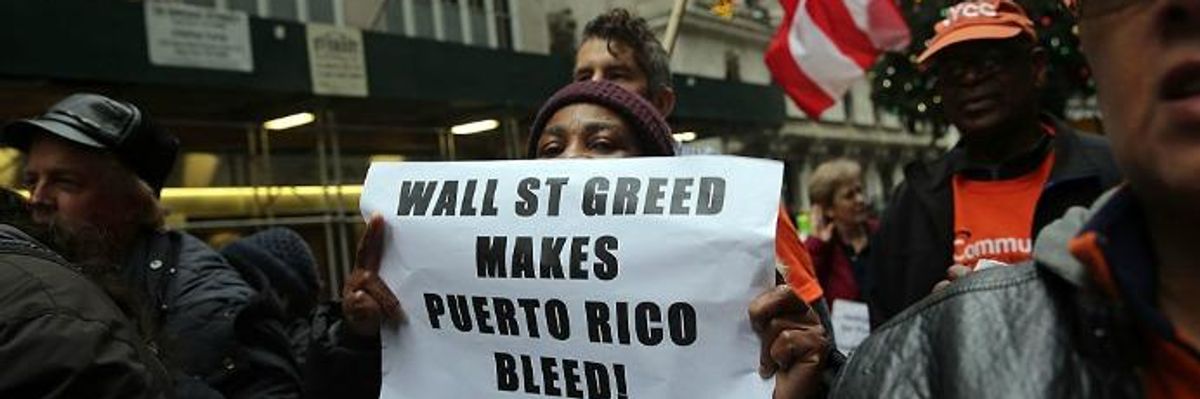
People protest outside of Wall Street against cutbacks and austerity measures forced onto the severely indebted island of Puerto Rico in New York City. (Photo: Spencer Platt/Getty Images)
Previous attempts by Wall Street financiers and government officials to privatize Puerto Rico's water system have produced "disastrous results," but private equity vultures are exploiting the death and destruction caused by Hurricane Maria to plow ahead with yet another privatization effort--one that environmentalists warn could further imperil the island's public water infrastructure.
"With the privatization of Puerto Rico's water authority, we expect Wall Street profiteers and corporate water operators will seek to extract wealth without addressing the long-standing issues with the commonwealth's water system."
--Wenonah Hauter, Food & Water Watch"While the water system urgently needs repairs and upgrades following the destructive Hurricane Maria, privatization is not the answer," declared Food & Water Watch executive director Wenonah Hauter on Tuesday after Puerto Rico's Public-Private Partnerships Authority officially kicked off the process (pdf) of partially privatizing the Puerto Rico Aqueducts and Sewers Authority (PRASA), a government-owned entity responsible for water quality and management.
"Responsible, public control of the system is the best way to ensure that every person on the island has access to safe and affordable water and that PRASA operates in the service of the people, not in the service of profits," Hauter added. "With the privatization of Puerto Rico's water authority, we expect Wall Street profiteers and corporate water operators will seek to extract wealth without addressing the long-standing issues with the commonwealth's water system."
Citing the Puerto Rican government's newly unveiled bid to begin the privatization process, Food & Water Watch notes that island officials are looking to "crack down on 'illegal' access to water, a troubling sign that the bid is focused on profits, not remedying the systemic issues plaguing the water system that is hampering accessibility to safe, clean drinking water for all Puerto Ricans."
While access to clean water on the island appears to be improving slowly in the aftermath of Hurricane Maria, many Puerto Ricans are still being forced to boil their water, and the island's infrastructure still faces systemic problems that existed prior to last year's Category 4 hurricane.
According to a report (pdf) released by the Natural Resources Defense Council last year, "99.5 percent of Puerto Rico's population was served by community water systems in violation of the Safe Drinking Water Act" in 2015.
Privatization, Hauter argued on Wednesday, would exacerbate these systemic issues while leading to "excessively high water bills for households and businesses already struggling to rebuild in the wake of the climate disaster."
"PRASA can't afford another privatization failure now," Hauter concluded. "It should instead focus on basic services and ensure that every Puerto Rican has access to safe public water."
Dear Common Dreams reader, It’s been nearly 30 years since I co-founded Common Dreams with my late wife, Lina Newhouser. We had the radical notion that journalism should serve the public good, not corporate profits. It was clear to us from the outset what it would take to build such a project. No paid advertisements. No corporate sponsors. No millionaire publisher telling us what to think or do. Many people said we wouldn't last a year, but we proved those doubters wrong. Together with a tremendous team of journalists and dedicated staff, we built an independent media outlet free from the constraints of profits and corporate control. Our mission has always been simple: To inform. To inspire. To ignite change for the common good. Building Common Dreams was not easy. Our survival was never guaranteed. When you take on the most powerful forces—Wall Street greed, fossil fuel industry destruction, Big Tech lobbyists, and uber-rich oligarchs who have spent billions upon billions rigging the economy and democracy in their favor—the only bulwark you have is supporters who believe in your work. But here’s the urgent message from me today. It's never been this bad out there. And it's never been this hard to keep us going. At the very moment Common Dreams is most needed, the threats we face are intensifying. We need your support now more than ever. We don't accept corporate advertising and never will. We don't have a paywall because we don't think people should be blocked from critical news based on their ability to pay. Everything we do is funded by the donations of readers like you. When everyone does the little they can afford, we are strong. But if that support retreats or dries up, so do we. Will you donate now to make sure Common Dreams not only survives but thrives? —Craig Brown, Co-founder |
Previous attempts by Wall Street financiers and government officials to privatize Puerto Rico's water system have produced "disastrous results," but private equity vultures are exploiting the death and destruction caused by Hurricane Maria to plow ahead with yet another privatization effort--one that environmentalists warn could further imperil the island's public water infrastructure.
"With the privatization of Puerto Rico's water authority, we expect Wall Street profiteers and corporate water operators will seek to extract wealth without addressing the long-standing issues with the commonwealth's water system."
--Wenonah Hauter, Food & Water Watch"While the water system urgently needs repairs and upgrades following the destructive Hurricane Maria, privatization is not the answer," declared Food & Water Watch executive director Wenonah Hauter on Tuesday after Puerto Rico's Public-Private Partnerships Authority officially kicked off the process (pdf) of partially privatizing the Puerto Rico Aqueducts and Sewers Authority (PRASA), a government-owned entity responsible for water quality and management.
"Responsible, public control of the system is the best way to ensure that every person on the island has access to safe and affordable water and that PRASA operates in the service of the people, not in the service of profits," Hauter added. "With the privatization of Puerto Rico's water authority, we expect Wall Street profiteers and corporate water operators will seek to extract wealth without addressing the long-standing issues with the commonwealth's water system."
Citing the Puerto Rican government's newly unveiled bid to begin the privatization process, Food & Water Watch notes that island officials are looking to "crack down on 'illegal' access to water, a troubling sign that the bid is focused on profits, not remedying the systemic issues plaguing the water system that is hampering accessibility to safe, clean drinking water for all Puerto Ricans."
While access to clean water on the island appears to be improving slowly in the aftermath of Hurricane Maria, many Puerto Ricans are still being forced to boil their water, and the island's infrastructure still faces systemic problems that existed prior to last year's Category 4 hurricane.
According to a report (pdf) released by the Natural Resources Defense Council last year, "99.5 percent of Puerto Rico's population was served by community water systems in violation of the Safe Drinking Water Act" in 2015.
Privatization, Hauter argued on Wednesday, would exacerbate these systemic issues while leading to "excessively high water bills for households and businesses already struggling to rebuild in the wake of the climate disaster."
"PRASA can't afford another privatization failure now," Hauter concluded. "It should instead focus on basic services and ensure that every Puerto Rican has access to safe public water."
Previous attempts by Wall Street financiers and government officials to privatize Puerto Rico's water system have produced "disastrous results," but private equity vultures are exploiting the death and destruction caused by Hurricane Maria to plow ahead with yet another privatization effort--one that environmentalists warn could further imperil the island's public water infrastructure.
"With the privatization of Puerto Rico's water authority, we expect Wall Street profiteers and corporate water operators will seek to extract wealth without addressing the long-standing issues with the commonwealth's water system."
--Wenonah Hauter, Food & Water Watch"While the water system urgently needs repairs and upgrades following the destructive Hurricane Maria, privatization is not the answer," declared Food & Water Watch executive director Wenonah Hauter on Tuesday after Puerto Rico's Public-Private Partnerships Authority officially kicked off the process (pdf) of partially privatizing the Puerto Rico Aqueducts and Sewers Authority (PRASA), a government-owned entity responsible for water quality and management.
"Responsible, public control of the system is the best way to ensure that every person on the island has access to safe and affordable water and that PRASA operates in the service of the people, not in the service of profits," Hauter added. "With the privatization of Puerto Rico's water authority, we expect Wall Street profiteers and corporate water operators will seek to extract wealth without addressing the long-standing issues with the commonwealth's water system."
Citing the Puerto Rican government's newly unveiled bid to begin the privatization process, Food & Water Watch notes that island officials are looking to "crack down on 'illegal' access to water, a troubling sign that the bid is focused on profits, not remedying the systemic issues plaguing the water system that is hampering accessibility to safe, clean drinking water for all Puerto Ricans."
While access to clean water on the island appears to be improving slowly in the aftermath of Hurricane Maria, many Puerto Ricans are still being forced to boil their water, and the island's infrastructure still faces systemic problems that existed prior to last year's Category 4 hurricane.
According to a report (pdf) released by the Natural Resources Defense Council last year, "99.5 percent of Puerto Rico's population was served by community water systems in violation of the Safe Drinking Water Act" in 2015.
Privatization, Hauter argued on Wednesday, would exacerbate these systemic issues while leading to "excessively high water bills for households and businesses already struggling to rebuild in the wake of the climate disaster."
"PRASA can't afford another privatization failure now," Hauter concluded. "It should instead focus on basic services and ensure that every Puerto Rican has access to safe public water."